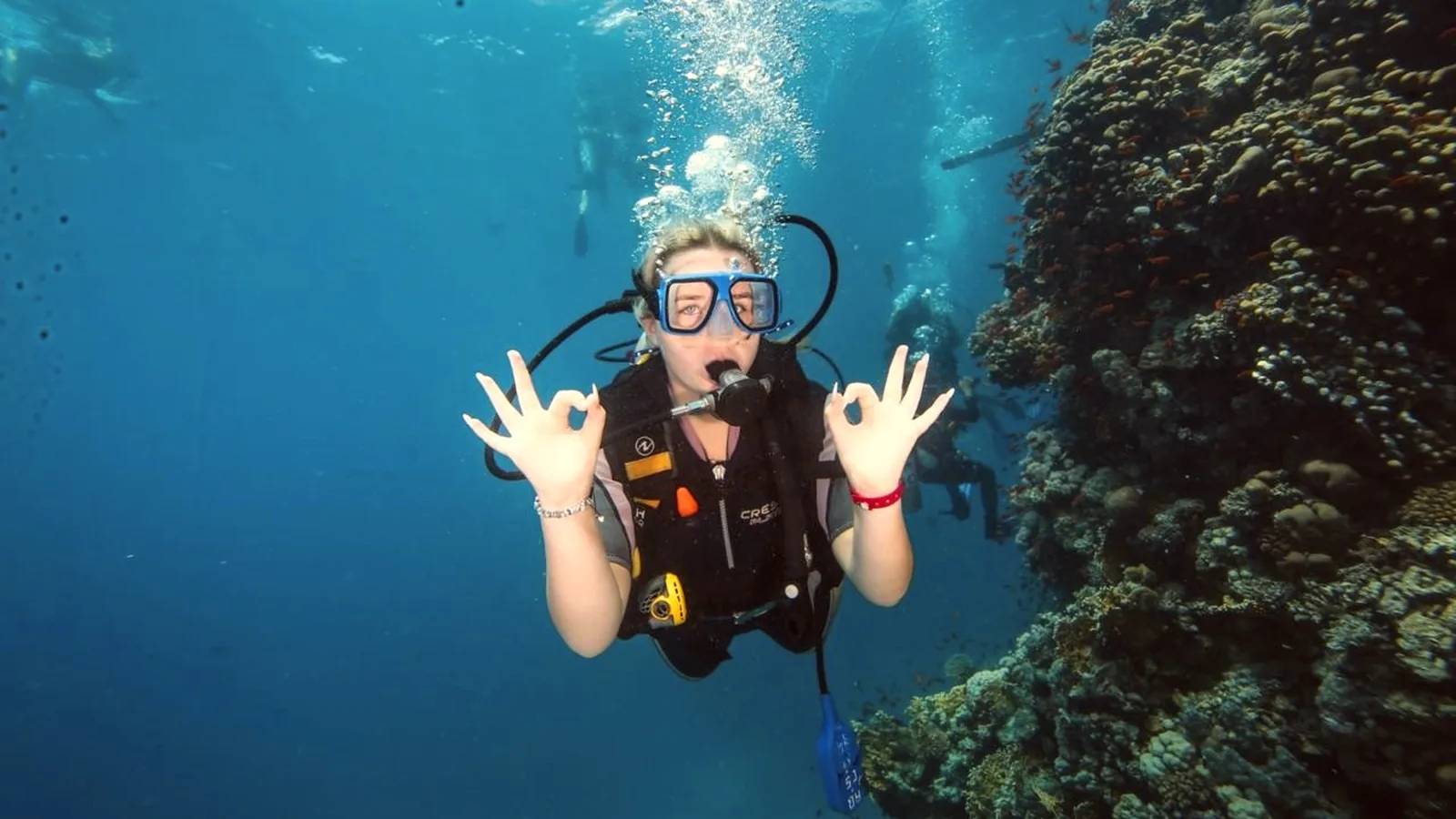
Of all the scuba kit a new diver rents or buys, the mask is the one that can quietly ruin a dive. A regulator that breathes a touch stiffly or fins half a size too long are minor annoyances you soon forget; a mask that seeps a cold trickle into your eyes every few minutes is a slow misery that turns a bucket-list reef into an anxious blur of stopping, tilting and clearing. Here is the reassuring part: a comfortable, leak-free mask has almost nothing to do with how much you spend. It comes down to fit — and fit is ruthlessly individual. Faces differ in width, nose height and cheekbone shape, so a mask that seals beautifully on a friend can flood on you, which is exactly why a good dive shop hangs dozens on the wall. This guide shows you how to test a mask on your own face in about thirty seconds, what the lenses, skirts and features actually do, how divers who wear glasses or contacts get a sharp view underwater, and how to stop the whole thing fogging on your very first breath.
Why the mask matters more than the price tag
The mask is the most personal piece of dive gear you will ever own. It sits pressed against your skin for the whole dive, and if it does not seal, nothing else about it counts — not the crystal glass, not the designer frame, not the brand on the strap. A leaking mask forces you to stop, clear it, refocus, and do it all again a minute later; it is the single biggest source of stress and cut-short dives for beginners. Worse, a marginal seal often passes in the calm of the shop and then betrays you underwater: the mask that felt perfect on dry land can flood the moment you grin at a passing turtle, because a broad smile bunches your cheeks and lifts the skirt just enough to break the seal. So the golden rule of mask buying is fit first, features second, brand and price last — and because fit is so individual, this is the one piece of kit most worth choosing in person rather than ordering blind (more on that below).
The fit test, step by step
Every reputable dive shop and training agency teaches the same thirty-second dry-land test, and it is the only verdict that counts — not the star ratings online, not what suited your buddy's face. It works because a well-shaped skirt holds itself to your face by gentle suction alone, no strap required. Run it on every mask on the rack; the one that passes is your mask.
- Sweep your hair off your forehead and take the strap out of the equation — loop it forward over the front of the lens so it plays no part in holding the mask on.
- Rest the mask on your face without the strap, positioned exactly as you would wear it diving.
- Inhale gently through your nose and let go with your hands. That soft breath creates a light vacuum inside the mask; if it seals and stays put on its own for a few seconds — hands-free, no air hissing in, no need to keep sucking — it fits the shape of your face. Bonus test: talk or smile while it is stuck there. A great fit shrugs it off; a marginal one lets go the instant your cheeks move.
- Hunt for gaps in the skirt. Feel and look right around the edge where the silicone meets skin. The three places a mask most often fails are the nose bridge (too narrow or too wide for you), the cheeks, and the upper lip just below the nose. If suction dies the moment you stop inhaling, or you can feel a draught, move on to the next mask — no strap and no tightening will ever fix a seal that isn't there.
- Check the nose pocket. Your nose should sit inside the soft pocket without being squashed or pressing on the underside of your septum. Crucially, you must be able to pinch the nose pocket shut to equalise your ears — the same "pinch and gently blow" you will do on every descent. Diving cold water in gloves? Try that pinch wearing them.
- Only now fit the strap. Sit it high on the crown of your head, just above your ears — not low across the widest part of your skull, which peels the bottom of the skirt away and invites leaks. Tighten it just enough to stop the mask sliding around. The strap's job is to hold the mask in place, not to force a seal: crank it down and you actually distort the skirt, make the leak worse, and earn a headache and a red groove across your face for the privilege.
A quick word on facial hair: a moustache is the classic seal-breaker, because coarse hair on the upper lip props the skirt off the skin and lets a slow trickle in. A beard below the mouth rarely matters — it is the strip directly under the nose that counts. Trimming it short, or smoothing a little silicone grease or defog gel along it, usually closes the gap.
Mask types and features, explained
Single lens vs twin (dual) lens
A single-lens mask is one continuous pane of glass with no bar across the middle, so the view opens up wide and uninterrupted — many divers find it the least boxed-in to look through. A twin- or dual-lens mask splits that into two panes with a slim frame bridge over the nose. That bridge earns its keep two ways: it lets the glass sit closer to your eyes (usually lower volume — see below), and it is what allows separate prescription lenses to be dropped in on each side, the single biggest reason spectacle-wearers pick twin-lens. The only gripe people report is being faintly aware of the central divider. Neither type is better in the abstract; it comes down to which one seals on your face and which view you prefer.
Low volume vs high volume
"Volume" is simply how much air space sits between your face and the glass, and it matters more than beginners expect. A low-volume mask keeps the lenses close to your eyes, which pays off three ways: less air to push out means it clears faster if water sneaks in, it equalises more easily, and it puts the reef right up against your eyes for a natural, wrap-around view. That is why low-volume is the default for most scuba divers and essential for freedivers. A high-volume mask sits further off the face with a bigger air pocket and a larger window — airy and open, and the extra depth can be genuinely useful for a strong prescription, keeping thick corrective lenses from brushing your face — but it takes a bigger breath to clear. For most new divers, a low- to medium-volume mask is the comfortable middle ground.
Framed vs frameless
A framed mask hangs its lens and skirt on a rigid plastic frame; it is easy to service and lenses can often be swapped. A frameless mask bonds the skirt straight to the glass, so it runs lower-volume, lighter, and folds almost flat — a favourite travel and backup mask. Both are perfectly good. Frameless is a design choice, not an upgrade, and tells you nothing about how well a given mask will fit your face.
Skirt material and skirt colour
The skirt is the soft flange that seals against your face, and its quality matters more than almost any other spec on the box. Look for a soft, medical- or food-grade silicone skirt; the cheapest masks still cut corners with a harsher PVC-type rubber that seals less kindly, stiffens in cold water and yellows with age. Skirt colour, meanwhile, is a real decision rather than a styling choice:
| Clear / translucent | Black / opaque | |
|---|---|---|
| How it feels | Bright and open; light floods in from the sides | Focused and cinematic; a contained "tunnel" view |
| Best for | Nervous first-timers and anyone prone to feeling closed-in | Underwater photographers and videographers |
| Why | Side light stops the mask feeling like a blindfold on those first descents | Blocks stray light and kills reflections on the inside of the glass that would ruin a shot |
| Trade-off | Can show a little internal glare in bright water | The same tunnel effect can feel confining to a beginner |
Neither colour changes the seal one bit — it is purely about the view you want. In short: clear for comfort and confidence, black for focus and photography.
Glass, field of view, side windows and purge valves
- Tempered glass is the standard for any proper dive mask — heat-treated to shrug off impacts and, if it ever does break, to crumble into blunt granules instead of shards. Steer clear of plain plastic lenses, which scratch and distort; almost every real dive mask is stamped "tempered." Premium models often add ultra-clear (low-iron) glass, which strips out the faint green tinge ordinary glass shows at its edges for a slightly brighter, truer-coloured view — a genuine but subtle upgrade, never a reason to overlook fit.
- Field of view owes more to how close the lens sits and to skirt colour than to sheer pane size. Some masks add angled side windows for extra peripheral vision; they let in more light and widen the view, at the cost of a little more volume and sometimes a touch of distortion right at the edges.
- Purge valves are one-way valves in the nose pocket that let you clear water by breathing out through your nose without tilting your head. Handy in theory — but clearing an ordinary mask is a basic skill you learn on day one and takes a couple of seconds, while a purge valve is one more moving part that can jam, snag or perish. Most experienced divers happily do without one on a recreational mask. File it under "nice to have," never a reason to accept a worse-fitting mask.
If you wear glasses or contacts
Poor eyesight is no barrier to diving — and nor are most common health conditions, which this health self-check for divers walks through. You simply cannot wear glasses under a mask, so there are two routes to a clear view.
Prescription (optical) lenses
- Drop-in / stock lenses: many twin-lens masks accept ready-made corrective lenses that clip straight in to replace the standard glass. This is the cheapest and quickest route, with lenses sold in fixed half-diopter steps of common short-sighted (and some long-sighted) powers. They handle a simple "everything's a bit blurry" prescription beautifully, but they generally can't correct astigmatism, and you have to start with a mask built to take them.
- Custom-bonded / laminated lenses: for the sharpest result — or for astigmatism, bifocals (a little reading segment for checking gauges and framing a camera), prisms or strong prescriptions — an optical lab grinds lenses to your exact script and bonds them to the inside of the mask's own glass. It is the priciest route, but done well it corrects almost any eyes and never works loose mid-dive.
As a rough guide to expectations, stock lenses typically span short-sighted powers to around −8.00 and long-sighted to around +4.00, in half-diopter steps; anything stronger or more complex points you toward custom lenses, and a very strong prescription sits happier in a slightly higher-volume mask so the thick glass never touches your lashes. Take your current prescription to a dive shop or specialist optician and let them confirm what your eyes actually need.
Diving in contact lenses
Plenty of divers just wear their usual contacts, and with a few sensible precautions it is generally considered safe. Soft lenses are strongly preferred over hard or rigid gas-permeable ones: under a rigid lens, tiny nitrogen bubbles can gather between lens and eye as you ascend, blurring your vision and sometimes stinging, and rigid lenses pop out far more easily. The everyday risk, though, is simply losing a lens the instant your mask floods — so keep your eyes shut whenever you flood or clear the mask, and carry spares. There is a hygiene angle too: eye specialists link wearing contacts in natural water to rare but sight-threatening infections, so daily disposables you bin after the dive are the safest bet. Never rinse or store a lens in seawater, pool or tap water, and it is worth a quick word with your optician before a dive trip.
Stopping the fog: prep and defog
A brand-new mask will fog on your first breath, over and over, and it is not a fault — it is the invisible factory film, a wafer-thin silicone residue left on the glass during manufacture. This one thing is why nine out of ten new masks "won't stop misting up," and clearing it is a one-time job. But before you reach for anything abrasive, check one thing.
First: does your mask have a factory anti-fog coating? A growing number of modern masks now ship with a permanent, plasma-bonded anti-fog layer baked onto the glass (and many plastic-lens snorkelling masks come pre-treated too). On those, the old film-removal tricks would strip off the very coating you paid for — so never scrub or burn an anti-fog-coated lens. Peel off any protective sticker, skip the prep entirely, and go straight to a gentle defog before each dive. If the box and lens say nothing about a coating, assume it has the ordinary factory film and prep it as below.
- Toothpaste method (the safe DIY default): squeeze a pea-sized blob of plain white, non-gel toothpaste onto the inside of each lens and rub it firmly with a fingertip for a few minutes, then rinse. Repeat a couple of times; some divers leave the paste on overnight for a stubborn film. Use ordinary paste only — whitening and "micro-bead" toothpastes hide fine grit that can scratch the glass. A dedicated mask-prep scrub or cleaner (the kind dive shops sell) does exactly the same job with less mess.
- Flame method (falling out of favour — best skipped): some old hands burn the film off by flicking a lighter flame across the inside of the glass only, keeping it moving so no spot overheats, then wiping away the soot. It works, but it is desperately easy to scorch or melt the silicone skirt, loosen the lens in its frame, or wreck an anti-fog coating — which is why training agencies say it should only be attempted by someone experienced in the technique, and most modern dive shops simply advise against it. For a first mask, the toothpaste scrub is safer and just as effective.
Prepped or coated, you still need to defog before every single dive: put a drop of commercial defog (or, at a pinch, well-diluted baby shampoo or even a smear of saliva) on the dry inside of each lens, spread it around, and give it the lightest rinse in seawater just before the mask goes on. Two small comforts round it off — a slip-on neoprene strap cover stops the silicone strap yanking your hair and spreads the pressure, and you should always sweep stray hairs out from under the top of the skirt, because even a few strands are enough to break the seal and start a leak.
Buying: try before you buy, and what to spend
Because a mask lives and dies by fit, the strongest advice is unglamorous: try masks on in person and run the suction test on each, rather than ordering online on looks or star ratings. A mask that suits a friend's face, or tops a "best of" round-up, may leak on yours — faces really are that individual. If you must buy online, choose a retailer with an easy returns policy and test the seal at home, indoors and dry, before you snip a tag or get it wet.
On price, you do not need to spend a fortune, and the gaps between tiers are smaller than the numbers suggest — a dearer mask buys slightly clearer glass, softer silicone and nicer buckles, not a better seal. As an approximate 2026 guide (prices swing with retailer, region and exchange rate, so check current listings):
- Entry-level: roughly €30–55 / £25–45. Perfectly good diving if it fits your face.
- Mid-range (where most recreational divers land): roughly €60–110 / £50–95. Softer silicone, tempered glass, genuinely good clarity.
- Premium: roughly €130–300+ / £110–260+. Ultra-clear low-iron glass, very soft "liquid" silicone skirts, refined frames.
- Prescription adds to the bill: stock drop-in lenses are a modest extra (often around €30–65 / £25–55 each, or a ready-made prescription mask in the region of €70–140 / £60–120 all in), while fully custom bonded or bifocal lenses commonly run €150–450+ / £130–380+ depending on complexity.
Spend the bulk of your attention, not your budget, on the fit test — a €50 mask that seals will out-dive a €250 one that doesn't, every time. The same fit-first logic runs through the rest of your kit: the guide to choosing a wetsuit for the Red Sea works through thickness, comfort and fit in exactly the same way.
Dive the Red Sea with a mask that fits
Aquarius provides well-maintained rental masks and full equipment on every trip, and helps every diver get a comfortable, leak-free seal before the dive begins. New to diving? Try a dive or take a PADI course — send your dates and certification level to start planning.
Start diving →A note for the Red Sea
The Red Sea is prized for exceptionally clear, bright water — visibility on offshore reefs and walls often runs 20–30 metres, and can top 40 on the clearest sites — over vivid coral gardens and famous wrecks. That clarity rewards a good mask: quality tempered glass and a seal you can forget about let the reef and the big blue scenery do the talking, with nothing trickling in to break the spell. Skirt colour splits along the lines above. Anyone hoping to photograph the corals, turtles and wrecks will lean toward a black skirt, which tames the internal reflections that fierce tropical light throws onto the glass. A nervous first-timer is usually happier behind a clear skirt, whose open, airy feel takes the edge off those first descents into deep blue water. Either way the priority never changes, in the Red Sea or anywhere else: a mask that fits your face and keeps the water out.
Frequently asked questions
How should a dive mask fit?
A well-fitting mask seals to your face by gentle suction alone. Hold it against your face without using the strap, look forward and inhale softly through your nose: it should stay put hands-free for a few seconds with no air leaking in. Check the soft skirt touches your skin all the way round — especially at the nose bridge, cheeks and just under the nose — and make sure you can pinch the nose pocket to equalise. If it holds by suction and feels comfortable, it fits.
How do I stop my dive mask fogging?
A new mask fogs because of an invisible factory film on the glass, which you scrub off once with plain (non-whitening) toothpaste, rubbing the inside of each lens for a few minutes and rinsing. The exception is a mask sold with a factory anti-fog coating — never scrub or burn that, just defog it. After prepping, apply a defog product (or diluted baby shampoo, or saliva) to the dry lens before every dive and give it a light rinse just before you put the mask on. Keeping stray hair out of the seal helps too.
Single vs twin lens dive mask — which is better?
Neither is universally better. A single-lens mask gives one open pane with no central bar, which many find less enclosing. A twin-lens mask has a bridge over the nose, usually sits lower-volume (closer to your eyes and easier to clear), and — the key practical advantage — can take separate prescription lenses. Choose whichever seals best on your face and gives you the view you prefer.
Can I wear glasses or contacts when diving?
You can't wear glasses under a mask, but you have two good options. You can fit corrective lenses to the mask itself — ready-made “drop-in” lenses for simple prescriptions, or custom-ground lenses bonded in for astigmatism, bifocals or strong prescriptions. Or you can dive in contact lenses: soft lenses are recommended over hard/rigid ones, keep your eyes shut whenever you clear the mask so you don't lose one, use daily disposables where possible, and check with your optician first.
Black vs clear mask skirt — what's the difference?
It's about light. A clear skirt lets side light in, so the mask feels brighter and more open — reassuring for beginners or anyone who feels closed-in. A black skirt blocks stray light for a more focused view and, by killing reflections on the inside of the glass, is the choice of underwater photographers. Neither affects the seal; it's purely about the view and comfort you want.
How much does a dive mask cost?
Expect roughly €30–55 / £25–45 for a decent entry-level mask, €60–110 / £50–95 for the mid-range where most divers buy, and €130–300+ / £110–260+ for premium models with ultra-clear glass and very soft silicone. Prescription lenses cost extra — a small amount for stock drop-ins, considerably more for fully custom or bifocal lenses. Fit matters far more than price, so a cheaper mask that seals well is the better buy.
Why does my dive mask leak?
Usually one of four things: the mask doesn't match your face shape (the most common cause — no strap can fix a gap in the seal); the strap is over-tightened, which distorts the skirt; the strap is sitting too low on the back of the head instead of high on the crown; or hair or a moustache is trapped under the skirt breaking the seal. Re-check the fit with the suction test, ease off the strap, reposition it higher, and clear any hair from under the silicone.
Sources & references
- PADI — How to Prepare a New Mask for Scuba Diving (removing the factory film with non-whitening toothpaste or a commercial cleaner; the burning method as an expert-only technique; pre-dive defogging).
- PADI — Scuba Diving if You Wear Contacts or Glasses (prescription mask options; soft lenses preferred over rigid; keeping eyes closed when flooding or clearing the mask).
- Divers Alert Network (DAN) — Divers Alert Network (diving with contact lenses — soft preferred; rigid/gas-permeable lenses associated with eye pain and blurred vision from bubble formation on ascent).
- General optometry and eye-care guidance on wearing contact lenses in water — soft, daily-disposable lenses preferred, eyes closed during mask clearing, never rinsing lenses in natural water, and consulting an optician before a dive trip.
- Manufacturer and dive-media guidance on tempered-glass and ultra-clear (low-iron) dive lenses, factory anti-fog coatings (which must not be scrubbed or burned), and 2026 retail price ranges from specialist dive retailers.
This is an educational guide to help you choose and fit a dive mask; it does not recommend or endorse specific brands or models. Prices are 2026 market ranges that vary by retailer, region and exchange rate, so check current listings. Eyesight and contact-lens advice is general — consult your optician. Verified August 2026.