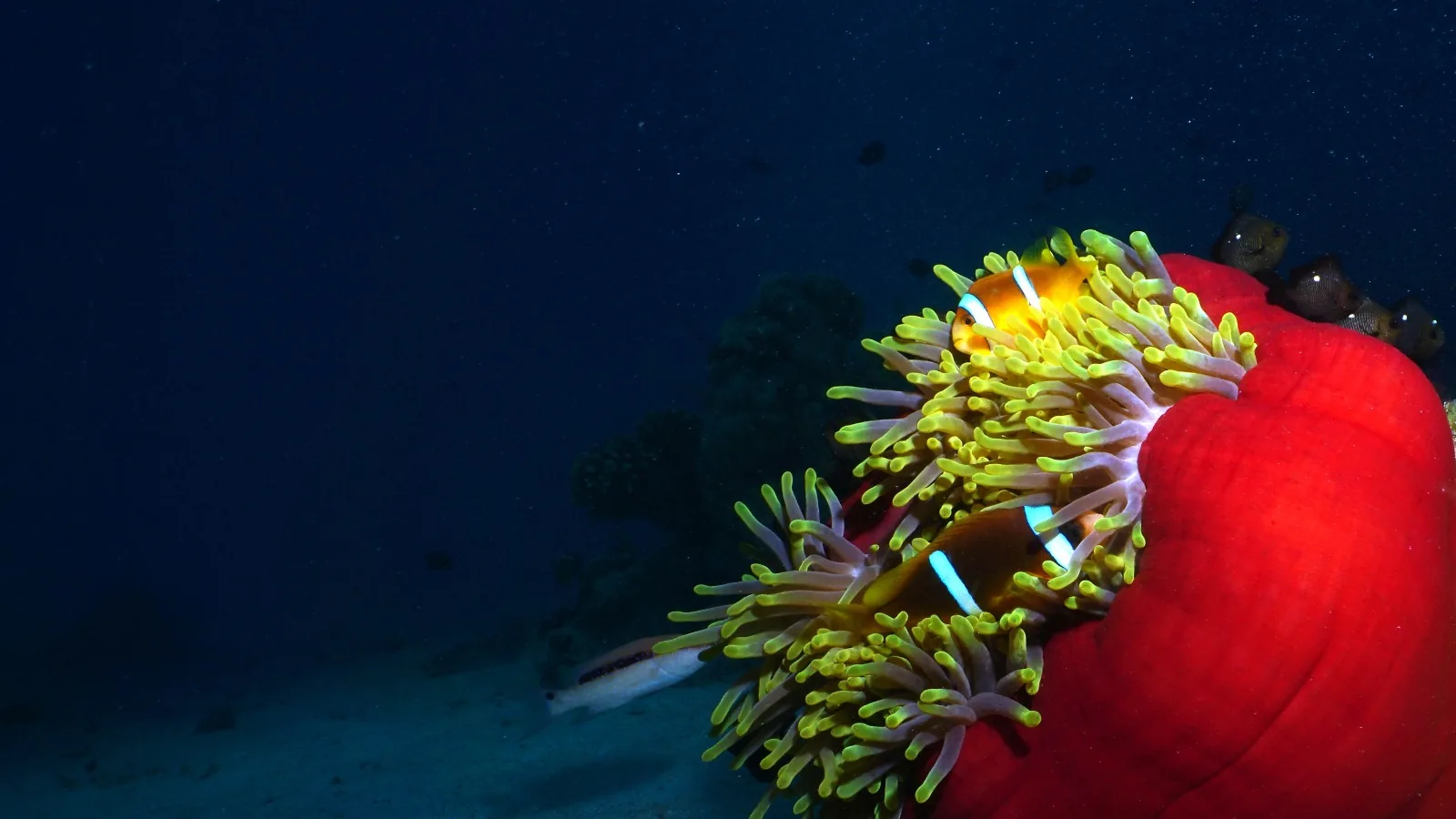
Makadi Bay is the Red Sea at its most approachable: a wide, sheltered curve of coast where the reef starts a few fin-kicks from the sand and the water stays calm when the open coast is choppy. Tucked on the mainland shore roughly half an hour south of Hurghada, it has grown from empty desert bay into a string of resorts — and, quietly, into one of the friendliest places on the Egyptian coast to learn to dive, bring a mixed-ability family, or simply dive an easy house reef in the morning and a boat site in the afternoon. This guide covers where Makadi Bay is, what the diving is really like, the dive sites within reach, the marine life, snorkelling, who it suits and when to go.
Where Makadi Bay is
Makadi Bay is a natural bay on Egypt's Red Sea coast, on the mainland shore roughly 30 to 35 kilometres south of Hurghada and about the same distance — a 30 to 45 minute drive — from Hurghada International Airport (HRG). It sits between the busy dive hub of Hurghada to the north and the quieter town of Safaga to the south, which is the key to its diving: from one calm base you can reach reefs that belong to both areas.
Unlike a town, Makadi Bay is essentially a run of beach resorts strung along a single sweeping bay. There is no old harbour and no bustling promenade — the appeal is the opposite of Hurghada's energy. The curve of the coast blocks much of the prevailing north wind, so the water inside the bay is often flat and clear when the open sea is white-capped, and the shoreline shelves gently over sand into shallow coral. It is that shelter, more than any single famous reef, that defines diving here.
Makadi Bay sits on the same stretch of Red Sea coast as its better-known neighbours, and shares their reefs and marine life — the Hurghada sites to the north and the Safaga sites to the south. For the bigger picture of the region and its conditions, see the complete guide to scuba diving the Red Sea.
Why divers choose Makadi Bay
Makadi Bay tends to win people over for practical reasons rather than one headline dive. The strongest of them:
- It is calm and sheltered. The bay's curve tames the wind and chop, so shore entries are easy and boats can usually run when rougher coasts are marginal — a real advantage for nervous or newly certified divers.
- The reef is right there. House-reef diving straight off the jetty or beach means no long boat ride to a first or last dive of the day, and unlimited shore dives are a common part of a package.
- It suits every level in one group. A family or mixed-ability group can dive the same day — a shallow shore reef for one diver, a boat wall for another — without splitting up or travelling far.
- It reaches two areas' reefs. From Makadi, boats run north towards the classic Hurghada reefs and south towards the Safaga sites, so the site list is longer than the bay's size suggests.
- It is quiet. Fewer boats than Hurghada Marina means less crowded reefs and a more relaxed pace, on the surface and below it.
Getting there from the airport
Getting to Makadi Bay is refreshingly simple. It sits about 30 to 35 kilometres south of Hurghada International Airport, a road transfer of roughly 30 to 45 minutes depending on traffic — one of the quickest Red Sea diving bases to reach after landing. Most divers arrive as part of a resort stay, and diving is arranged with a centre on the bay.
Once you are there, the diving comes to you. The house reef is a shore dive reached on foot from the dive centre, while the boat sites are short hops from the bay — the nearer reefs are 20 to 40 minutes away, and the further Safaga sites and wrecks are a longer day trip. Because most sites are close, a typical day runs two boat dives with a leisurely surface interval, or a boat dive paired with an unhurried shore dive on the house reef.
The Makadi Bay house reef
The heart of diving here is the house reef — the fringing reef that runs along the front of the bay, reached by walking in from the beach or stepping off a jetty. Entry is typically over sand in just a few metres of water, which makes it forgiving: an easy place to run through skills, settle nerves, check gear, or simply potter about with no pressure and no boat schedule.
From the shallow entry the reef slopes down, with the main coral wall and its life sitting at a comfortable 15 to 18 metres or so and deeper sand and coral gardens beyond. It is genuinely rich for a shore dive: hard and soft corals, clouds of anthias and reef fish, lionfish tucked under ledges, moray eels, octopus, blue-spotted stingrays over the sand, and — a Makadi speciality — turtles, which are seen regularly and sometimes daily. Divers with a sharp eye and a slow pace also turn up camouflaged sand-dwellers here: crocodilefish, stonefish and, now and then, seahorses and ghost pipefish.
Because the house reef is shallow, sheltered and endlessly re-diveable, it doubles as a training ground and a check-dive site — the perfect place to build the buoyancy and comfort that make every other dive better. Those are exactly the skills the first dives of an Open Water course build, and Makadi Bay's calm water is an ideal classroom.
The dive sites around Makadi Bay
The house reef is the easy everyday dive, but the reason Makadi punches above its weight is the boat diving within reach. Sites run in two directions — north towards Abu Ramada and the Hurghada reefs, and south towards the Safaga sites — so a few days here can string together shallow gardens, dramatic walls, drifts and even wrecks.
Gota Abu Ramada — "The Aquarium"
The most-loved site in reach of Makadi is Gota Abu Ramada, an oval coral block rising from a bright sandy seabed offshore to the north. It is widely nicknamed "The Aquarium" — for the sheer density and variety of fish, and for the excellent visibility the pale sand throws back. The main reef sits at a comfortable 12 to 16 metres, ringed by coral pinnacles, gorgonians, anemones and brain corals, and swarming with butterflyfish, parrotfish, groupers, sweetlips, goatfish and glassfish, with moray eels in the cracks and barracuda and jacks cruising the edges. Turtles and blue-spotted stingrays are regular, eagle rays a happy surprise. Because it is shallow, sheltered and easy, it suits all levels — a firm favourite for a relaxed, colourful, camera-friendly dive.
Abu Ramada North and South
The same reef system offers more demanding diving on its flanks. Abu Ramada North is a dramatic near-vertical wall dropping well past recreational depth, hung with soft coral and fanned by current — a dive for confident, Advanced-level divers who enjoy hanging over the blue. Abu Ramada South is the gentler counterpart: a relaxed drift over a coral slope in the 10 to 25 metre range, suitable for most certified divers and a good pairing with "The Aquarium" on a two-dive day.
Abu Hashish
To the north-east of the bay, Abu Hashish is a broad reef with several ways to dive it. The sheltered lagoon is shallow and calm — 3 to 12 metres over sand and coral, ideal for beginners and skill practice — while the outer reef offers a classic Red Sea drift along a wall and sandy plateau in clear water, with reef fish, morays and rays. It is a versatile site that a dive centre can pitch easy or lively depending on the group and the current.
Panorama Reef and Tobia Arba — the Safaga sites
A little further south, towards Safaga, sit two of the coast's best-known reefs. Panorama Reef (at Ras Abu Soma) is a big, sweeping wall and plateau that drops steeply into deep water — superb, current-swept wall diving with a real chance of reef sharks in the blue, best for Advanced divers. Nearby, in the shelter of the Ras Abu Soma headland, Tobia Arba — often called the "Seven Pinnacles" — is its complete opposite: a cluster of tall, narrow coral towers standing on a sandy seabed at around 12 metres, wave- and current-free, and made for weaving between the pinnacles. Draped in soft coral and swirling with anthias, lionfish, pufferfish, Napoleon wrasse and barracuda, it is a photographer's site that still suits most levels.
The wrecks
For divers who want steel as well as coral, Makadi is within reach of two Red Sea wrecks on special trips. The El Mina, a former Egyptian navy minesweeper lying at around 18 to 32 metres off Hurghada, is an atmospheric Advanced-level dive. Further south off Safaga, the Salem Express — a passenger ferry lost with heavy loss of life in 1991 — is a serious, deeper wreck treated by divers and guides as a solemn memorial as much as a dive site; it is an Advanced trip approached with respect. Both are occasional special trips rather than everyday dives.
A typical Makadi day pairs an easy site with a livelier one — "The Aquarium" and a wall, or a lagoon and a drift — so mixed-ability groups dive together comfortably. Divers based nearer Hurghada can compare the northern line-up in the best dive sites in Hurghada guide.
Marine life
Makadi Bay's reefs hold the full cast of northern Red Sea life, from the house-reef shallows to the offshore walls. What you might meet, depending on site and season:
- Turtles: green and hawksbill turtles are among the bay's signatures, seen regularly on the house reef and at Gota Abu Ramada, often grazing calmly and unbothered by divers.
- Reef residents: Napoleon wrasse, giant moray eels, groupers, sweetlips, lionfish, pufferfish, and clouds of anthias and butterflyfish over the coral.
- Over the sand: blue-spotted stingrays, eagle rays, and camouflaged ambush hunters — crocodilefish and stonefish — plus octopus, goatfish and the occasional guitarfish for the sharp-eyed.
- Out in the blue: barracuda and jacks patrol the reef edges, and on the deeper Safaga walls such as Panorama there is a genuine chance of reef sharks; dolphins sometimes pass the offshore reefs.
- The coral itself: hard-coral gardens on the plateaus and dense soft corals and gorgonians on the walls, in good condition thanks to the sandy, sheltered setting.
For the wider seasonal picture of what appears when, see the marine life encyclopedia.
Conditions and who it suits
Makadi Bay's real strength is range: it has a site for almost everyone, which is why it works so well for mixed groups.
Beginners and families are the sweet spot. The house reef and the Abu Hashish lagoon are shallow, calm and sandy-bottomed, with easy shore or shallow-boat entries — the kind of forgiving water that lets a nervous first-timer relax and a family dive together. Visibility across the area typically runs 20 to 30 metres, so there is plenty to see with little effort.
Certified and Advanced divers are far from bored, though. The walls at Abu Ramada North and Panorama, the drifts at Abu Hashish and Abu Ramada South, and the El Mina and Salem Express wrecks give genuine depth, current and structure. Some of these carry moderate current and sit over deep water, so good buoyancy and, for the walls and wrecks, Advanced Open Water certification are recommended — and a guide who reads the site matches the day to your level.
Water temperature runs from the low 20s °C in winter to around 28–29 °C at the height of summer; the best time to dive the Red Sea guide has the month-by-month detail and wetsuit advice.
Snorkelling in Makadi Bay
Makadi Bay is as good for snorkellers as it is for divers, and for the same reason: the reef starts in the shallows and the water is calm. The house reef is snorkel-friendly, with a gentle sandy entry and coral within easy reach of the surface, so families and first-time snorkellers can float over the reef without a boat. The shallow coral and seagrass hold plenty of reef fish, and turtles are seen from the surface as often as from below.
For those who want more, snorkelling boat trips run to nearby reefs and to the islands and lagoons off the coast, where clear, shallow water sits over bright sand. It makes Makadi a natural choice for groups where some want to dive and others want to snorkel — everyone can be on the same reef, on the same day.
When to go
Makadi Bay dives all year, and the sheltered bay means conditions are workable in almost any season. The character changes month to month:
- June to September (summer): the warmest water (around 28–29 °C), a thin wetsuit or even a shorty, and the most marine life. Long, hot, sunny days — the surface can be very warm, but the diving is easy and colourful.
- December to February (winter): cooler water (around 21–22 °C) and air, often the calmest and clearest conditions, and a noticeably quieter coast. A thicker wetsuit is worth packing, but the diving is excellent and uncrowded.
- Spring and autumn: the comfortable middle ground — warm-enough water, settled weather and fewer crowds than peak summer. Many regulars consider these the best all-round months.
How to plan and book
Makadi Bay works best as a relaxed, few-days base: easy house-reef dives to warm up or wind down, and boat trips to Gota Abu Ramada, Abu Hashish and the Safaga reefs when you want more. Because the sites span every level, it is an ideal place to learn, to bring a mixed group, or simply to dive good reefs without long travel or crowds. Newer divers can build confidence on the house reef before stepping up to the walls and drifts.
Aquarius runs guided diving from its Makadi Bay base — shore dives on the house reef and boat trips to the region's best sites, with guides who match each dive to your level, quality equipment and small groups. Whether you are here for your very first breaths underwater or an experienced diver after the walls and wrecks, plan and book your Makadi Bay diving and the day is built around you.
Frequently asked questions
Is Makadi Bay good for diving?
Yes. Makadi Bay is a calm, sheltered bay on the Red Sea coast about 30 to 35 kilometres south of Hurghada, with easy shore-accessible house reefs and a wide choice of boat dives within a short ride. The curve of the bay shelters it from the prevailing wind and chop, so conditions are often calmer than the open coast at Hurghada, and visibility commonly runs 20 to 30 metres. It suits beginners, families and certified divers alike, and gives access to some of the best reefs of the Hurghada and Safaga areas.
Is Makadi Bay good for beginners?
Very much so. The house reefs have gentle, sandy shore entries and shallow, protected water, which makes Makadi Bay one of the easier places on the Red Sea to learn to dive or ease back in after a break. The gently shelving beach in front of the dive centres is ideal for first skills, and the shallow reef sits at a comfortable depth. Calm conditions and 20 to 30 metre visibility mean beginners see more with less effort.
What dive sites are near Makadi Bay?
Makadi Bay has its own shore-accessible house reef, and boats reach a string of reefs to the south and north. Popular sites include Gota Abu Ramada, widely nicknamed 'The Aquarium', Abu Ramada North and South, and Abu Hashish. A little further south towards Safaga are Panorama Reef at Ras Abu Soma and Tobia Arba, the 'Seven Pinnacles'. Wreck trips run to the El Mina and, further south, the Salem Express.
How far is Makadi Bay from Hurghada airport?
Makadi Bay is roughly 30 to 35 kilometres south of Hurghada International Airport (HRG), a transfer of about 30 to 45 minutes by road depending on traffic. That makes it one of the quickest Red Sea diving bases to reach after you land.
Can you snorkel in Makadi Bay?
Yes. The house reef is snorkel-friendly, with a calm, sandy entry and shallow coral close to shore, which makes Makadi Bay a good choice for families and first-time snorkellers. The sheltered bay keeps the water calm, and the shallow reef and seagrass hold plenty of fish and, often, turtles. Boat snorkelling trips to nearby reefs and islands are also available.
What will I see diving in Makadi Bay?
Makadi Bay's reefs hold classic Red Sea life: hard and soft corals, clouds of anthias and reef fish, lionfish, groupers, moray eels, blue-spotted stingrays, octopus and Napoleon wrasse. Green and hawksbill turtles are seen regularly on the house reef, along with eagle rays, and with luck dolphins pass the offshore reefs. The sandy shallows around Makadi are also a good place to spot camouflaged life such as crocodilefish, stonefish and, occasionally, seahorses and ghost pipefish.
When is the best time to dive Makadi Bay?
Makadi Bay dives all year. Summer, June to September, brings the warmest water, around 28 to 29 degrees Celsius, and the most marine life. Winter, December to February, is cooler, around 21 to 22 degrees Celsius, calmer and often the clearest, and a thicker wetsuit is worth packing. Spring and autumn are a comfortable middle ground. Because the bay is sheltered, diving is possible in almost any conditions.