Where to see them
When to see them
The blackspotted sweetlips is a year-round Red Sea resident rather than a seasonal visitor, and there is no month that reliably improves the odds of finding one — a resting group under a favourite ledge tends to be there in every season. What changes through the year is less the fish's presence than the ease of watching it: calm, clear water makes it easier for a diver to approach a shaded group without disturbing it. Juveniles, which keep to sheltered spots near coral heads and seagrass, show no known seasonal pattern either.
Year-round resident Daytime rest under ledges, night-time foraging over sand
How to recognise a blackspotted sweetlips
The blackspotted sweetlips is a fairly easy fish to name once its family of Red Sea look-alikes is known. The features worth checking:
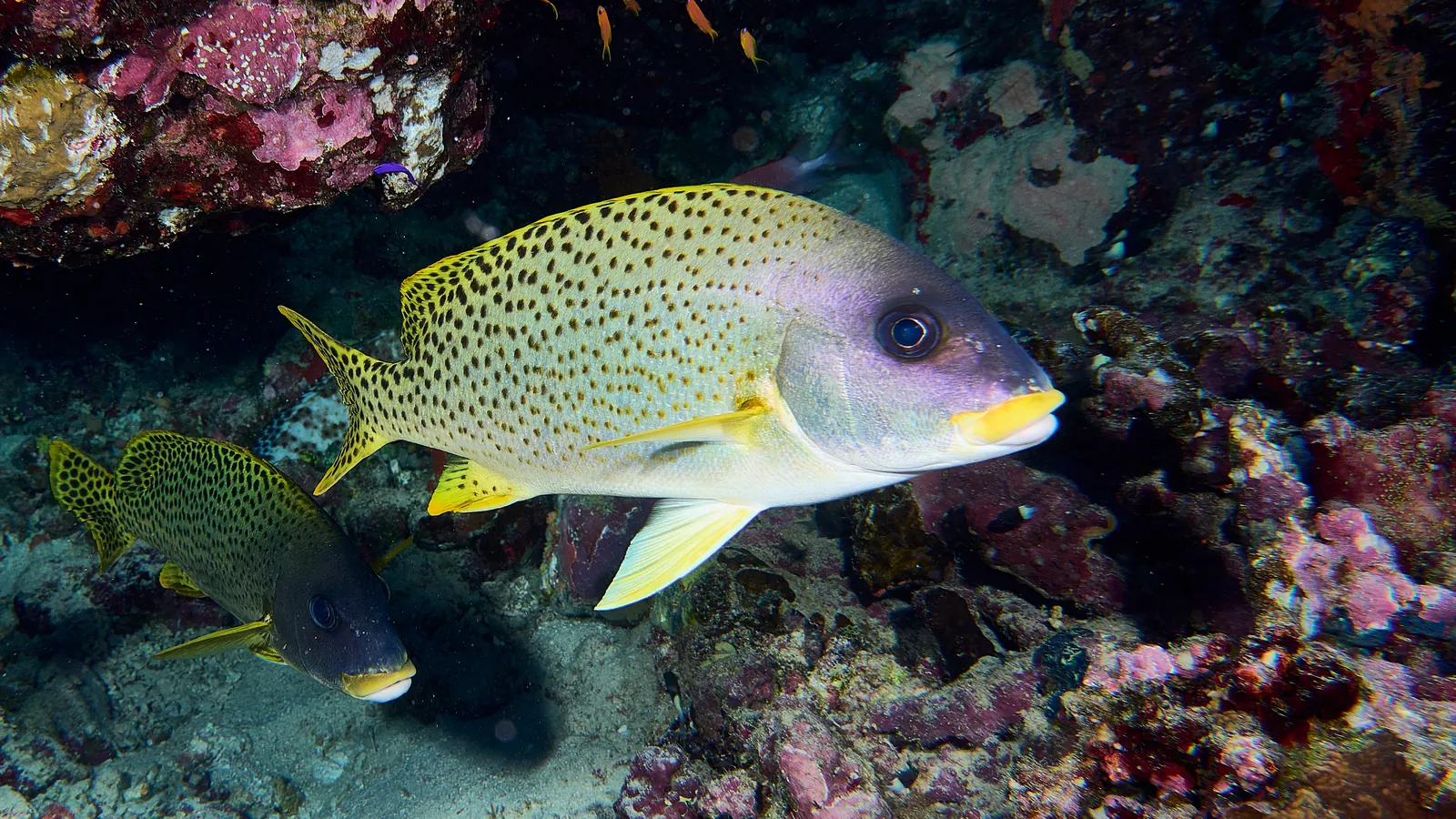
- Body shape: A deep, oval, laterally compressed body typical of the grunt family, with a long-based dorsal fin — around 13 spines and 19 to 20 soft rays — running most of its length, reaching a maximum of roughly 50 cm, with a common adult length of around 35 cm.
- Colour: Yellowish-grey overall, shading to a greenish back and a paler yellowish belly.
- Spots: Rows of dark grey to black-brown spots cover the body and continue out onto the fins, giving the fish a densely freckled look at any size once it has passed the juvenile stage.
- Head & lips: The face darkens with age and often carries a grey to lilac cast, and the lips — thick, fleshy and bright yellow, the feature behind the common name "sweetlips" — are proportionally thick and yellow in the adult.
- Fins: The pectoral and pelvic fins are plain yellow, picking up the colour of the lips and belly, while the dorsal and tail fins carry the same dark spots as the body.
Look-alikes worth knowing. The Red Sea holds several other Plectorhinchus species and one close relative in the genus Diagramma, and a few of them are genuinely easy to confuse with the blackspotted sweetlips at a glance. The lemonfish, or goldspotted sweetlips (Plectorhinchus flavomaculatus), is the closest match in pattern but with the colours reversed: an adult is bluish-grey with orange and blue lines on the head and often small orange to gold spots on the upper body and fins, rather than dark spots on a pale yellowish-grey body, and it grows larger, to around 60 cm. As a juvenile it is striped like a young blackspotted sweetlips, but its stripes are golden or rusty orange rather than brown, and they break up into a net-like pattern and then small spots as the fish grows. The sombre or minstrel sweetlips (Plectorhinchus schotaf), also recorded in the Red Sea, sits at the other extreme: a plain grey, silvery or brownish fish with no spots at all as an adult, identified instead by a reddish-orange gill-cover margin and red colouring inside the mouth and at the base of the pectoral fins. The Red Sea's one Diagramma is Diagramma punctatum, a species found only in the Red Sea and at Socotra, which reaches about 35 cm and takes its name, meaning spotted, from the spots on the head of adults and subadults. It is now treated as a species in its own right, having long been lumped with the painted sweetlips (Diagramma pictum), a much larger fish of the Persian Gulf and the wider Indo-Pacific that current taxonomy does not place in the Red Sea, so a Red Sea sighting listed as a painted sweetlips most likely refers to this species. With several of these species overlapping closely in colour and pattern — and sweetlips as a group having a long history of taxonomic confusion — the safest approach is to check the spot colour against the body colour first, then the head markings and any red markings around the mouth and gill cover, before relying on size alone.
Ledges by day, open sand by night
Daylight hours are, for a blackspotted sweetlips, almost entirely given over to resting. Adults gather in loose, unhurried groups — sometimes just two or three fish, sometimes considerably more — pressed into the shade of a ledge, overhang or small cave, hanging almost motionless with only the slowest movement of the pectoral fins to hold position. They can be curious; a diver who settles nearby is sometimes studied for a while, and a sweetlips will occasionally drift a little closer for a better look. Approach too quickly, though, and the same fish will dart back under cover in an instant.
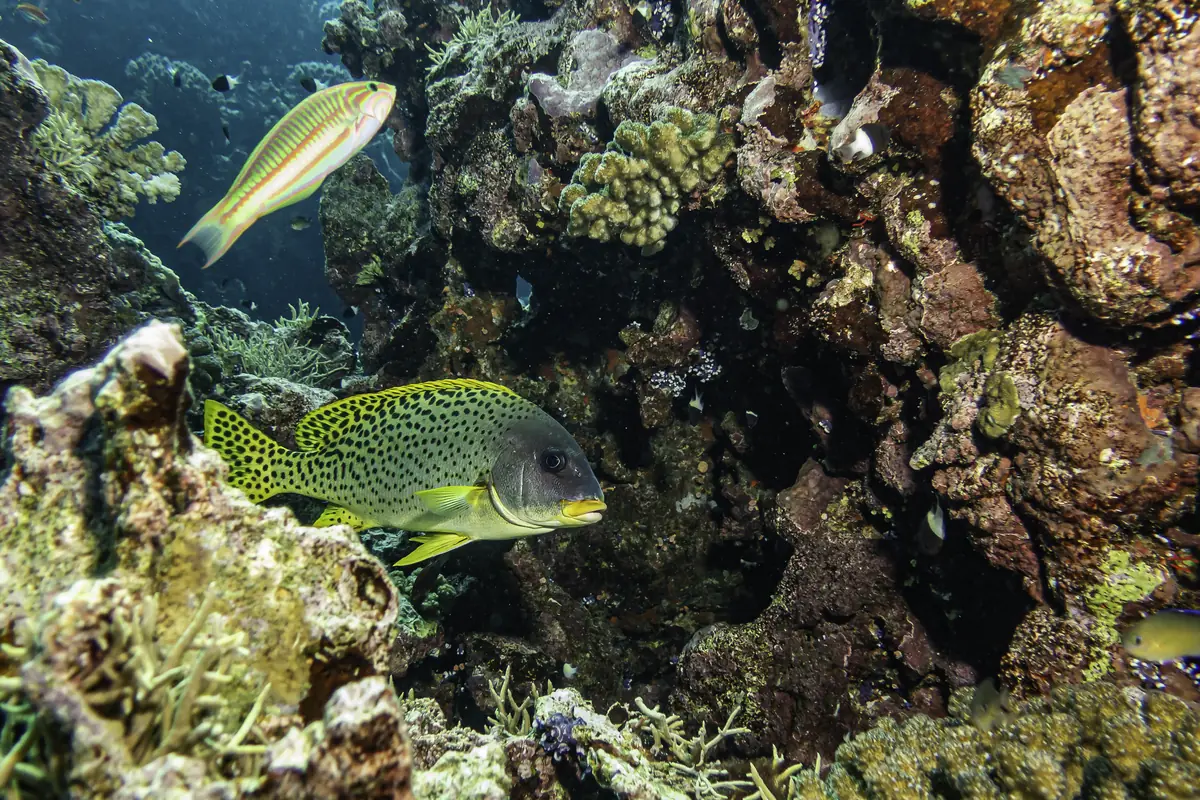
That daytime stillness gives way after dark to something much more active. Once the light fades, blackspotted sweetlips leave the shelter of their ledge and spread out over open sand and rubble to forage — the classic pattern for the whole sweetlips group, and the reason a fish that is easy to overlook by day may be seen out in the open on a night dive.
Sweetlips in general are regular clients at cleaning stations across the Indo-Pacific and the Red Sea, where small cleaner wrasse pick parasites and dead skin from their bodies and gill covers; a fish being serviced typically hovers with its fins spread and gill covers flared open. Published observations of the blackspotted sweetlips itself at cleaning stations are scarce, but it shares its reefs and its cleaner wrasse with relatives that are well-known clients.
Breeding is documented only in part: the species is oviparous (egg-laying) and shows distinct pairing during breeding. A spawning aggregation has been observed at an inshore reef off Kuwait in the Persian Gulf, but the timing and location of spawning within the Red Sea itself are not well documented.
The grunt family, Haemulidae, takes its common name from the sounds its members make by grinding their pharyngeal tooth plates together, with the swim bladder amplifying the noise. The blackspotted sweetlips is likely to be able to do the same, although sound production has not been confirmed for this species.
Diet
The blackspotted sweetlips is a nocturnal, bottom-feeding carnivore. Once it leaves its daytime shelter, it works over open sand, rubble and the sediment at the base of the reef, taking mainly small fish and crustaceans such as shrimps and crabs, along with worms and other bottom-living invertebrates. FishBase estimates its trophic level at about 3.8, based on its food items, consistent with a diet built almost entirely around animal prey rather than algae or coral.
Juveniles, which stay near coral heads and in seagrass beds rather than joining the adult groups under a ledge, are assumed to take similarly small prey close to their hiding place, though far less has been documented about their feeding habits specifically than about the adults'.
Watching and photographing blackspotted sweetlips
Blackspotted sweetlips are a rewarding subject once a diver understands their daily rhythm:
- Let a resting group come to you. A slow, unhurried approach along the reef, rather than a straight swim towards the ledge, is far more likely to allow a close look at a group of blackspotted sweetlips than a direct approach.
- Keep bright lights and strobes brief. A blackspotted sweetlips resting in deep shade, or actively foraging on a night dive, is more likely to hold still for a quick, well-aimed shot than for a barrage of test flashes.
- Mind the ledge as much as the fish. The overhangs, small caves and coral slopes that sweetlips depend on for daytime shelter are also fragile reef structure — a careless fin kick or a hand placed on the coral to steady a shot damages exactly the habitat this species relies on.
- Give a cleaning station space. If a blackspotted sweetlips is waiting to be serviced by cleaner wrasse, hanging back rather than crowding the station lets the interaction continue undisturbed and usually produces a better view in the end.
- No particular hazard to divers. Blackspotted sweetlips are not venomous, and as with any reef fish they should not be touched or handled; the worst a diver risks from getting too close is scaring the fish back under its ledge before a decent look, or photograph, is possible.
Conservation status
The blackspotted sweetlips is listed as Least Concern on the IUCN Red List (assessed in 2018, published in 2019), which describes it as common and locally abundant through most of its range. It is fished across much of that range with traps, handlines and gillnets and sold fresh, though its flesh is not especially prized — an iodoform-like off-taste has been reported. The IUCN calls it a minor component of commercial fisheries in the Persian Gulf and elsewhere, but notes that it is heavily exploited in some areas, Kenya being the example given. Juveniles are also fished for the marine aquarium trade. FishBase rates the species' vulnerability to fishing as moderate (42 out of 100).
As with most reef fish assessed as Least Concern, that status reflects a wide range and a lack of any documented steep decline rather than an absence of pressure altogether: the IUCN notes that heavy fishing in some regions is not known to be causing global-level declines, and that no species-specific conservation measures are in place. Healthy coral reef habitat, particularly the ledges and overhangs the species uses for daytime shelter, is the setting for its whole daily routine across the Red Sea and the wider western Indian Ocean.
Related Red Sea reef fish
The blackspotted sweetlips shares its reef ledges and cleaning stations with several other characterful Red Sea residents:
- Coral grouper — another reef predator often found resting near the same ledges and overhangs by day.
- Moray eel — a fellow master of the reef's crevices and caves, though a far more permanent resident of any one hole.
- Emperor angelfish — a boldly patterned reef regular that patrols the same walls and coral slopes.
- Masked butterflyfish — a Red Sea near-endemic seen on many of the same coral slopes.
- Anthias — the small, colourful reef fish often clouding the water in front of the very ledges a sweetlips shelters beneath.
For the bigger picture of what lives on an Egyptian reef and how the seasons shape a dive, see the complete guide to scuba diving in the Red Sea. To browse the full encyclopedia species by species, visit the Red Sea marine life guides.
Frequently asked questions
The two are easy to confuse at a glance because both are handsome, spotted reef fish, but the spot colours run in opposite directions. The blackspotted sweetlips (Plectorhinchus gaterinus) has dark grey to black-brown spots scattered over a pale, yellowish-grey to greenish body, with thick yellow lips. The goldspotted sweetlips or lemonfish (Plectorhinchus flavomaculatus) is the reverse: a bluish-grey fish with orange and blue lines on the head and often small orange to gold spots on the upper body and fins. The lemonfish also grows larger, to about 60 cm against a maximum of roughly 50 cm for the blackspotted sweetlips, and a juvenile lemonfish is striped in golden or rusty orange rather than the brown bands of a young blackspotted sweetlips, so the colour of the spots and stripes is the quickest clue.
Yes. The sombre or minstrel sweetlips (Plectorhinchus schotaf) is a good example of the opposite extreme: a plain grey to silvery-brown fish with no spots at all as an adult, best identified by its reddish-orange gill-cover margin and red mouth lining. The Red Sea also has its own Diagramma sweetlips, Diagramma punctatum, a species found only in the Red Sea and at Socotra, which reaches about 35 cm and takes its name, meaning spotted, from the spots on the head of adults and subadults. It was long lumped with the painted sweetlips (Diagramma pictum), a much larger fish of the Persian Gulf and the wider Indo-Pacific that current taxonomy does not place in the Red Sea. With several of these species overlapping in colour and pattern, check the spot colour and the head and gill-cover markings before relying on size.
Very different. A juvenile blackspotted sweetlips is light silver-grey rather than yellowish-grey, with yellow fins and five to seven bold, dark horizontal bands running the length of its body, a pattern with almost nothing in common with the finely spotted adult. Once the fish reaches roughly 10 to 12 centimetres in length, those bold bands begin to break apart into the rows of small spots that will cover it for the rest of its life, while the face gradually darkens and the lips turn a stronger yellow.
They are nocturnal hunters. By day, blackspotted sweetlips rest in loose groups under reef ledges and overhangs, barely moving; at night they leave that shelter and spread out over open sand and rubble to forage, taking mainly small fish and crustaceans such as shrimps and crabs, along with worms and other small invertebrates from the substrate. This day-shelter, night-forage pattern is typical of the wider sweetlips group, and is one reason divers usually see them motionless rather than actively hunting.
Probably, although published observations of this species on its own are scarce. Sweetlips as a group are regular clients at cleaning stations across the Indo-Pacific and the Red Sea, where small cleaner wrasse pick parasites and dead skin from their bodies and gill covers, and a sweetlips being serviced typically hovers motionless with its fins spread and gill covers flared.
They reach a maximum recorded length of around 50 centimetres, though a common adult size is nearer 35 centimetres. That makes them a mid-sized member of the sweetlips family, noticeably smaller than a fully grown sombre or minstrel sweetlips (up to about 80 centimetres) or lemonfish (about 60 centimetres), but considerably bulkier than most of the small reef fish sheltering alongside them.
Any time of year, since this is a year-round resident rather than a seasonal visitor. Look under ledges, small caves and overhangs along coral slopes and drop-offs, where groups typically rest through the day. The species is regularly recorded around Hurghada, Makadi Bay and Sahl Hasheesh, where calm fringing reefs are worth checking for juveniles near coral heads, and around Sharm el-Sheikh, Ras Mohammed and the Straits of Tiran, where resting adults turn up along reef slopes and channel walls.