Where to see them
When to see them
The Picasso triggerfish is a year-round resident rather than a seasonal visitor, so there is no particular month that improves the odds of a sighting — it is recorded on Red Sea reefs in every month of the year. No seasonal migration or absence has been documented for this species.
Year-round resident Recorded in every month of the year
How to recognise a Picasso triggerfish
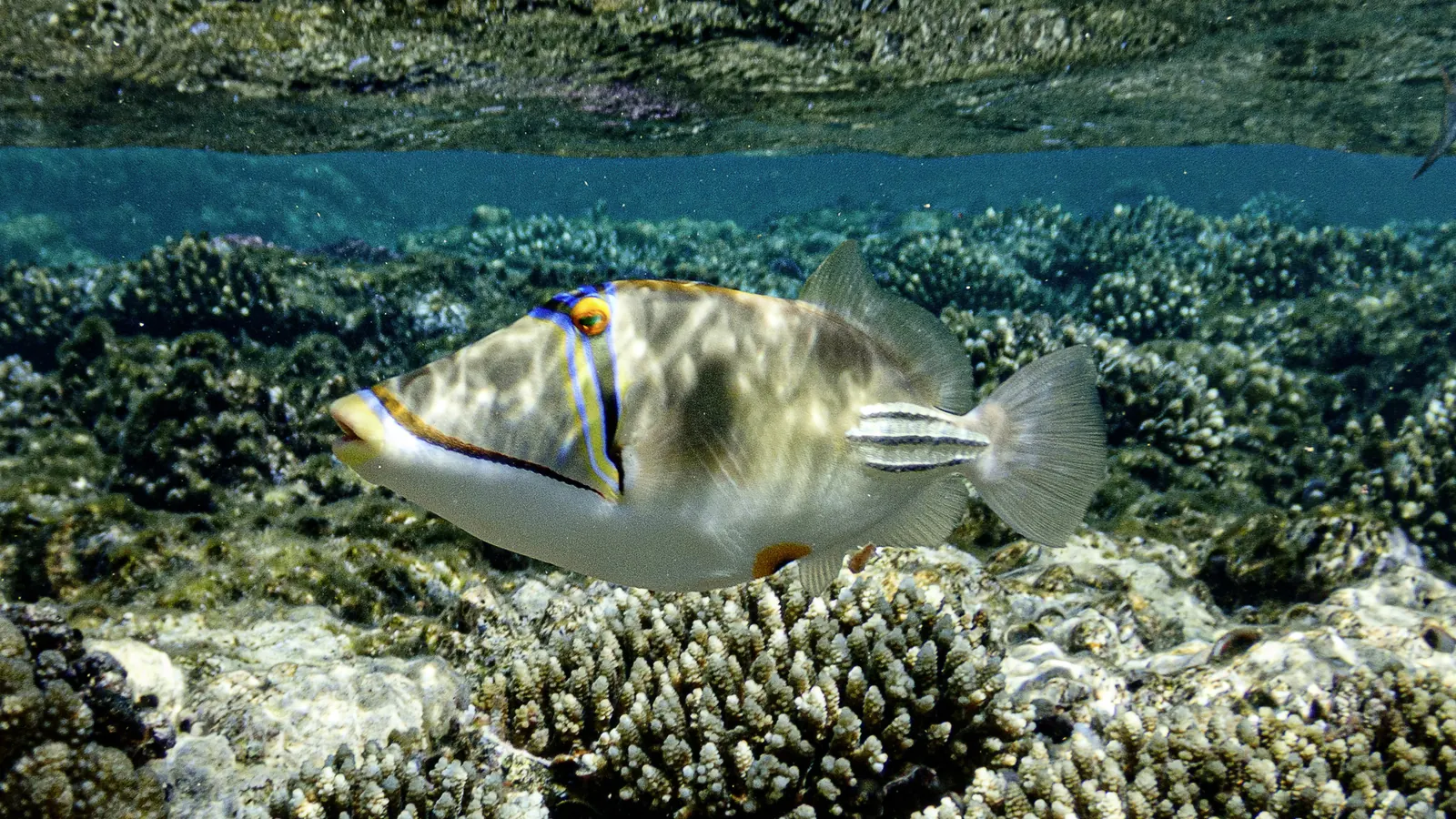
Once its more famous namesake is set aside — see below — the Picasso triggerfish is one of the easier reef fish to name with confidence. The key features to check:
- Body shape and size: A deep, laterally flattened body with a large, pointed head making up roughly a third of its length — the classic triggerfish silhouette — reaching a maximum of around 30 cm.
- Colour: Tan above, fading to white or cream on the belly, with a yellow to orange-brown patch around the vent (the anal region) that stands out against the pale underside.
- The blue face-bands: Thin, vivid blue bands, alternating with black ones, cross the head between the eyes, and a blue-edged dark bar drops from the eye to the gill opening, with blue and yellow lines running down the cheek in front of it — the most eye-catching marking, and a big part of the painted, abstract look behind the "Picasso" nickname.
- Lips and snout: Fleshy yellow lips at the tip of a long, pointed snout, with a thin dark streak running from the mouth back to the base of the pectoral fin — a mark the lagoon triggerfish lacks. The small but powerful mouth carries strong, chisel-like teeth built for cracking hard-shelled prey.
- Tail and caudal peduncle: A pale, near-translucent tail, preceded by dark stripes along the caudal peduncle — the narrow base of the tail — formed by rows of small, keeled, spiny scales, a trait shared across the genus and sometimes used (through the number of rows) to help separate related species.
- The locking spine: A tall, erectile first dorsal spine, lockable upright by the small "trigger" spine directly behind it — the anatomical feature that gives the entire family its name.
The look-alike that matters most. Worth settling before anything else: the "Picasso triggerfish" most divers picture — a strikingly bold, dark fish with sharp white bars across its rear flank and an orange stripe running back from the mouth, familiar from aquarium shops and from photographs taken across the Pacific, the Maldives and East Africa — is not this fish. That better-known species is the lagoon triggerfish (Rhinecanthus aculeatus), a wide-ranging Indo-Pacific fish whose listed distribution runs from East Africa to Hawaii and north to southern Japan, without the Red Sea appearing in it. The standard checklist of Red Sea fishes likewise includes just one member of the genus, Rhinecanthus assasi — a separate, closely related species found only in the Red Sea and the neighbouring Arabian seas — so a Picasso triggerfish photographed on an Egyptian reef is almost certainly this one. It is also known by the more precise common names Arabian picassofish and Assasi triggerfish, which help keep it apart from its far more widely photographed Pacific relative. Both fish are casually nicknamed "Picasso triggerfish", and that shared nickname is a likely reason why Red Sea photographs and captions are sometimes labelled with the wrong species. Side by side, the difference is straightforward: the lagoon triggerfish is darker and higher-contrast, with bold white bars across the flank and an orange stripe from the mouth, while the Red Sea's own Picasso triggerfish is altogether warmer and softer — an even tan above and white below, with no white bars, and a thin black streak, rather than an orange stripe, running from the mouth to the base of the pectoral fin.
The naming confusion runs one step further still. Hawaii's state fish, humuhumunukunukuāpuaʻa ("triggerfish with a snout like a pig"), is neither of the above — it belongs to a third species again, the reef triggerfish (Rhinecanthus rectangulus), told apart from both by a broad black band running from the eye almost to the base of the anal fin and by extra rows of small spines along its caudal peduncle. Like the lagoon triggerfish, it is a Pacific and Indian Ocean species that is not normally encountered in the Red Sea and is not included in the standard checklist of Red Sea fishes.
A locking spine, a solitary life, and a temper to match
Like every member of the family, the Picasso triggerfish carries the anatomical trick that gives triggerfish their name: a front dorsal fin reduced to three spines, of which a tall first spine can be locked upright by a much smaller second spine directly behind it. When alarmed, it can retreat into a narrow crevice in the reef and raise the tall spine, which locks in place as the base of the small second spine slots into a groove in the first — a lock that can only be released by pressing that second "trigger" spine back down. Wedged and locked into a crevice this way, a triggerfish is hard for a predator to pull back out, and an erect spine also makes the fish look larger. The Picasso triggerfish is reported to retreat at night to a den with a narrow entrance to sleep.
Adults are usually seen alone, over their own patch of reef flat or rubble slope, and are described as territorial, driving off fish that intrude on their ground. Juveniles are commonly found on shallow reef flats. As in other triggerfishes, a startled Picasso triggerfish probably makes audible drumming or grunting sounds. In the closely related lagoon triggerfish these are short drum rolls, made when the pectoral fins sweep a set of scutes (thickened scales) against the swimbladder wall, typically when the fish is startled or meets a predator; the mechanism appears to be widespread across the family, but it has not been described in the Picasso triggerfish itself.
Detailed breeding behaviour does not appear to have been documented for R. assasi itself, so what follows is inferred from a close relative rather than confirmed for this species directly. In the lagoon triggerfish, pairs spawn near sunrise, the eggs are laid as masses attached to sand, coral rubble or algae, and the female alone stands guard for roughly twelve to fourteen hours, fanning the eggs with her pectoral fins and driving off intruders until they hatch around sunset. If the Picasso triggerfish follows a similar pattern — plausible given how closely related the two species are, though not yet documented for this species — a nest defended that fiercely, even for a matter of hours, would go some way towards explaining the feisty reputation these fish are commonly given.
Diet
The Picasso triggerfish is an opportunistic bottom-feeder that eats mostly invertebrates, working sand and rubble for whatever it can find: sea urchins and other echinoderms, crabs and small shrimps, sea squirts, worms and the eggs of other fish, along with coral polyps (recorded in Oman). Rather than digging with its mouth alone, it is reported to blast jets of water down into loose sand to expose buried worms and other prey hiding just beneath the surface — a foraging trick shared with several other bottom-feeding triggerfish.
Sea urchins present an obvious hazard to any predator, and triggerfishes are well built to handle them: the Picasso triggerfish's eyes sit high on a head that makes up roughly a third of its body length, and — as in triggerfish generally — each eye is able to move independently of the other, letting the fish keep watch while it works close to a set of spines. Like other triggerfishes, it is reported to nudge or flip a sea urchin over, using its mouth or a jet of water, to attack the far less protected underside instead of attacking from above.
Watching and photographing a Picasso triggerfish
A Picasso triggerfish is a rewarding subject once its temperament is respected:
- Approach from the side, not head-on. A direct approach reads as a threat and can push a territorial fish into a defensive posture; a slow approach from an angle, giving it an obvious way past, is far less likely to provoke a reaction.
- Never block or reach into a den. The same locking spine that keeps the fish safe from predators also means a cornered individual has nowhere to go — leave its crevice, and any nest it may be guarding, well alone.
- Watch the body language. A fish that stops feeding, angles itself towards a diver, or flares its fins may be signalling irritation; backing off a metre or two is often enough to settle it again.
- Keep hands and fins off the reef. Its favoured habitat — reef flats, rubble margins and sandy patches — is exactly the structure that suffers most from a careless fin kick or a hand braced on the coral.
- Frame the face. The blue-and-black bands around the eye are the fish's best feature for a photograph; getting low and shooting roughly level with the fish shows the pattern off far better than a shot from above.
Conservation status
The Picasso triggerfish is listed as Least Concern on the IUCN Red List (assessed 2022). FishBase rates it as having low to moderate vulnerability to fishing pressure and medium resilience, with a minimum population doubling time estimated at 1.4 to 4.4 years. It is not known to be the target of a major commercial fishery, though it is caught with artisanal gear, mainly fish pots, in parts of its range, and it also appears in the aquarium trade.
Because its range is limited to the Red Sea and the neighbouring Arabian seas — the Gulf of Aden, the Somali coast and Socotra, the Gulf of Oman and the Persian Gulf — rather than the vast Indo-Pacific enjoyed by its much-photographed look-alike, the health of reefs in this region matters directly to the species: it has no wider Indo-Pacific range to fall back on.
Related Red Sea reef fish
The Picasso triggerfish shares its shallow reef flats and sandy margins with several other characterful residents:
- Titan triggerfish — a much larger, far more formidable relative with a reputation for aggression, especially around its nest.
- Sohal surgeonfish — another boldly patterned, territorial resident of the same shallow reef flats.
- Masked pufferfish — a distinctive, slow-moving reef fish often turning up over the same sandy-rubble ground.
- Bluespotted ribbontail ray — usually hides under coral ledges by day, then feeds over the shallow sandy flats beside the same reefs at night.
- Porcupinefish — another spine-covered reef fish that shelters in reef crevices by day, much like a Picasso triggerfish at night.
For the bigger picture of what lives on an Egyptian reef and how the seasons shape a dive, see the complete guide to scuba diving in the Red Sea. To browse the full encyclopedia species by species, visit the Red Sea marine life guides.
Frequently asked questions
No. The strikingly bold, dark triggerfish with sharp white bars across its flank and an orange stripe running back from the mouth that most people picture as the 'Picasso triggerfish' is the lagoon triggerfish (Rhinecanthus aculeatus), a wide-ranging Indo-Pacific species whose listed range runs from East Africa to Hawaii and southern Japan and does not include the Red Sea. The fish found on Egyptian reefs is a different, closely related species, Rhinecanthus assasi, restricted to the Red Sea and the neighbouring Arabian seas — hence its more precise names, Arabian picassofish or Assasi triggerfish. It is warmer and softer in colour, an even tan above and white below with no white bars, and has a thin black streak, rather than an orange stripe, running from the mouth to the base of the pectoral fin. Both fish are casually nicknamed 'Picasso triggerfish', a likely reason why photographs from the Red Sea are sometimes labelled with the Pacific species' name.
No. Hawaii's state fish is the reef triggerfish (Rhinecanthus rectangulus), a third, separate species found across the Pacific and Indian Ocean but not normally encountered in the Red Sea. It can be told apart from both the Red Sea's Picasso triggerfish and the Indo-Pacific lagoon triggerfish by a broad black band running from the eye almost to the base of the anal fin, and by extra rows of small spines along the base of its tail.
Mainly in size and temperament. The Picasso triggerfish tops out at around 30 cm, modest by triggerfish standards, while the titan triggerfish can reach about 75 cm and has a well-earned reputation as one of the most aggressive fish on the reef, particularly females guarding a nest. The Picasso triggerfish is territorial and can be feisty on its own patch of reef, but it is smaller, less imposing, and much less of a concern for divers than its larger relative.
It reaches a maximum length of around 30 cm, making it one of the smaller triggerfishes — bigger than many reef fish, but far smaller than reef heavyweights like the titan triggerfish.
It is an opportunistic bottom-feeder that eats mostly invertebrates, taking sea urchins and other echinoderms, crabs, small shrimps, sea squirts, worms and fish eggs, along with coral polyps, picked up while foraging over sand and rubble. It is reported to blow jets of water into the sand to expose buried prey and, like other triggerfishes, to flip sea urchins over to attack their less-protected underside.
Not usually. FishBase lists the species as harmless to humans, but these fish are solitary and territorial and can behave defensively if crowded, cornered or — potentially, based on closely related species — guarding a nest, and may nip with their small, strong teeth. At around 30 cm they are far less of a concern than a large, nesting titan triggerfish. Giving one space, approaching from the side rather than head-on, and never trying to block or reach into its den is usually enough to avoid trouble.
It is a year-round resident rather than a seasonal visitor, so there is no particular month to plan around. Look for it over shallow reef flats, sandy-rubble margins and sheltered house reefs at Hurghada, Makadi Bay and Sahl Hasheesh, as well as the reef flats of Sharm el-Sheikh, Ras Mohammed and the Straits of Tiran — it is common across the Egyptian Red Sea and a frequent sight on shallow dives and snorkels.