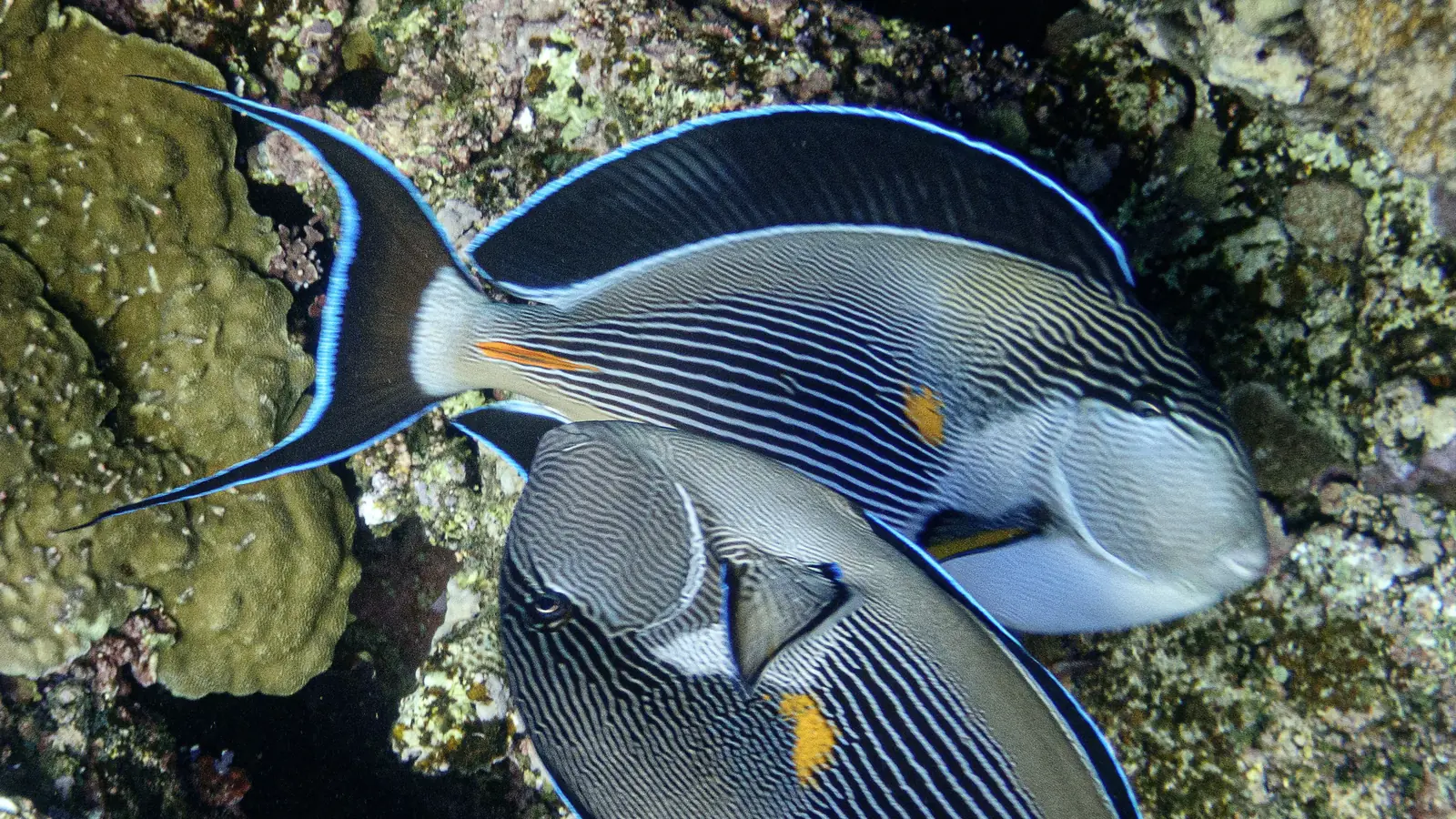
Where to see them
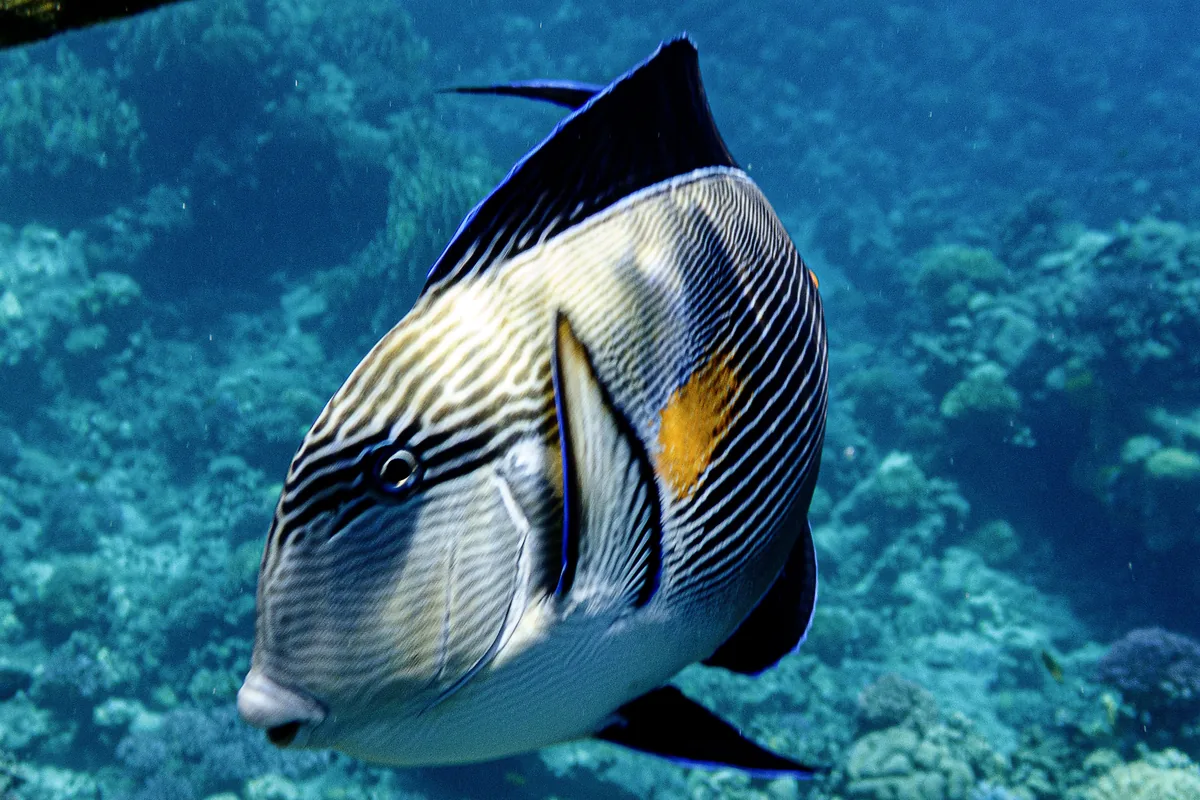
When to see them
There is no reported migration or seasonal pattern in the sohal surgeonfish's behaviour — it is a true year-round resident that holds the same stretch of reef through every month, and no particular season improves the odds of a sighting. What does change is how comfortable it is to watch: in calm, clear conditions a resident fish will patrol out in the open for long stretches, while heavier surge and swell tend to push it in tighter against the reef structure it knows so well.
Year-round resident Same territory held in every season
How to recognise a sohal surgeonfish
The sohal surgeonfish is not a subtle fish, and once its handful of Red Sea look-alikes are known it is one of the easier reef residents to name with confidence. The key features to check:
- Body shape & size: A deep, laterally compressed, oval body typical of the family, reaching a maximum of around 40 cm — noticeably larger and heavier-bodied than most other Red Sea surgeonfish.
- Colour & pattern: Fine, wavy black stripes run the length of the body, separated by narrower olive-green stripes — finer and more sinuous on the upper body, broader and straighter lower down. The head and underside are pale grey with faint lines rather than bold stripes.
- Fins: The dorsal, anal and pelvic fins are black, each trimmed with a vivid, almost neon-blue margin; the tail is dark and lunate, with drawn-out lobes.
- The orange marks: A conspicuous orange patch sits on the body just behind the pectoral fin, and the sheath covering the scalpel-like spine at the base of the tail is bright orange too — the two features to check if the striping alone still leaves any doubt.
- The tail spine: Like every member of its family, a sohal surgeonfish carries a sharp, folding, scalpel-like spine on each side of the tail base, normally tucked flat against the body and flicked out sideways only when threatening a rival or defending its territory.
Look-alikes worth knowing. At a glance, any drab, brownish surgeonfish sharing the same reef could be mistaken for a young or washed-out sohal, but the brown surgeonfish (Acanthurus nigrofuscus) is a different species: it tops out at only about 21 cm — roughly half the length of an adult sohal — and its body is a muted brown crossed by fine bluish-grey lines rather than sohal's bold black-and-olive banding. Small black spots at the bases of the dorsal and anal fins, a thin pale-blue edge to those fins and only a sprinkling of tiny orange spots on the head and breast — rather than a large orange patch behind the pectoral fin and an orange-sheathed tail spine — confirm a brown surgeonfish rather than a small sohal.
Two very different-looking but similarly sized Zebrasoma tangs share the same reefs and are sometimes lumped in with "surgeonfish" by newer divers. The yellowtail tang (Zebrasoma xanthurum, also called the yellowtail surgeonfish or purple tang) is deep blue to purple over most of its body, marked with irregular black spots and lines rather than clean parallel stripes, and carries a solid, unmistakable bright-yellow tail — colour alone rules out a sohal, whose tail is dark. The Red Sea sailfin tang (Zebrasoma desjardinii) grows to a similar maximum size, around 40 cm, but its body is mottled grey-brown with fine wavy and dotted lines rather than parallel bands, fine orange-yellow lines run through its darker body bars, and its dorsal and anal fins are drawn up into a dramatic, oversized sail that a sohal's fins never approach.
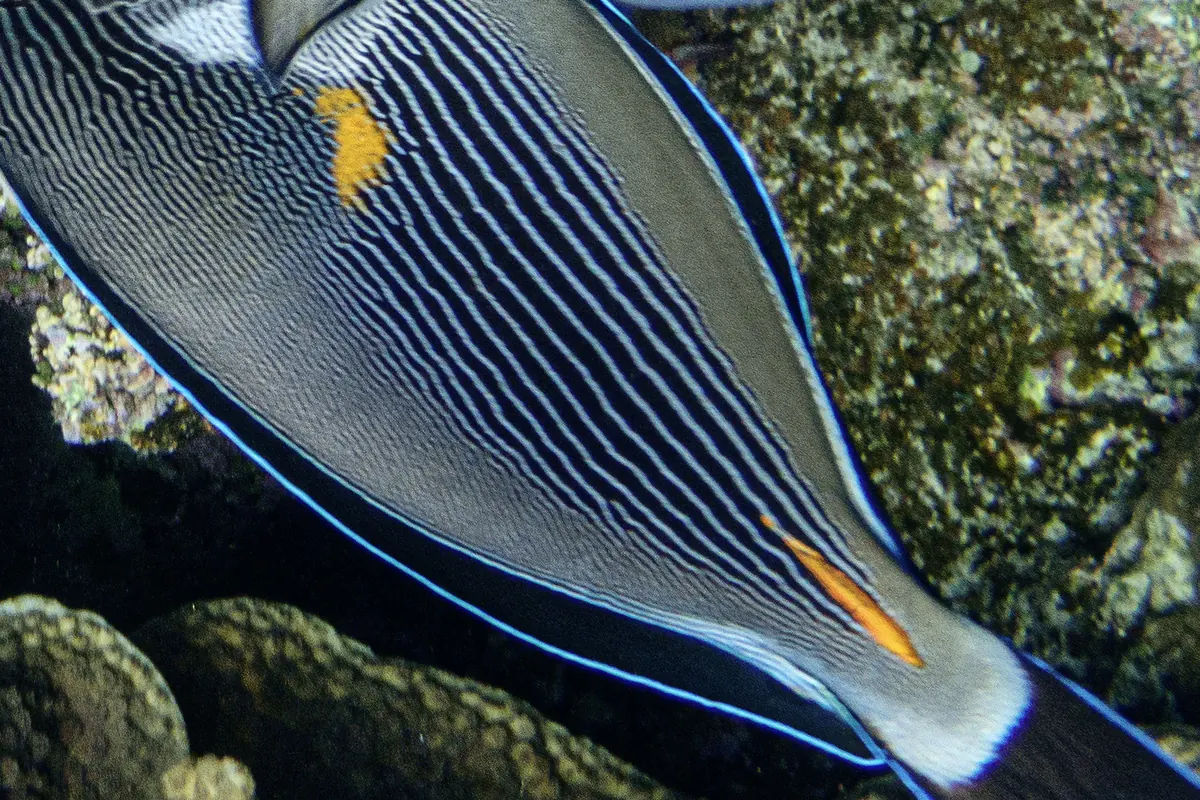
Solitary, territorial, and quick to react
Sohal surgeonfish are usually encountered alone or in loose, small groups, and adults are consistently described as one of the more territorial fish on the reef. A resident fish holds a defined patch of hard substrate — its own algae "garden" — and spends much of the day grazing within it or patrolling its boundary, though it may range some distance from the core territory, or retreat into shelter, at other times.
A field study of Acanthurus sohal on the fringing reefs of Ras Mohammed National Park found that the fish directs a high number of aggressive, chasing responses at intruders — both other sohal surgeonfish and the bicolor parrotfish (Cetoscarus bicolor) — though each individual encounter tends to be brief and low in intensity rather than a prolonged fight. In practice this usually looks like a short, fast dart toward the intruder rather than sustained combat.
Curiously, despite this solitary, defend-your-own-patch habit, sohal surgeonfish are also reported to set their independence aside when it suits them: several will sometimes group together specifically to graze inside another fish's territory, since a lone territory-holder that can easily see off one intruder struggles to see off several feeding at once.
Divers get a front-row seat to this territoriality more often than with most other reef grazers, because a sohal surgeonfish that judges a diver or snorkeller to be too close, too slow to move on, or hovering directly over its garden will often react the same way it would to a rival fish — with a fast, direct dart toward the intruder. This is widely reported by Red Sea divers and dive guides, and while it is rarely more than a startling rush rather than a genuine attack, it is one reason the species has a reputation as one of the reef's more assertive characters.
Diet
Sohal surgeonfish are herbivorous grazers, feeding on algae growing on hard substrate — chiefly Sargassum and fine, filamentous algal turf — scraped or nipped from bare rock, dead coral and rubble with a small, forward-set mouth. This constant grazing pressure is exactly why a resident fish defends its patch so persistently: a healthy algal turf takes time to regrow, and every bite taken by an intruder is one the territory-holder cannot take itself. Eggs are released into open water and drift as plankton, larvae develop away from the reef before settling, and young fish are reported to already resemble small, round-bodied versions of the adult — banding and the blade at the tail base already present — rather than passing through a strikingly different juvenile colour phase.
Watching and photographing sohal surgeonfish
A little respect for its temperament goes a long way toward a calm, close encounter:
- Read the body language. A sohal surgeonfish that stops feeding, angles side-on, or flicks its tail is warning a rival off its patch — treat the same signal aimed at you as your cue to back off and give it room, rather than push closer for a photograph.
- Don't hover directly over its garden. The territory is usually a specific, recognisable patch of reef rather than the whole surrounding area; drifting to one side rather than sitting in the middle of its feeding ground is usually enough to avoid triggering a chase.
- Keep hands and gauges tucked in. The scalpel-like spine at the base of the tail is normally folded flat, but a startled or defensive fish can flick it out fast — this is not a fish worth petting, cornering or reaching toward.
- Mind your buoyancy on the reef edge. Its favoured habitat — the shallow, surge-exposed rim of the reef — is also some of the most current-affected, wave-washed structure on any dive site, and it is easy to be pushed into the coral while trying to hold a shot.
- Approach slowly and low. A calm, level approach along the reef, rather than head-on or from above, gives the best chance of a resident fish continuing to feed naturally rather than bolting for cover.
Conservation status
The sohal surgeonfish is listed as Least Concern on the IUCN Red List (assessed 2010, published 2012). It is not the target of any large-scale commercial fishery, though it is caught locally as a food fish across parts of its range using nets, traps and occasionally trawls, and is collected in smaller numbers for the marine aquarium trade — neither pressure is currently considered a threat to the wild population as a whole. The species shows medium resilience, with modelled population-doubling times of roughly one and a half to four and a half years.
That global picture is not uniform everywhere, however: a separate regional assessment of the Persian and Arabian Gulf population — at the edge of the species' range, where reefs face heavier development and more extreme temperatures — rated it Vulnerable in 2015, a reminder that a healthy global status can still mask real pressure on a more exposed local population.
Related Red Sea reef fish
The sohal surgeonfish shares its shallow, current-swept reef edge with several other characterful residents:
- Yellowbar angelfish — a large, boldly patterned angelfish that patrols the same reef walls and drop-offs.
- Emperor angelfish — another big, brightly striped resident often seen along the same current-swept edges.
- Masked butterflyfish — a Red Sea near-endemic butterflyfish sharing the same shallow coral slopes.
- Picasso triggerfish — a common resident of the same shallow reef flats, patrolling the sandy margins nearby.
- Anthias — the small, orange-pink planktivores that swarm in their hundreds over the same current-facing reef edges the sohal defends.
For the bigger picture of what lives on an Egyptian reef and how the seasons shape a dive, see the complete guide to scuba diving in the Red Sea. To browse the full encyclopedia species by species, visit the Red Sea marine life guides.
Frequently asked questions
Like every member of the surgeonfish family, the sohal surgeonfish carries a sharp, scalpel-like spine folded flat against each side of its tail base, which it can flick out sideways to slash at a rival or a threat. A cut from this spine is typically immediately painful and can be a surprisingly deep laceration, and at least one ichthyological reference describes the spine's sheath as possibly venomous in this species, though that has not been established with the same certainty as the mechanical injury itself. In practice the spine is a weapon used against other fish, serious injuries to divers are rare, and it is simply not a fish worth cornering, touching or provoking.
It has a strong reputation among Red Sea divers for being one of the bolder, more assertive reef fish, and it will often dart quickly toward a diver or snorkeller who lingers too close to its territory, much as it would toward a rival surgeonfish or an intruding parrotfish. This behaviour is widely reported by divers rather than documented as a formal study of diver interactions, and a genuine injury to a person is rare — the usual result is a startling rush rather than a real attack — but giving a sohal surgeonfish room, and not hovering directly over its patch of reef, is the simplest way to avoid provoking it.
Size and colour both settle it quickly. The brown surgeonfish (Acanthurus nigrofuscus) reaches only about 21 centimetres, roughly half the maximum length of a sohal surgeonfish, and its body is a muted, uniform brown crossed by fine bluish-grey lines, with small black spots at the bases of the dorsal and anal fins, only a thin pale-blue edge to those fins and a sprinkling of tiny orange spots on the head and breast. The sohal surgeonfish, by contrast, is boldly black-and-olive striped, reaches around 40 centimetres, and carries vivid blue-edged black fins plus an orange patch near the pectoral fin and an orange-sheathed spine at the base of the tail.
Colour is the fastest check. The yellowtail tang (Zebrasoma xanthurum, also called the yellowtail surgeonfish or purple tang) is deep blue to purple over most of its body, marked with scattered black spots and lines, and has a solid, bright yellow tail, nothing like the sohal surgeonfish's dark tail and black-and-olive banding. The similarly sized Red Sea sailfin tang (Zebrasoma desjardinii) is easier to separate by fin shape: its dorsal and anal fins are drawn up into a dramatic, oversized sail, far taller than anything seen on a sohal surgeonfish, over a mottled grey-brown body patterned with fine wavy lines rather than clean parallel stripes.
It is a herbivorous grazer, feeding on algae scraped from hard reef substrate with a small, forward-set mouth, mainly Sargassum and fine, filamentous algal turf growing on bare rock, dead coral and rubble. This grazing is the whole reason it defends a territory so persistently: a patch of algae takes time to regrow, and every bite an intruder takes is food the resident fish cannot have.
Almost anywhere the reef meets open water in shallow, surge-exposed conditions. It favours the outer edges of reef flats and fringing reefs, the shallow crest at the top of a wall or drop-off, and current-swept sites in general — house reefs at Hurghada, Makadi Bay and Sahl Hasheesh usually hold at least one resident along their surge-exposed edge, while stronger-current locations such as the Straits of Tiran and the fringing reefs of Ras Mohammed National Park are well-documented habitat for the species.
No. It is listed as Least Concern on the global IUCN Red List, assessed in 2010 (published 2012), and is not considered to be under significant threat across most of its range. The main exception is a regional assessment of the Persian/Arabian Gulf population, at the harsher edge of the species' range, which was separately rated Vulnerable in 2015, a useful reminder that a healthy global listing can still hide more localised pressure.