Where to see them
When to see them
Titan triggerfish are permanent, non-migratory residents of the Red Sea, so there is no time of year when they simply disappear from the reef — a diver can expect to see one on almost any dive, in almost any month. What changes seasonally is not whether the fish is present, but how it behaves. Nest-guarding and the territorial aggression that comes with it are reported most often through the warmer months, roughly June to September in the Egyptian Red Sea. In several other triggerfish species spawning follows a lunar rhythm, with week-long bursts of nesting around the full or new moon, so nesting activity may come in pulses rather than as one steady season. Outside these periods, a titan triggerfish is generally unbothered by a diver who keeps a respectful distance.
Present year-round Nest-guarding and heightened territoriality most often reported June–September
How to recognise a titan triggerfish
Size alone gives away a large titan triggerfish, but a closer look reveals a set of field marks that make it one of the easier reef fish to name with confidence:
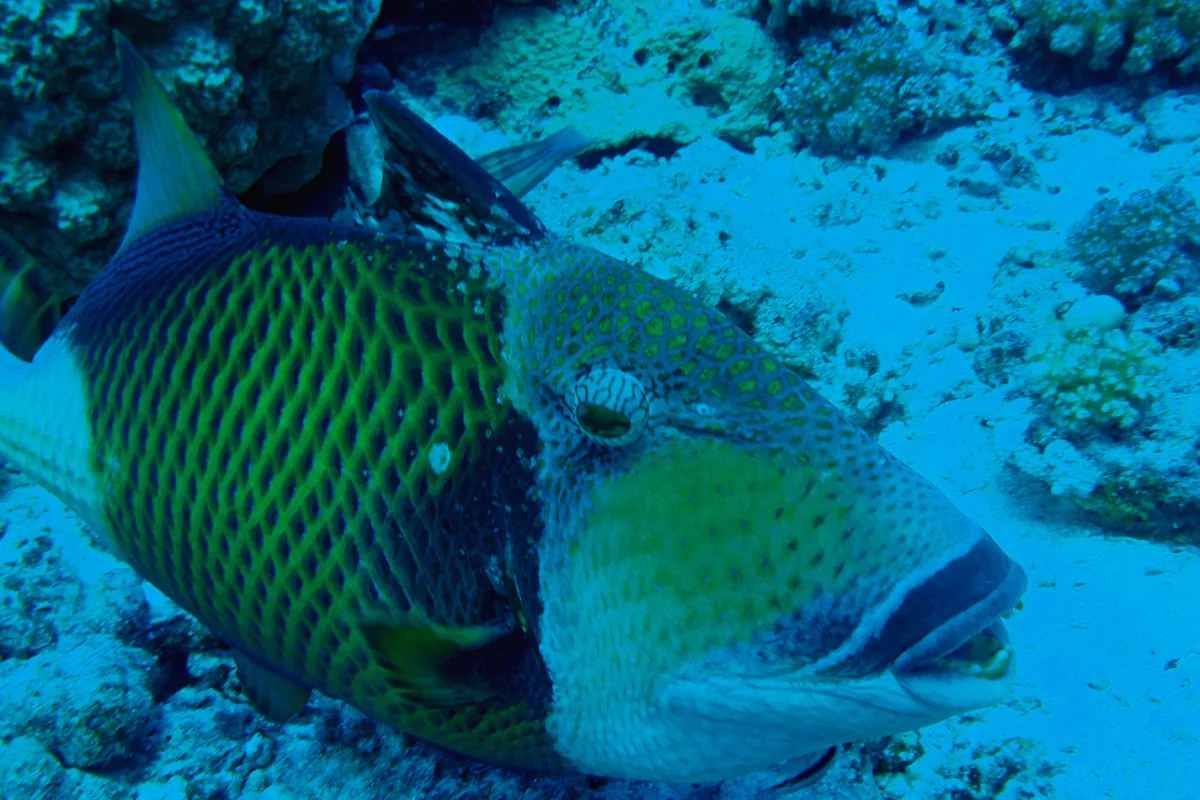
- Size & shape: A large, deep-bodied, oval fish that can reach roughly 75 cm in length — the largest triggerfish found in the Red Sea and across most of the Indo-Pacific.
- Scale pattern: The heavily scaled body carries pale scale margins that build up into a distinctive crosshatch, or "tiled," pattern across the flanks.
- The "moustache": A dark, curved band runs behind and above the mouth, separating a pale chin from a yellowish cheek — the marking behind the alternative common name "moustache triggerfish."
- Face: A scaleless, naked patch surrounds the lips, and a deep groove sits in front of each high-set eye.
- Fins & tail: The dorsal and anal fins carry black margins; the tail base is pale, with the rear of the tail yellow and edged in black. Several rows of small, forward-curving spines run along each side of the tail base (caudal peduncle).
- The trigger: Like every member of its family, it carries three dorsal spines. The long first spine locks upright once the short second spine is raised behind it, and can only be released by pressing that second "trigger" spine down — the mechanism that gives the whole triggerfish family its name, and one the fish uses to wedge itself into a crevice for the night.
Look-alikes worth knowing. Two other Red Sea triggerfish are sometimes confused with a titan, usually because of their size or their reputation rather than a genuine resemblance. The yellow-spotted, or blue, triggerfish (Pseudobalistes fuscus) is nearly as large, reaching around 55 cm, but has a brown body scattered with pale yellow spots and yellow-margined fins, and it lacks the titan's dark moustache band entirely. The much smaller orange-lined triggerfish (Balistapus undulatus), which tops out at around 30 cm, is boldly marked with curved orange lines radiating from the mouth and is territorial in its own right — but its bite and its bulk are in a different league altogether, and it should not be mistaken for its much larger, far more formidable relative.
Daily life, cleaning stations and a fierce nesting season
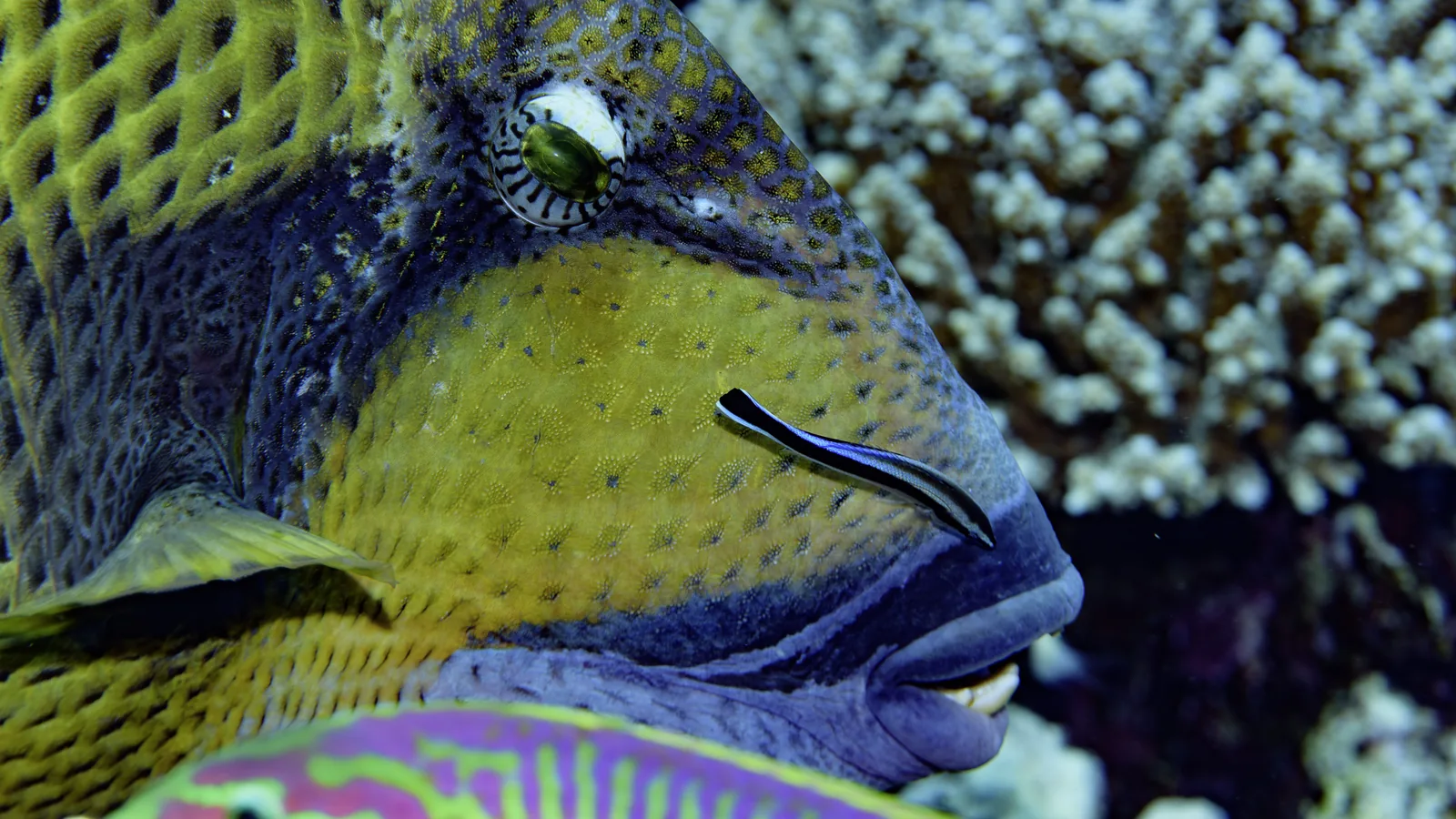
Away from the breeding season, a titan triggerfish leads a fairly solitary, unhurried life. It is active by day, working a patch of reef alone as it forages, and at night it retreats into a crevice in the coral, using its locked first dorsal spine to wedge itself in place — the very mechanism described above, doing double duty as a burglar-proof lock against nocturnal predators. Like many large reef fish, it is also a regular visitor to cleaning stations: the bluestreak cleaner wrasse (Labroides dimidiatus) is a documented cleaner of titan triggerfish, picking parasites from the fish's gills and body in exactly the kind of encounter pictured at the top of this page. If the glossary term is new to you, see what a cleaning station is and why so many reef species rely on one.
Everything changes once nesting begins. A female titan triggerfish digs a shallow, crater-shaped nest into a flat patch of sand or rubble, usually with a male in attendance nearby, and lays her eggs directly onto the open ground rather than hiding them. From that point on she rarely leaves, fanning and guarding the clutch and confronting almost anything that comes near. What makes this genuinely hazardous for divers is the shape of the territory she defends: rather than a simple radius around the nest, the guarded zone is roughly cone-shaped, narrow at the seabed and widening as it rises toward the surface. A diver who is well clear of the nest horizontally can still be well inside the cone if they are hanging in open water above it. Before charging, an agitated fish typically gives some warning — raising its first dorsal spine into an erect position, facing the intruder directly, or rolling onto its side with jerky, rapid eye movements — though not every charge is preceded by an obvious signal, and a fish that has already decided to attack may give little notice at all.
Diet
The titan triggerfish is a powerful, opportunistic predator of hard-shelled and armoured reef animals. Its diet is built around sea urchins, crabs and other crustaceans, molluscs, tube worms and pieces of branching coral, all of which it tackles with a set of thick, chisel-shaped teeth strong enough to crush shells and bite off chunks of coral. A 2019 osteological description of a single 46 cm specimen recorded four pairs of teeth in the outer row of the upper jaw, with a further three pairs behind them, and three pairs in the lower jaw — consistent with the generally heavy, incisor-like dentition typical of the wider triggerfish family.
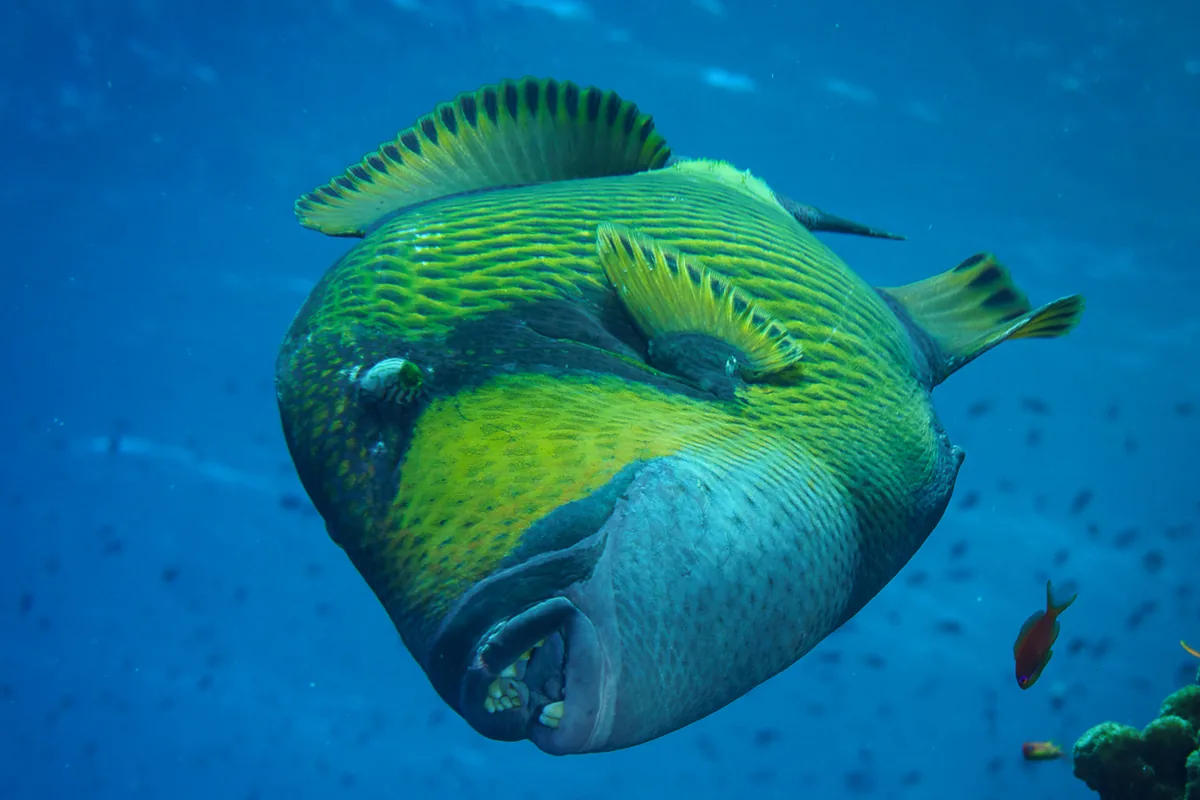
Feeding is as much a matter of technique as brute force. A titan triggerfish will turn over rocks and rubble to expose whatever is sheltering underneath, and it deals with a sea urchin by flipping it over to attack the far less protected underside rather than the spines. It is also known to jet water at the sand to unearth prey buried just beneath the surface, a habit that disturbs enough sediment and small animals that other, smaller fish often trail behind it, snatching scraps and exposed invertebrates for themselves. Among its more surprising documented prey items is the crown-of-thorns starfish; a titan triggerfish that tackles one targets the unprotected underside, where the starfish's toxic spines offer no defence, making it one of the few reef fish willing to take on this notoriously well-defended, coral-eating starfish.
Watching and photographing titan triggerfish safely
Most encounters with a titan triggerfish are entirely uneventful, but this is one Red Sea species where knowing the etiquette genuinely matters:
- Learn the warning signs. An erect first dorsal spine, a fish facing you head-on, or one rolling onto its side while staring are all signals of stress — treat any of them as a cue to back off, not to move in for a closer photograph.
- Be cautious over open sand in the breeding season. Bare, sunlit sand or rubble patches on a shallow reef flat are exactly where a nest is likely to be dug through the warmer months; avoid hovering directly above one for longer than necessary.
- If charged, swim away horizontally and low — never straight up. Because the defended territory is cone-shaped and widens toward the surface, heading upward can keep you inside the danger zone for longer rather than taking you out of it.
- Put your fins between yourself and the fish. Fins make a natural, disposable barrier; there is no need to kick at the fish, only to keep something other than bare skin facing it as you retreat.
- Don't corner it or block its retreat. Like most reef fish, a titan triggerfish that has an open route back to shelter is far less likely to press an attack than one that feels trapped.
- Listen to your guide's briefing. Dive guides who know a site well are usually aware of an active nest and will route the group well clear of it.
A titan triggerfish's bite is not venomous, but its teeth are strong enough to cause a genuine puncture or laceration rather than a superficial nip, and there is at least one documented case of several divers being bitten during a single encounter with a defensive female. Any bite that breaks the skin should be cleaned as soon as possible, and, given the infection risk that comes with any puncture wound picked up in the sea, anything beyond the most minor scrape is worth having assessed by a medical professional.
Conservation status
The titan triggerfish is listed as Least Concern on the IUCN Red List (assessed 2022), a status supported by its wide distribution across the Red Sea and most of the Indo-Pacific and the absence of any major documented population decline. It is taken in modest numbers by some artisanal and commercial fisheries within its range and sold fresh or dried and salted, but it is not the target of any large dedicated fishery. Like a number of large reef predators, its flesh has occasionally been implicated in ciguatera fish poisoning, which likely limits how heavily it is targeted for food in some areas.
Ecologically, a fish this large and this armed plays a genuine role in reef health. By preying on sea urchins, crustaceans and, on occasion, the corallivorous crown-of-thorns starfish, it helps keep the numbers of some coral-damaging or grazing animals in check. The main pressures on the species, as with most Red Sea reef fish, are indirect — coral degradation, coastal development and reef damage that reduce the sheltered feeding and nesting ground it depends on, rather than any direct threat to the species itself.
Related Red Sea reef fish
A titan triggerfish shares its reef with several other characterful residents worth learning to recognise:
- Picasso triggerfish — a much smaller, boldly patterned relative from the same family, sharing the same trigger-spine defence mechanism.
- Crown-of-thorns starfish — the well-defended, coral-eating starfish that is, occasionally, on the titan triggerfish's own menu.
- Napoleon wrasse — another large, distinctive reef resident that patrols the same coral slopes and drop-offs.
- Moray eel — the reef's other well-armed crevice-dweller, sharing the same taste for a well-hidden daytime retreat.
- Masked pufferfish — a slower, equally well-defended reef fish that relies on an entirely different strategy to deter predators.
For the bigger picture of what lives on an Egyptian reef and how the seasons shape a dive, see the complete guide to scuba diving in the Red Sea. To browse the full encyclopedia species by species, visit the Red Sea marine life guides.
Frequently asked questions
Attacks are almost always a defensive response, not predatory aggression. A female titan triggerfish digs a crater-shaped nest in a sandy or rubble patch and lays her eggs there, then aggressively defends a roughly cone-shaped territory that starts at the nest and widens as it rises toward the surface. Any diver, snorkeller or fish that strays into this zone, even without realising a nest is nearby, can be charged or bitten. Outside the nesting season, titan triggerfish are generally unbothered by divers who keep a respectful distance.
Swim away immediately, but go horizontally and low over the reef rather than straight up. Because the defended territory is cone-shaped and widens toward the surface, swimming upward can actually keep you inside the danger zone for longer, and there are accounts of a triggerfish following a diver all the way to the surface. Put your fins between yourself and the fish as a barrier, keep it in sight as you retreat, and head away from the nest site rather than trying to circle around it.
Before charging, an agitated titan triggerfish typically raises its first dorsal spine into an erect position and may face the intruder directly, sometimes rolling onto its side while staring. Jerky, rapid eye movements are another sign of stress. These postures are a warning rather than a guarantee of an attack, but a diver who notices them should back away calmly rather than approaching for a closer look or a photograph.
The bite itself is not venomous, but the fish's strong, chisel-like teeth are built for crushing shells and coral and can cause a deep puncture or laceration rather than a superficial nip. There is at least one documented case of several divers being bitten during a single encounter with a nesting female. Any bite that breaks the skin should be cleaned as soon as possible, and, because of the infection risk from a puncture wound sustained in the sea, anything beyond a very minor scrape should be assessed by a medical professional.
Titan triggerfish can reach a total length of around 75 cm and a weight of several kilograms, making them the largest triggerfish species found in the Red Sea and across most of the Indo-Pacific. Most individuals encountered on a dive are smaller than this maximum, but even a mid-sized adult is noticeably larger and more heavily built than any other triggerfish likely to be seen on the same reef.
They feed mainly on sea urchins, crabs and other crustaceans, molluscs, tube worms and pieces of branching coral, using powerful jaws and chisel-like teeth to crush hard shells. A titan triggerfish will turn over rocks and rubble to expose hidden prey, flip sea urchins to attack their less-protected underside, and blow jets of water at the sand to uncover buried animals, with smaller fish often following behind to snatch scraps disturbed in the process. It has also been recorded preying on crown-of-thorns starfish, targeting the unprotected underside where the starfish's toxic spines offer no defence.
No. The IUCN Red List classifies the titan triggerfish as Least Concern, reflecting its wide distribution across the Indo-Pacific and the Red Sea and the absence of any major population threat. It is taken in small numbers by some local fisheries and sold fresh or dried and salted, but like a number of large reef predators its flesh has occasionally been linked to ciguatera fish poisoning, so it is not a significant target species in most areas.