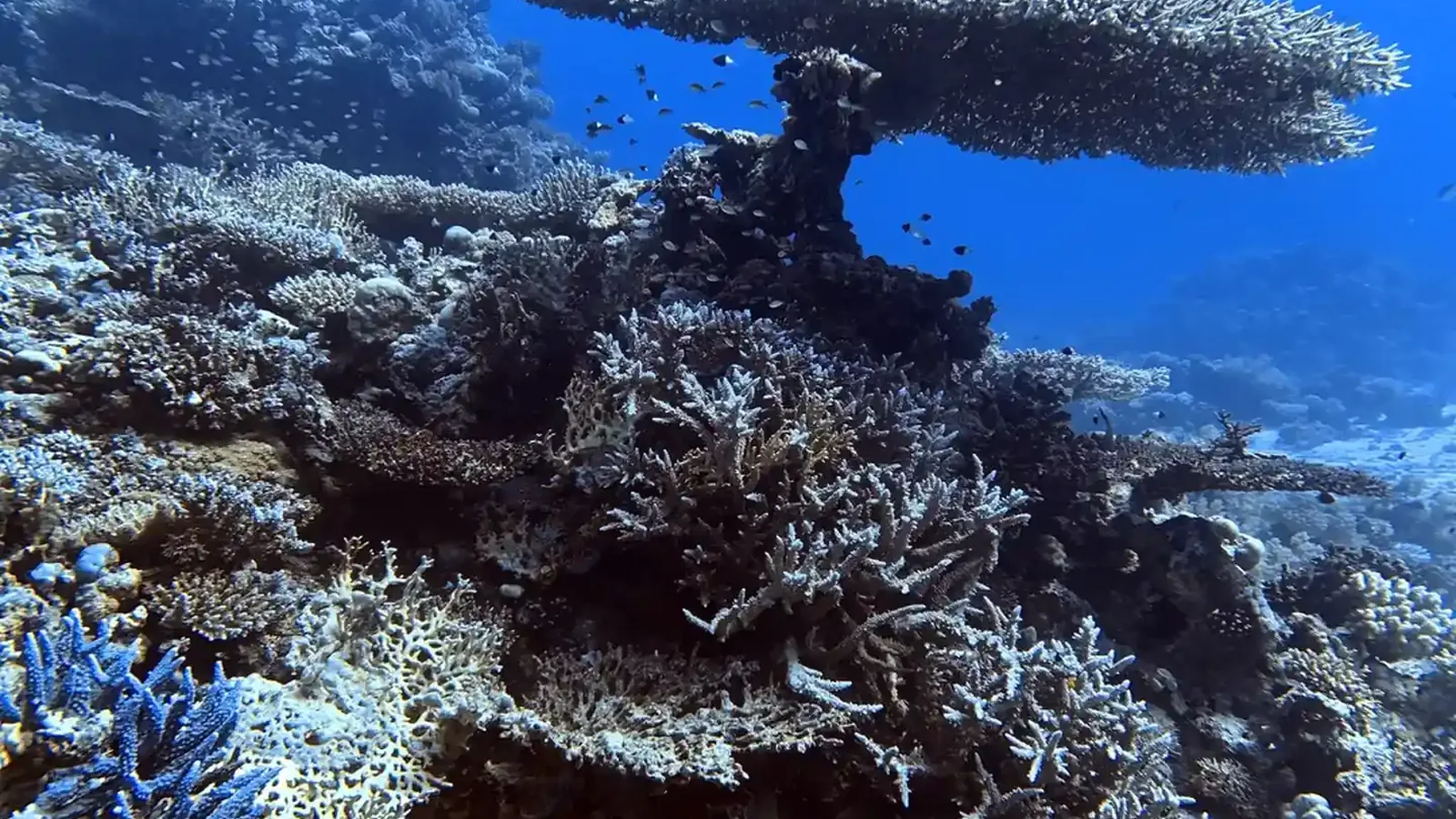
Careless Reef is one of those sites that earns its reputation the moment you drop in. It sits out in open water north of Hurghada, unprotected and exposed to the current — and that current is exactly what makes it special. It feeds the reef, pulls in predators, and gives the site its two headline attractions: an extraordinary gathering of giant moray eels, and a wall that simply falls away into deep blue. This is a dive for divers who like a little edge to their day.
What and where — the reef at a glance
Careless Reef is an offshore reef lying in open water to the north of Hurghada. Unlike the sheltered house reefs and inshore sites closer to the marina, it stands alone in the blue with no landmass to protect it — which means it takes whatever the sea sends. Most days that translates into a steady, nutrient-rich current sweeping across the structure, and it is that current, more than anything, that shapes the diving here.
The reef itself is built around two coral pinnacles that rise from the seabed, separated by a valley — a saddle of roughly 16 metres — that divers cross between the two towers. The pinnacles are draped in hard and soft coral and busy with fish. On the seaward side, the reef gives way to a wall that drops vertically well past 60 metres into the open water, disappearing into a blue that seems to have no floor. Most of the dive is spent shallower than that, around 18 metres average, working the tops and flanks of the pinnacles — but the wall is always there beside you, and it commands respect.
The name — "Careless" — has long invited stories, but the takeaway for a diver is simple: this is a site that does not forgive carelessness. It rewards planning, buoyancy control and situational awareness, and it punishes the opposite. Approached with the right skills, it is one of the most exhilarating reef dives the northern Red Sea offers.
Getting there and the day
Careless Reef is a boat dive — there is no shore access. From Hurghada the crossing takes roughly an hour, though the exact time depends on the departure point, the boat and the state of the sea. Because the reef sits in open water, the ride out can be lively when there is any wind; a calm morning makes for the smoothest trip, which is one reason boats tend to run this site early.
A typical day is a two-dive boat trip, with Careless Reef as the highlight and a second, often more sheltered, reef for the following dive once the group has warmed up and gas is planned. On the boat you will get a full site briefing before you gear up: where the current is running, the planned route between the pinnacles, the maximum depth, the turn-around gas, and the exit. On a current dive that briefing matters — this is not a site to jump in and improvise.
Entries are usually a negative or prompt descent so the group drops together and stays together in the moving water. Your guide will read the current on the day and decide whether to run the dive as a drift along the wall, a circuit of the pinnacles, or a sheltered exploration of the lee side if the flow is strong. Flexibility is part of the appeal: no two days at Careless Reef are quite the same.
The dive — pinnacles, saddle and wall
The classic Careless Reef dive works around the two pinnacles and the saddle between them, keeping the wall on the seaward side. Here is how it tends to unfold.
The descent
You drop into the blue and the reef materialises beneath you — first the pale crown of a pinnacle, then the coral-covered flanks falling away. Because the site is exposed, the group descends promptly and regroups on the reef out of the worst of the current. The first impression is of scale and life: fish in every direction, coral heads busy with movement, and the ever-present sense of open water beyond the reef edge.
The pinnacles and the saddle
Most of the dive is spent around 18 metres, exploring the tops and sides of the two towers and crossing the saddle — the roughly 16-metre valley — between them. This middle ground is where the morays are most often found, and where the reef fish congregate thickest. Anthias shimmer over the coral in clouds, groupers hold station in the overhangs, and neutral buoyancy lets you drift past it all without a fin-stroke disturbing the sand.
The wall and the blue
On the seaward flank the reef falls away as a vertical wall, dropping past 60 metres into open water. Divers stay along the upper wall while keeping an eye on the blue, because that is where the big animals cruise — tuna, trevally, patrolling reef sharks and, now and then, the silhouette of something larger. The wall is the site's drama: a reminder that Careless Reef is a real piece of the open sea, not a contained aquarium. It also demands discipline — the temptation to chase a shark deeper along a wall that has no bottom is exactly the kind of thing the site's name warns against.
The ascent
As gas is consumed the group works back up onto the reef top, where the shallower coral shelters a slower, gentler finish to the dive. A safety stop at 5 metres is standard; in current, guides often deploy a surface marker buoy so the boat can track the group and pick everyone up cleanly. Then it is back aboard, dry off, and swap stories about which moray came closest.
What you'll see — the morays and more
Careless Reef leads with its morays, but the current-fed abundance means there is far more going on than one headline species. Here is what to look for.
Giant moray eels: This is the reason most divers come. Careless Reef holds an unusually dense concentration of giant morays, some approaching two metres, and it is common to see several on a single dive. What makes it special is not just the number but the behaviour: the morays here are often out in the open, weaving across the coral in broad daylight rather than lurking in crevices. Watching a large moray glide freely across a reef, mouth opening and closing as it breathes, is a rare and unforgettable sight. Give them space and let them move on their own terms.
Sharks: The current draws in predators, and the reef is a reliable place to encounter whitetip and grey reef sharks patrolling the wall and the deeper water. On the right day, in the right season, there is even the chance of hammerheads cruising out in the blue — never guaranteed, but the kind of possibility that keeps experienced divers coming back.
Pelagics and predators: Expect tuna flashing past, big schools of barracuda hanging in the current, and giant trevally hunting along the reef edge. These are fast, powerful fish that thrive in moving water, and the exposed nature of the site is precisely why they gather here.
Reef life: The pinnacles themselves are alive with colour — clouds of anthias over the coral, groupers in the overhangs, and lionfish hanging in the shadows. Hard and soft corals cover the structure, and smaller reef fish fill every gap. Even between the big encounters, there is never a dull moment.
Who Careless Reef is for
Let's be honest about the level, because it matters. Careless Reef is an advanced dive, and it is not a beginner site. Three things put it beyond entry-level: the depth (with a wall that keeps going well past recreational limits), the exposed open-water position, and the current — which can be strong and often makes this a drift dive.
The right diver here holds a PADI Advanced Open Water certification (or equivalent), is comfortable in moving water, and has reliable buoyancy and air management. A very confident Open Water diver with genuinely solid skills may be able to enjoy the shallower parts of the reef under a guide's discretion, but that is a judgement made on the day, not a default. If your buoyancy is still a work in progress, or a strong current would rattle you, this is a site to build up to — not to cut your teeth on.
None of that is meant to put anyone off. It is meant to set the right expectation. Divers who are ready for Careless Reef tend to rate it among the best dives of their Hurghada trip; divers who are not yet ready are better served by the region's many gentler, shallower reefs first. If you are working toward that level, a course such as Advanced Open Water is exactly the bridge — and it opens up sites like this one.
Conditions and best time
The Red Sea offers year-round diving, and Careless Reef can be dived across the seasons — but conditions here are dictated by the open water. Wind and sea state are the main variables: because the reef is exposed, a calm day makes for an easier crossing and a more relaxed dive, while a windy one can build both surface chop and current. This is why boats favour early departures and why a trip may occasionally be re-routed to a more sheltered site if the sea is up.
Water temperature and visibility follow the broader Red Sea pattern — warmer, calmer conditions through the summer and into autumn, cooler water in winter — with generally good visibility offshore. For a fuller picture of when the region dives best, and what to expect month by month, the guide to the best time to dive the Red Sea breaks it down season by season. The one constant at Careless Reef is that current is common; treat every dive as a potential drift and you will never be caught out.
Responsible diving
An exposed, current-swept reef is a productive place precisely because it is a healthy one — and healthy reefs stay that way only when divers treat them carefully. Perfect your buoyancy before you dive here: in current, a careless fin-kick or a dangling gauge can do real damage to coral that takes decades to grow. Keep well clear of the reef, hold your position with your body rather than your hands, and never touch or chase the marine life.
The morays deserve particular respect. They are not aggressive, but they are large, powerful animals with a serious bite, and they should be observed, not crowded. Let them move where they want to; do not corner them, reach toward them, or try to touch them for a photograph. The same goes for the sharks — give them room, stay calm, and enjoy the encounter from a distance. Take nothing but pictures, leave nothing behind, and the reef will keep delivering these encounters for the divers who come after you.
Practical tips
- Come current-ready. Assume a drift dive. Know how to swim efficiently in current, how to shelter behind structure, and how to deploy or follow a surface marker buoy on ascent.
- Watch your depth on the wall. The wall drops past 60 metres and the blue is tempting. Set a maximum depth, stick to it, and resist chasing anything deeper along a wall with no bottom.
- Plan your gas. Depth and current both increase air consumption. Agree a turn-around pressure, watch your SPG, and keep reserve for the ascent and safety stop.
- Bring the right certification and a recent logbook. Advanced Open Water or equivalent is expected; if your last dive was a while ago, a refresher first will make the day far more enjoyable.
- Photograph the morays with patience. They are the shot of the dive — but let them come into the open on their own. Approach slowly, stay low, and never block their path.
- Listen to the briefing and the day's call. Guides read the current fresh each morning. If the plan shifts, or the site changes for safety, that is experience protecting your dive — go with it.
How to book
Careless Reef is typically offered on guided daily diving boats out of Hurghada, alongside the region's other offshore and inshore reefs. A standard day is a two-dive boat trip with tanks, weights, an experienced guide, soft drinks and lunch on board; equipment rental is usually available for divers travelling without their own kit. Because of the depth and current, an Advanced Open Water certification (or equivalent) and a reasonably recent dive are needed — and where a refresher makes sense, it is worth arranging one on a house reef before heading offshore.
To pair Careless Reef with the rest of what the area offers, browse the best dive sites in Hurghada, or read up on nearby favourites such as the El Mina wreck, the shore diving at Ras Ghamila, and the ships of Abu Nuhas. When you are ready to dive, the daily diving schedule and Hurghada reservation pages have everything you need.