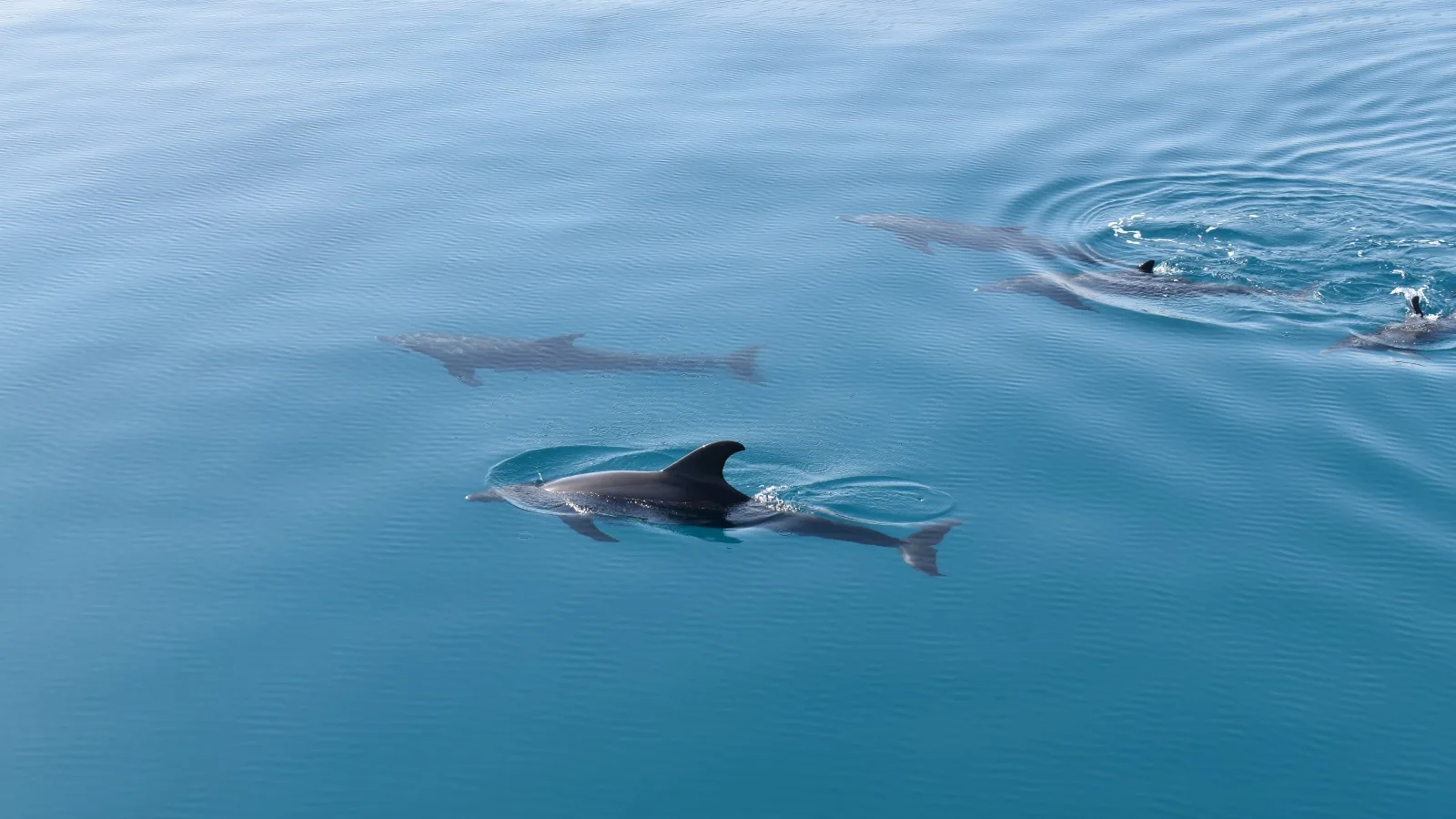
Some days the lagoon is empty and you snorkel a beautiful reef. Other days a pod of wild spinner dolphins drifts past beneath you, unhurried, and the whole boat goes silent. That is the honest reality of Dolphin House — the popular name for Shaab El Erg, a big horseshoe reef about 25 kilometres off Hurghada. It is one of the most reliable places on the Egyptian Red Sea to encounter wild dolphins while snorkeling, and it is also a lovely reef in its own right. This guide is the straight version: what the day is like, what the swim with dolphins Hurghada trip really involves, what divers can do, and how to do it without harming the very animals you came to see.
What Dolphin House (Shaab El Erg) actually is
"Dolphin House" is a nickname, not a place on the chart. The reef is Shaab El Erg — from the Arabic shaab (reef) and erg (a dune-like coral pinnacle). It's a large, curved, horseshoe-shaped reef system in the northern Hurghada area, sitting roughly between Hurghada and El Gouna and about 25 kilometres offshore.
The shape is the whole point. The horseshoe wraps around a shallow, sandy-bottomed lagoon — calm, sheltered and scattered with small coral pinnacles. That protected lagoon is where a resident pod of wild spinner dolphins comes to rest during daylight hours, and it's why generations of Hurghada boats have called this spot Dolphin House.
One quick clarification, because it confuses a lot of visitors: there is another reef far to the south near Marsa Alam — Sataya — that is also marketed as "Dolphin House." They are completely different sites, hundreds of kilometres apart. This guide is about Shaab El Erg near Hurghada, the one you can reach on a day trip from the Hurghada and El Gouna hotels.
The wild spinner dolphins
The stars here are spinner dolphins (Stenella longirostris), named for the spinning leaps they make clear of the water. A resident pod uses the sheltered Shaab El Erg lagoon as a daytime resting area: spinners feed offshore at night and return to calm, shallow water during the day to rest and socialise. That predictable daily rhythm is exactly what makes the lagoon such a dependable place to find them. Indo-Pacific bottlenose dolphins are also seen in the wider area, but the resting pod at Shaab El Erg is spinners.
It's worth being clear about what "resident" does and doesn't mean. These are wild, free-ranging animals — nobody feeds them, nobody keeps them, and they leave whenever they choose. Sightings are common, especially early in the day, but they are never guaranteed. Some days the pod is right there in the lagoon; some days they're out at sea and you'll have a fine snorkel and no dolphins. Honest operators will tell you this before you board, and good guides judge the dolphins' mood — a resting or nursing pod is left in peace, not pursued.
If you want to understand the animal before you meet it, our spinner dolphin species profile covers their behaviour, biology and why the resting-lagoon habit matters.
Getting there from Hurghada
Shaab El Erg lies about 25 kilometres off the coast in the Hurghada–El Gouna stretch. On a standard day boat the crossing is roughly 60 to 90 minutes each way; the whole excursion, including hotel transfers, is typically a full day of around 7 to 8 hours, leaving in the morning and back in the late afternoon. Trips from El Gouna are a little quicker because the reef is closer to that end of the coast.
As with any Red Sea day trip, the boat shapes the experience. A large group day-boat is the social, affordable option and builds in a couple of snorkel stops. A smaller or private speedboat gets you out to the lagoon faster and quieter — a real advantage for dolphin-watching, because fewer engines and less noise means a calmer pod and a better chance they'll stick around. Families who don't want a long crossing often prefer the speedboat option.
If you'd rather have the whole day organised — transfers, the right boat, gear and a guide who knows the lagoon and reads the dolphins responsibly — our team books Hurghada dolphin and snorkeling trips to Shaab El Erg.
What a day at Dolphin House looks like
A typical Dolphin House day has three parts: the dolphin lagoon, the reef snorkeling, and time relaxing on the boat.
The dolphin lagoon
The skipper approaches the lagoon slowly and quietly and looks for the pod. If dolphins are present and settled, the guide briefs everyone and snorkelers enter the water gently, a few at a time, to watch from a distance and let the dolphins decide whether to come closer. If the pod is resting, nursing or simply not in the mood, a good crew keeps its distance and you enjoy them from the boat instead. Either way the rule is the same: the dolphins are never chased or surrounded.
The snorkeling stops
The day also includes one or two snorkel stops on the coral parts of Shaab El Erg, away from the lagoon. The crew hands out masks, snorkels, fins and life jackets, gives a short safety briefing, and you drift over hard and soft coral with the usual Red Sea reef fish. These stops are the reliable highlight — they happen whether or not the dolphins show.
Lunch and downtime on board
Full-day boats usually serve a buffet lunch with soft drinks, with downtime between stops to sun yourself on deck and warm up. It's an easy, unhurried day — most of it spent in or beside flat, clear, warm water.
The snorkeling and the reef
Even on a no-dolphin day, the snorkeling at Shaab El Erg is genuinely good. The lagoon and the inner reef are shallow and sheltered, which makes them ideal for families, beginners and nervous swimmers — calm water, plenty to see, and nothing intimidating.
Reef fish: shoals of anthias and sergeant majors, butterflyfish, bannerfish, angelfish, parrotfish and wrasse over the coral, with the occasional lionfish hanging under a coral head. Green turtles turn up around the reef too.
Coral: hard coral gardens and soft corals across the reef tops and pinnacles, in good condition thanks to the area's protected status.
A note on expectations: the lagoon and inner reef are a shallow, gentle experience — small reef life and, if you're lucky, dolphins. The big stuff (sharks, the occasional manta, schooling pelagics) belongs to the deeper outer reef and is the diver's domain, not the snorkeler's. If you're weighing up snorkeling versus learning to dive, our guide on snorkeling vs scuba diving in the Red Sea is a useful read before you book.
For divers — diving Shaab El Erg
Shaab El Erg isn't just a snorkel site; it's a recreational dive site too, and a popular one out of Hurghada and El Gouna. Divers don't dive the dolphin lagoon (it's shallow and the dolphins are left undisturbed) — they dive the outer reef, which is far more varied underwater.
The reef offers easy-to-moderate diving suitable for most certification levels, with sandy lagoons, coral pinnacles (ergs) and walls dropping into the blue. Typical encounters include:
- Coral gardens and ergs — hard and soft coral pinnacles rising from the sand, good for relaxed reef dives and swim-throughs.
- Reef life — dense reef fish, blue-spotted rays on the sand, moray eels and green turtles.
- The walls and the blue — the outer reef drops away steeply, where divers sometimes see passing pelagics; Manta Point on the reef can deliver manta ray sightings, most often in the cooler months. As ever in the Red Sea, big-animal encounters are luck, not a promise.
These dives are run as a regular boat-diving day rather than as part of the dolphin-watching excursion. Conditions are usually calm with good visibility and modest depths, which makes Shaab El Erg a relaxed option early in a trip or an easy day between bigger dives. For the wider picture, see our best dive sites in Hurghada for 2026, and if you want to get in the water with us, our Hurghada daily diving boats visit the northern reefs regularly. New to it all? The complete guide to scuba diving the Red Sea is the place to start.
Doing it ethically
This matters more here than at almost any other Red Sea site, because the attraction is a wild animal. Done badly, dolphin tourism stresses the pod, disturbs resting and nursing animals, and can push them away for good. Done well, it's low-impact and the dolphins keep coming back. A few principles separate the two:
- Let the dolphins come to you. Never chase, corner, grab or swim hard after them. Stay calm at the surface and let them choose the encounter.
- No touching, no feeding. Touching spreads stress and disease; feeding changes wild behaviour. Neither has any place here.
- Keep numbers and noise down. Fewer boats and engines, quiet approaches, small groups in the water at a time — this is why a smaller boat is often the kinder choice.
- Respect resting and nursing pods. If the dolphins are clearly settling or have calves, the responsible move is to admire them from the boat and leave them be.
- Choose the right operator. Pick one that follows the HEPCA (Hurghada Environmental Protection and Conservation Association) code of conduct for the lagoon and is honest that sightings aren't guaranteed. Walk away from anyone promising a guaranteed swim or feeding the animals.
None of this lowers the magic — it raises it. The encounters that stay with people are the unhurried ones where a wild dolphin chose to come close. That only keeps happening if every boat treats the lagoon with respect.
What to pack and when to go
Dolphin House is an easy trip to prepare for, but a few things make the day better:
- Reef-safe sunscreen. A full day on open water and a reflective sea burns skin fast; reef-safe formulas protect both you and the coral.
- Swimwear under your clothes so you're ready to slip in quietly when the pod appears, plus a towel — boats provide gear but not always towels.
- Your own mask if you have one. Rental masks fit most faces, but a personal mask guarantees a good seal — handy when you want to watch dolphins without a leaking mask.
- A light layer or rash vest. You'll be in and out of the water repeatedly; even in warm months a thin layer keeps you comfortable on the crossing.
- A little cash for extras and any marine or park fee, and a waterproof case if you want photos (from a respectful distance — never crowd the animals for a shot).
Best time to go: the Red Sea is a year-round destination, and the resident pod uses the lagoon all year. Early-morning departures give the best dolphin odds, because the pod is more likely to be resting in the calm lagoon after a night of feeding. Calm, early conditions also mean a smoother crossing and clearer water. For seasonal water-temperature and visibility detail, see our guide on the best time to dive the Red Sea.
Common mistakes
- Treating dolphins as guaranteed. They're wild. Book the trip for the whole experience — reef, lagoon, boat day — and a dolphin encounter becomes a bonus, not a make-or-break.
- Confusing it with Sataya. The southern "Dolphin House" near Marsa Alam is a different reef entirely. For a Hurghada day trip you want Shaab El Erg.
- Booking the cheapest, most crowded boat. Packed, noisy boats are worse for dolphin-watching and worse for the dolphins. A smaller, quieter boat usually means a better encounter and a kinder one.
- Chasing for a photo. Swimming hard after the pod or crowding them ends the encounter and stresses the animals. Stay calm and let them decide.
- Expecting a dive in the lagoon. The dolphin lagoon is for gentle snorkeling. If you want to dive, book the outer reef of Shaab El Erg as a separate boat-dive day.
How to plan and book
Dolphin House works for almost everyone: families with children, couples, non-divers hoping to see wild dolphins, and divers who want one easy, beautiful reef day in the mix. The water is calm and shallow, the day is unhurried, and — with the right operator — the encounter is something you'll remember long after the tan fades. It pairs naturally with a few days of diving the Hurghada reefs, or a beach-and-snorkel day at Orange Bay on Giftun Island.
Aquarius Hurghada arranges Dolphin House snorkeling trips and Shaab El Erg dives from our Hurghada base — the right boat for your group, gear, a guide who reads the dolphins responsibly, and transfers. If you're combining a dolphin day with diving or a course, we can build the whole week around it. Plan and book your Hurghada trip and tell us who's coming, and we'll match the day to your group.