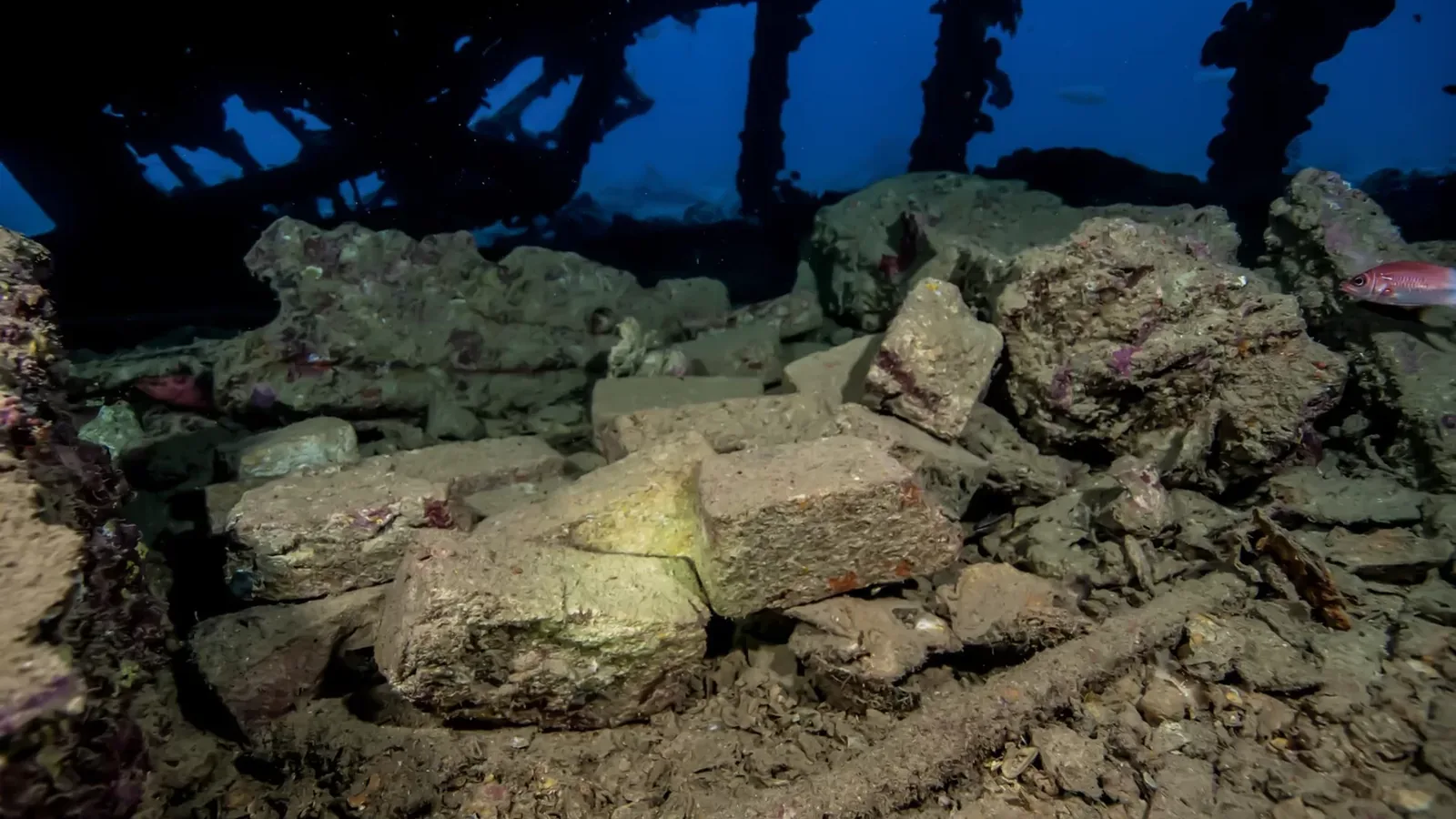
Roll off the boat, drop down the reef wall, and a ship's hull looms out of the blue the wrong way up — keel to the surface, rudder and propeller hanging over the sand, coral spilling from every plate. This is the Dunraven, a Victorian steamer that has lain upside down against the reef off Sharm el-Sheikh for close to 150 years. She is one of the oldest wrecks divers can visit in the Red Sea, and one of the most atmospheric: smaller, shallower and far less crowded than the celebrated Thistlegorm, but with a ghostly, coral-draped hull, easy swim-throughs and interiors thick with silver glassfish. This guide covers the ship's story, what the dive is really like, who it suits and how to plan it.
The story of the SS Dunraven
The Dunraven was a product of her age: a British steam-and-sail cargo vessel built in 1873, in the years when steam power was overtaking sail but ships still carried masts and rigging as a hedge. She traded the long route between Britain and India, carrying steel and timber out to Bombay and returning with a cargo of spices, cotton and cloth — and it was on that homeward leg that her voyage ended.
In 1876, working up the Red Sea toward the Suez Canal, she ran onto Beacon Rock at Sha'ab Mahmoud, the reef complex just south of the headland at Ras Mohammed. She struck, took on water and — by some accounts, caught fire — before she went down, rolling as she sank so that she came to rest inverted on the seabed. It was an ordinary, avoidable Victorian shipping loss — a vessel lost to a reef in the dark — and for a century that is all it was: a story in the record books with no ship to go with it.
The wreck was rediscovered in 1977, reportedly after a documentary team went looking for it, and its identity was confirmed from the ship's fittings. What they found was remarkably intact for a wreck of its age, and it quickly became a fixture of the Sharm el-Sheikh dive scene. Sitting near the same reefs as the great sites of Ras Mohammed National Park, the Dunraven added a genuine piece of nineteenth-century history to a coastline better known for its coral.
What and where the wreck is
The Dunraven lies at Sha'ab Mahmoud, an exposed reef area south of Ras Mohammed reached from Sharm el-Sheikh by boat, usually on a day trip from the marina. Boat times vary with the marina, the itinerary and the sea state, so the crossing is best confirmed with the operator on the day rather than treated as fixed.
The wreck rests upside down against the base of Beacon Rock — the very reef that sank her — with the keel uppermost and the hull sloping down toward the sand. The topmost part of the hull sits at around 18 metres, while the deepest sections and the surrounding seabed lie at roughly 28 to 30 metres. Over the decades she has broken into two main sections spanning around 80 metres of hull, and time has softened the hard edges: the plates are now furred with coral, and the stern, rudder and propeller stand out as the most recognisable "ship" features on an otherwise reef-covered hulk. It sits within the wider Sharm diving area — for the full line-up see the best dive sites in Sharm el-Sheikh and why divers choose Sharm el-Sheikh.
The dive — the upside-down hull
What makes the Dunraven special is that inverted hull. Most wrecks sit upright, deck uppermost; the Dunraven is the reverse, and it changes the whole feel of the dive. Divers typically follow the reef down and approach the wreck from the stern, where the rudder and propeller — the clearest surviving evidence that this was once a ship — rise from the sand.
The swim-throughs
Because the hull is upside down and broken open where the two sections part, the interior is open, light and forgiving rather than a maze. Divers can drift through the hull along its length, moving from the darker interior toward the breaks where daylight pours in. These are genuine swim-throughs, not deep penetration: there is usually a visible way out and ambient light filtering through the plating and the gaps in the hull, which is a large part of why the Dunraven suits divers newer to wrecks. That said, it is still an enclosed overhead in places — a torch is useful, silt on the "ceiling" (the ship's floor, now above you) is easily stirred, and anything beyond the obvious swim-through routes is territory for divers with proper wreck training.
The light and the atmosphere
The best of the Dunraven is atmospheric rather than dramatic. Shafts of sunlight cut through the broken hull and the portholes; silver curtains of glassfish part around your torch beam and close again behind you; the coral-covered ribs of the ship arch overhead. It is a slower, more contemplative wreck dive than the cargo-hunting of the Thistlegorm — a dive you drift through and photograph rather than tick off feature by feature.
What you'll see
Nearly 150 years underwater have turned the Dunraven's hull into a thriving reef, so the marine life is as much the draw as the history. Depending on the season and where you look, expect:
- Glassfish: the signature sight — vast, shimmering shoals of tiny glassfish (sweepers) fill the interior of the hull, dense enough to briefly hide the structure and to swirl in your torchlight.
- Reef predators: where there are glassfish there are hunters. lionfish hang in the shadows of the hull, and moray eels peer out from the plating and the broken sections.
- Groupers and goatfish: resident groupers patrol the wreck, and schools of goatfish work the sand around the hull.
- The coral: soft corals and black corals drape the inverted plates and ribs, with the usual reef fish — anthias, wrasse and butterflyfish — busy over the growth. The wreck is, in effect, an artificial reef with a Victorian skeleton underneath.
For the wider seasonal picture of what appears when, see the marine life encyclopedia and the best time to dive the Red Sea.
Who it suits and conditions
The Dunraven is one of the more approachable wrecks in the Sharm area, but it is still a wreck dive at depth, so honesty about level matters.
Because the wreck sits between roughly 18 and 30 metres and the dive usually involves passing through the hull, the standard recommendation is Advanced Open Water certification — the depth alone puts the deeper parts beyond the Open Water limit. A confident Open Water diver with good buoyancy, a comfortable air consumption and a guide can dive the shallower, swim-through parts of the wreck, staying within their depth limit; the key is buoyancy control, because kicking the silt off the inverted hull turns a bright, easy swim-through into a blackout in seconds. Any deeper penetration beyond the natural, well-lit passages calls for proper wreck training, a torch and backup, and line-handling — the same discipline any overhead environment demands.
Conditions are generally kind: visibility around the wreck is often good, and the swim-throughs shelter you from any current running over the reef. The site sits in an exposed reef area south of Ras Mohammed, though, so the surface conditions and the boat ride depend on the weather, and the trip runs when the sea state allows. Water temperature follows the Red Sea's seasons, from the low 20s °C in winter to the high 20s in summer; the best time to dive the Red Sea guide has the month-by-month detail and wetsuit advice. If your buoyancy isn't quite there yet, that is simply the next step — the PADI pathway from Open Water to Divemaster explains how divers build toward wrecks like this, and what learning to dive really feels like covers those first dives.
Dunraven vs the Thistlegorm
Sharm's two famous wrecks are often mentioned together, but they are almost opposites, and knowing the difference helps you plan.
- The Thistlegorm is a large Second World War cargo ship, sunk in 1941, packed with motorbikes, trucks and munitions. It is a bucket-list "underwater museum" — bigger, busier, a longer boat ride, and often crowded. Full details are in the Thistlegorm wreck guide.
- The Dunraven is older, smaller, shallower and quieter — a Victorian steamer with no cargo to explore, prized instead for its atmospheric upside-down hull, its glassfish and its coral. It is an easier dive and you will often share it with far fewer people.
Many divers do not choose between them at all: a few days of diving out of Sharm can take in both, along with the reefs of Ras Mohammed and the Straits of Tiran. The Dunraven makes an ideal counterpoint to the Thistlegorm — the intimate, photogenic wreck to set against the famous, feature-packed one.
When to go
The Dunraven dives all year, and the season mostly changes the surface, not the wreck:
- June to September (summer): the warmest water and the calmest, most reliable surface conditions for the crossing to Sha'ab Mahmoud — the easiest time to be sure the trip runs.
- October to May (cooler months): often excellent visibility and a quieter site, at the cost of cooler water and a thicker wetsuit. On calm days out of season the wreck can feel like it is yours alone.
- Weather-dependent: because the site is exposed, the deciding factor is the sea state rather than the calendar. A good operator will read the forecast and plan the day — and switch to a sheltered alternative if the crossing isn't sensible.
Diving the wreck responsibly
The Dunraven is not a war grave — she was a merchant steamer lost in 1876 — but she is both a historic wreck and a living reef, and both deserve care:
- Take nothing. The wreck and its fittings are protected history; removing anything, living or dead, is off-limits and spoils the site for everyone who follows.
- Mind your buoyancy and the silt. Inside the inverted hull the silt sits on surfaces above you; one careless fin-kick can drop visibility to nothing. Move slowly, stay off the structure, and keep good trim.
- Stay within your training. The natural, well-lit swim-throughs are fine with a guide; venturing beyond them into true penetration needs wreck certification, redundant light and line skills. When in doubt, stay in the light.
- Protect the reef. The hull is now coral — don't touch, hold or drag gear across it. The Dunraven is in the condition it is because divers have treated it well.
Practical tips
- Bring a torch even though the wreck is bright — it lights the glassfish, brings out the colour of the soft corals in the shadows, and matters if you follow the hull into the darker sections.
- Plan your gas and depth. The deeper parts sit near 30 metres, so watch your no-decompression time; nitrox, where offered and if you are qualified, extends your bottom time on a dive like this.
- Approach from the stern. Starting at the recognisable rudder and propeller and working forward through the hull makes the wreck easiest to "read".
- Photographers, slow down. The Dunraven rewards patience — position yourself for the light coming through the hull, let the glassfish settle, and avoid stirring silt for the sake of one more frame.
- Pair it with a reef. A typical day combines the wreck with a nearby reef dive, so a mixed-level group can dive comfortably together.
How to plan and book
The Dunraven works best as part of a few days' diving out of Sharm el-Sheikh, where it can be slotted alongside the Thistlegorm, Ras Mohammed and the reefs of Tiran and matched to the day's conditions and your level. Divers newer to wrecks often use it as a gentle, atmospheric introduction before the bigger, busier sites. It pairs naturally with the other great Sharm dive sites.
Aquarius runs guided day boats to the Sha'ab Mahmoud area from its Sharm el-Sheikh base, with guides who know the Dunraven's swim-throughs, the conditions on the reef and how to build the day around your experience. Whether you are here for the history, the glassfish or a quieter alternative to the famous wreck, plan and book your Sharm el-Sheikh diving and the day is built around your level.