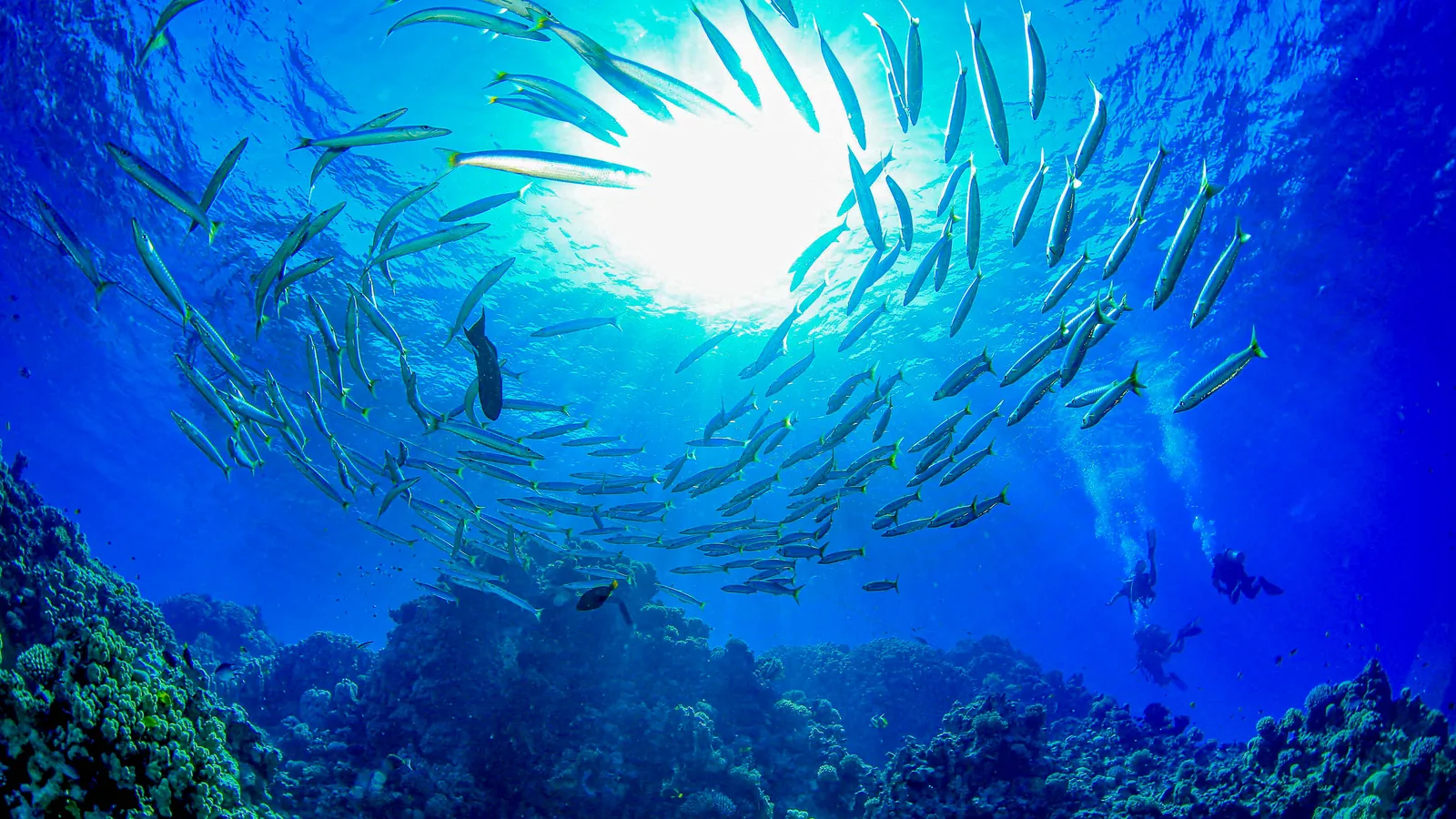
Two coral pinnacles rise from a seabed that falls away into darkness, a river of barracuda coils overhead, and somewhere below your fins a wall drops the better part of a kilometre. This is Ras Mohammed — the headland at the very tip of the Sinai, Egypt's first national park, and a place that appears on almost every list of the world's greatest dives. The star is Shark & Yolanda Reef, but the park is far more than one dive: shallow anemone gardens, a glassfish cave, a scatter of the strangest cargo in the Red Sea, and reefs kept vivid by four decades of protection. This guide covers what the sites are, what the diving is really like, who it suits, and how to plan it.
What Ras Mohammed is
Ras Mohammed — Arabic for "Mohammed's headland" — is the rocky peninsula at the southernmost point of the Sinai, the exact spot where the Gulf of Suez and the deeper Gulf of Aqaba meet the open Red Sea. That meeting of currents pushes nutrient-rich water past the reefs and is the reason the marine life here is so concentrated.
Declared in 1983, Ras Mohammed was Egypt's first national park. It has since grown to protect more than 480 square kilometres of coral reef, mangrove, coast and desert, home to over 200 species of coral and more than a thousand species of fish. Four decades of protection — no fishing, no anchoring, no collecting — are exactly why the reefs remain among the healthiest and busiest in the northern Red Sea.
For diving, the park is essentially a headland ringed by reef. Some sites are vertical walls plunging into the blue; others are shallow plateaus and coral gardens. It sits at the heart of the wider Sharm el-Sheikh diving area, alongside the Straits of Tiran and the local reefs — for the full picture see the best dive sites in Sharm el-Sheikh and why divers choose Sharm el-Sheikh.
Getting there from Sharm el-Sheikh
Nearly all diving in Ras Mohammed is run out of Sharm el-Sheikh. The most common way in is a day boat from the marina, a crossing of roughly 1.5 to 2 hours that usually delivers two dives inside the park — very often Shark & Yolanda followed by a gentler site. A handful of sites (Jackfish Alley, Eel Garden, the "shark observatory" area) can also be reached overland by 4x4 and dived as shore entries, a quieter alternative on calm days.
Because the marquee sites can carry current and sit over deep water, they are almost always dived with a guide who knows the park's tides and entry points. That local knowledge — reading the current, timing the drift, choosing the day's second site to match the group — is most of what turns Ras Mohammed from intimidating into unforgettable.
Shark & Yolanda Reef — the signature drift
If Ras Mohammed has a single dive that made its name, it is Shark & Yolanda Reef. Two great coral pinnacles — Shark Reef and Yolanda Reef — rise almost to the surface from a sandy seabed far below, joined by a shallow saddle. On the outer face the wall drops away to around 750 metres, so a diver hangs over true open-ocean blue. It is regularly listed among the top ten dive sites in the world, and on a good day it earns it.
Shark Reef and the wall
The dive typically begins at Shark Reef, drifting along a sheer coral wall with the blue on one shoulder and the reef on the other. This is where the schools gather: dense walls of reef fish, batfish, snapper and, in season, coiling towers of barracuda and jacks so thick they dim the light. The name is a nod to the sharks that patrol the drop-off; sightings are never guaranteed, but the deeper blue off the wall is exactly where they pass.
The saddle
Between the two pinnacles lies a shallower saddle, a coral-covered ridge around 10 to 20 metres deep. It is a busy, colourful stretch — a good place to slow down, watch the schooling fish stack up against the current, and let the drift carry you gently toward Yolanda.
Yolanda Reef and the famous cargo
The drift finishes at Yolanda Reef, and here is one of diving's great oddities. The Yolanda was a Cypriot cargo ship that grounded on the reef in 1980 carrying a hold full of bathroom fittings. The ship itself is long gone — it slid off the reef into deep water during a storm in 1987 and lay lost for two decades until it was rediscovered in 2005, far beyond recreational limits at around 145 to 160 metres down. What remains, scattered across the shallow reef between about 12 and 25 metres, is its cargo: rows of toilets, bathtubs, sinks and pipes — and, famously, the rusted hulk of a BMW said to have been the captain's own car — sitting incongruously among the coral, slowly becoming reef themselves. It is strange, photogenic and genuinely unique — and the reason Yolanda Reef is on so many divers' lists.
Anemone City
A short way from Shark & Yolanda lies Anemone City, and it is the perfect counterpoint — gentler, shallower and calmer. The plateau is named for the extraordinary carpet of sea anemones that colonise it, each one home to its own family of clownfish (anemonefish) darting in and out of the tentacles. It is a slow, relaxed, endlessly photogenic dive.
Because it is shallow and sheltered, Anemone City is often used as the second dive of the day and as a check dive for divers finding their feet in the park — a place to sort out buoyancy and trim before, or after, the bigger drift next door. Turtles, Napoleon wrasse and reef fish are regulars here too. New to your buoyancy? The skills that make a site like this effortless are exactly what the PADI Open Water course builds — and if you're curious what those first dives actually feel like, see what learning to dive really feels like.
The other sites in the park
Shark & Yolanda gets the headlines, but Ras Mohammed rewards divers who explore its other reefs — several of which are calmer and just as beautiful.
- Jackfish Alley — a shore or boat dive, often a gentle drift, named for the white sandy "alley" between the coastal reef and a parallel satellite reef that jacks and other predators patrol. It starts near a shallow cave and cut at around 5 metres, full of shimmering glassfish, then opens onto a sandy, coral-studded plateau where stingrays and morays hunt — one of the park's most photographed stretches.
- Shark Observatory (also called Ras Mohammed Wall) — a dramatic sheer wall beneath a roughly 60-metre rocky cliff topped by the old shark-watching balcony, its cracks and overhangs packed with hard and soft coral. The wall diving is superb; the historic surface shark-watching is much quieter than it once was.
- Ras Za'atar — a steep, coral-draped wall dropping into the blue, hung with dense soft corals and some of the largest gorgonian sea-fans in the Red Sea, usually a relaxed drift.
- Ras Ghozlani — one of the park's most pristine, protected reefs: an easy, shallow wall of prolific hard and soft coral, best dived in the morning when the light falls straight onto the reef.
- Eel Garden — a sandy slope from about 6 metres (with a small cave) where a colony of garden eels sways in the current, with reef and wall alongside.
A typical two-dive day pairs one of the big drifts with one of these gentler reefs, so a group of mixed experience can dive the park comfortably together.
Marine life
The convergence of currents at the tip of Sinai makes Ras Mohammed one of the richest patches of water in the northern Red Sea. What you might meet, depending on site and season:
- The schools: barracuda, bigeye and giant trevally (jacks), snapper, batfish and unicornfish. In June and July the reef hosts one of the Red Sea's great spectacles — a spawning aggregation of bohar snapper, normally solitary fish that gather here in their thousands to breed, joined by courting bigeye trevally (the males turning from silver to black) and swirling towers of barracuda.
- Sharks: grey reef and whitetip reef sharks patrol the drop-offs; in the warmer months, oceanic whitetips can appear in the blue, and hammerheads are an offshore possibility. All sightings are luck, not a promise.
- Reef residents: Napoleon wrasse, giant moray eels, green turtles, spotted eagle rays, blue-spotted stingrays and clouds of anthias over the coral.
- The coral: hard-coral gardens on the plateaus and dense soft corals and gorgonians on the walls, in exceptional condition thanks to the park's protection.
For the wider seasonal picture of what appears when, see the marine life encyclopedia and the complete guide to scuba diving the Red Sea.
Conditions and who it suits
Ras Mohammed covers the full range from easy to demanding, so the honest answer to "can I dive it?" is: it depends which site.
Shark & Yolanda Reef is the demanding end. It is dived as a drift, it can carry moderate to strong current, and it sits over very deep water, so the margin for a buoyancy slip is smaller. It is best suited to Advanced Open Water divers, or confident Open Water divers with a good number of dives and solid buoyancy, always with a guide. If your buoyancy isn't there yet, that's not a closed door — it's the next course; the PADI pathway from Open Water to Divemaster explains how divers build toward sites like this.
The gentler sites — Anemone City, Ras Ghozlani, parts of the reef on a calm day — suit newly certified divers and make a relaxed, shallow, colourful dive. Visibility across the park is typically 15 to 30 metres, often clearest in winter. Water temperature runs from the low 20s °C in winter to around 28–29 °C at the height of summer; the best time to dive the Red Sea guide has the month-by-month detail and wetsuit advice.
When to go
Ras Mohammed dives all year, but the character changes with the season:
- June to September (summer): the warmest water and the biggest schools. Early summer brings the famous bohar snapper spawning aggregation (June–July) and towers of barracuda and jacks at Shark & Yolanda, with sharks drawn in to hunt them. Busier, and the surface can be hot.
- October to February (winter): cooler water, often the best visibility, and a calmer, quieter park. A thicker wetsuit is worth it, but the wall diving and clarity are superb.
- Currents: these vary with the daily tides year-round, which is exactly what feeds the schools. A good guide plans the drift around them.
Diving the park responsibly
Ras Mohammed's reefs are as good as they are because the park is protected, and keeping them that way is on every diver:
- Pay the park fee. A national-park entry fee applies (usually built into the dive-day price) and funds the protection that keeps the reef alive.
- Perfect your buoyancy and stay off the reef. No touching, no standing, no dragging gear — one careless fin can undo decades of coral growth.
- No gloves, no collecting, no fishing. Glove use is discouraged inside the park precisely to remove the temptation to hold on; taking anything, living or dead, is prohibited.
- Follow the marine-park rules. Boats use mooring buoys rather than anchoring, and guides brief the current-and-drift plan — listen and stay with the group.
None of this takes anything away from the dive. A protected Ras Mohammed is the whole reason it still ranks with the best places on Earth to get in the water.
More than a dive site
Ras Mohammed is a national park on land as well as underwater, and the headland is worth a look above the surface too. At the tip of the peninsula it protects a rare mangrove forest — salt-tolerant trees that filter seawater and shelter young fish and migratory birds — reached by 4x4 along the park road. Nearby are the Magic Lake, a saltwater lagoon whose colours shift through the day, an earthquake fissure known as the Crack, and fossil-coral cliffs that were themselves living reef millions of years ago. Non-diving partners can join a snorkel-and-park day and still see the best of the place, and for divers the mangroves and Magic Lake make a memorable stop on the surface interval between dives.
How to plan and book
Ras Mohammed works best as part of a few days' diving out of Sharm el-Sheikh, so the sites can be matched to your level and the conditions on the day — the big drift when it's right for you, the gentle reefs when it isn't. Divers building toward Shark & Yolanda often use the trip to sharpen buoyancy on the calmer sites first. It pairs naturally with the other great Sharm dive sites and the reefs of the Straits of Tiran.
Aquarius runs guided day boats into the national park from its Sharm el-Sheikh base — Shark & Yolanda, Anemone City and the quieter park reefs, with guides who know the currents, all equipment, and the park fees arranged for you. Whether you're an experienced diver here for the wall or a newer diver easing into the park, plan and book your Sharm el-Sheikh diving and the day is built around your level.
Frequently asked questions
Where is Ras Mohammed National Park?
Ras Mohammed is at the southern tip of the Sinai Peninsula in Egypt, where the Gulf of Suez meets the Gulf of Aqaba. It is reached almost entirely from Sharm el-Sheikh, roughly a 20-minute drive or a 1.5 to 2-hour boat trip from the marina. Declared in 1983, it was Egypt's first national park and today protects over 480 square kilometres of reef, coast and desert.
What are the main dive sites in Ras Mohammed?
The most famous is Shark & Yolanda Reef, usually rated among the top ten dive sites in the world and dived as a drift from Shark Reef along to Yolanda Reef and its scattered cargo. Other renowned sites include Anemone City, Jackfish Alley, Shark Observatory, Ras Za'atar, Ras Ghozlani and Eel Garden.
Do you need to be an experienced diver to dive Ras Mohammed?
For the signature Shark & Yolanda drift, yes — it can carry current and sits over deep water, so Advanced Open Water certification and comfortable buoyancy are recommended. Several park sites, such as Anemone City and parts of the reef, are gentler and suit newly certified divers when conditions are calm. The right site is matched to your level on the day.
Can you still see the Yolanda wreck?
Not the ship itself. The Yolanda, a Cypriot cargo vessel, grounded on the reef in 1980 and slid off into deep water during a storm in 1987; it now lies far below recreational limits at around 145 to 160 metres. What divers see today is its famous spilled cargo — toilets, bathtubs and bathroom fittings — strewn across the shallow reef, which is how Yolanda Reef got its nickname.
When is the best time to dive Ras Mohammed?
Ras Mohammed is a year-round site. June to September brings the biggest schools of barracuda, jacks and snapper, warmer water and the best chance of sharks around the schools. October to February offers cooler water, often better visibility and a calmer, quieter park. Currents vary with the tides all year, which is part of what makes Shark & Yolanda so alive.
Is there a fee to dive Ras Mohammed?
Yes. Ras Mohammed is a protected national park, so a park entry fee applies and is usually added to the dive-day price. The fee funds the park's protection, which is a large part of why the reefs are in such good condition. Fishing, glove use, touching and anchoring on the reef are not allowed inside the park.