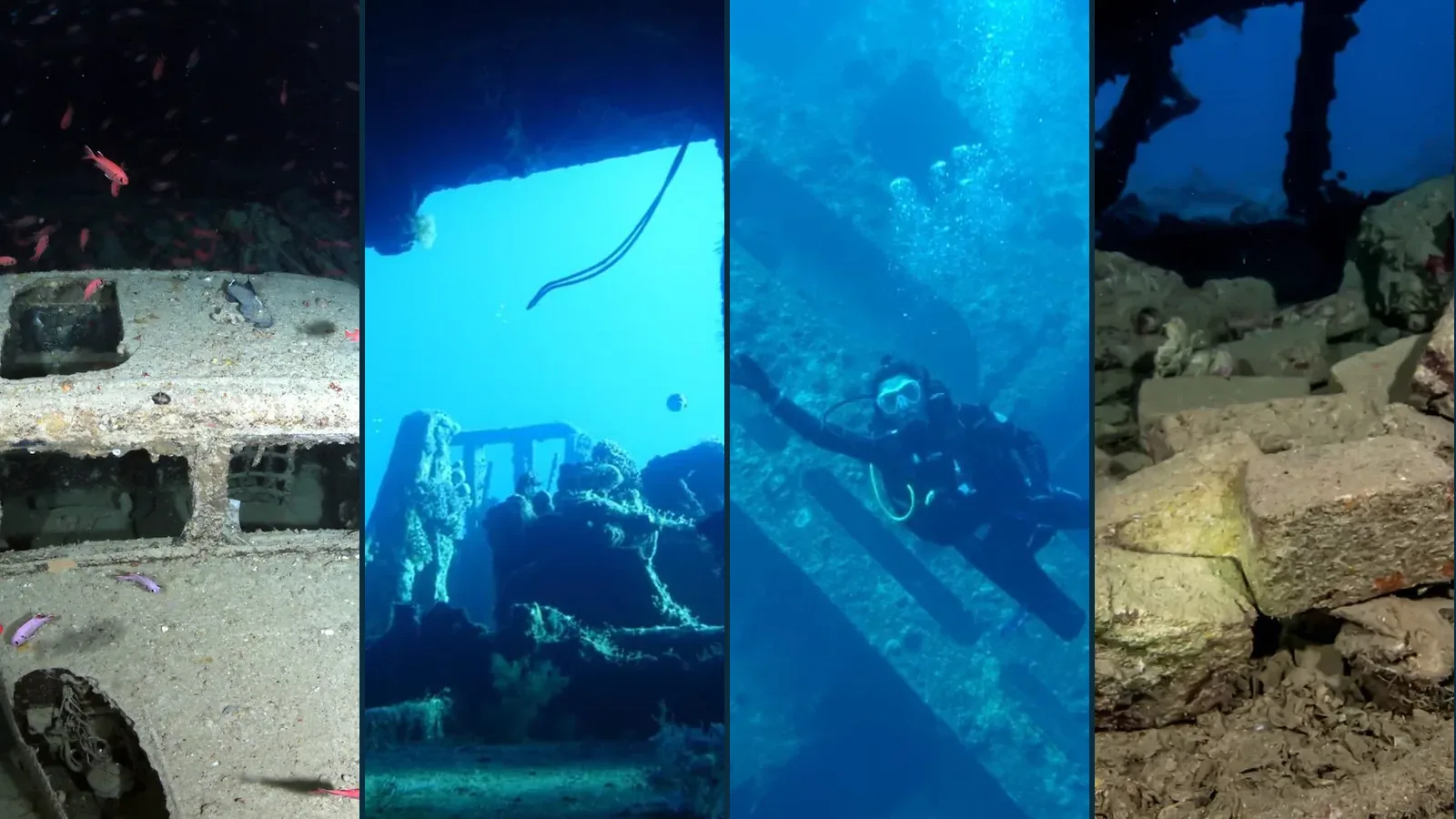
Egypt's northern Red Sea holds one of the densest concentrations of divable shipwrecks on the planet. The Gulf of Suez funnels shipping between the Suez Canal and the open Red Sea, and its approaches are studded with reefs that lie just below the surface — the Strait of Gubal, Abu Nuhas, Shag Rock and the four reefs of the Strait of Tiran. For more than 150 years ships have run onto them, been bombed beside them or slipped off their edges. This atlas compares every major wreck within reach of Hurghada, Safaga and Sharm el-Sheikh in one table, then gives each its own short profile: where it lies, how deep, what level it suits, what there is to see and the history behind it. It finishes with practical planning — choosing wrecks by certification, penetration safety, currents, season, nitrox, etiquette and a suggested itinerary from each base.
Every wreck at a glance
Depths below are the usual published range for the diveable part of each wreck, from the shallowest structure to the seabed or the deepest point most divers visit. Figures vary between sources by a few metres, so treat them as a planning guide rather than a survey.
| Wreck | Sank | Depth | Level | Usually dived from |
|---|---|---|---|---|
| SS Thistlegorm | 1941 | ~16–32 m | Advanced | Sharm (day trip), Hurghada (long day trip), liveaboard |
| Rosalie Möller | 1941 | ~32–50 m | Deep specialty / technical | Liveaboard, some Hurghada day boats |
| Giannis D | 1983 | ~4–27 m | Open Water (guided) to Advanced | Hurghada, liveaboard |
| Carnatic | 1869 | ~18–27 m | Advanced | Hurghada, liveaboard |
| Chrisoula K ("tile wreck") | 1981 | ~4–28 m | Advanced | Hurghada, liveaboard |
| Kimon M ("lentil wreck") | 1978 | ~5–32 m | Advanced | Hurghada, liveaboard |
| Kingston | 1881 | ~5–17 m | Open Water | Liveaboard, Hurghada or Sharm day boats |
| Ulysses | 1887 | ~5–28 m | Open Water (shallow) to Advanced | Liveaboard, Hurghada or Sharm day boats |
| El Mina | 1970 | ~25–32 m | Advanced | Hurghada (20 min) |
| Salem Express | 1991 | ~7–32 m | Advanced | Safaga (and Hurghada by road) |
| Dunraven | 1876 | ~18–30 m | Advanced | Sharm |
| Yolanda (cargo field) | 1980 (grounded) | ~12–25 m | Advanced (current) | Sharm |
| Kormoran | 1984 | ~10–15 m | Open Water (calm days) | Sharm |
| Million Hope | 1996 | ~6–24 m | Open Water to Advanced | Sharm (weather permitting) |
| Numidia | 1901 | ~8–80 m | Advanced to technical | Liveaboard only |
| Aida | 1957 | ~25–60 m+ | Advanced to technical | Liveaboard only |
Two famous Tiran hulls are deliberately missing from the dive list. The Loullia sits high and dry on top of Gordon Reef and the Lara is largely a skeleton on Jackson Reef — both are landmarks seen from the boat rather than wreck dives, and they are covered with the Tiran wrecks below.
Why the northern Red Sea has so many wrecks
Geography explains almost everything. Ships heading south from the Suez Canal run the length of the narrow Gulf of Suez and then thread the Strait of Gubal, where a scatter of islands and fringing reefs — Shadwan, Gubal, Abu Nuhas, Shag Rock — sits close to the shipping lane. Before modern navigation aids, a little drift at night was enough to put a ship on coral that rises almost to the surface from deep water. The same pattern repeats at the mouth of the Gulf of Aqaba, where four reefs crowd the Strait of Tiran.
The Second World War added a second layer. In 1941 the Gulf of Suez was a holding area for Allied supply ships waiting to enter the canal, and German bombers flying from Crete attacked them at anchor. Add a century of storms, a few navigational errors and at least one suspected insurance loss, and the result is an underwater museum spanning the age of sail-and-steam, the Second World War and the late twentieth century — almost all of it within recreational depth and coated in coral.
SS Thistlegorm

Where: Sha'ab Ali, at the southern end of the Gulf of Suez. Reached on a long day trip from Sharm el-Sheikh (around three hours each way), a very early long day trip from Hurghada, or a northern wreck liveaboard. Depth: roughly 16 m at the highest structure to about 32 m on the sand. Level: Advanced Open Water; wreck training for the holds.
The Thistlegorm is the wreck that made the Red Sea famous among wreck divers. Built in Sunderland and launched in 1940, the 126-metre British cargo ship was carrying supplies for the British Eighth Army in North Africa when she anchored to wait for passage north. In the early hours of 6 October 1941, two bombs dropped by a German Heinkel He 111 bomber struck her number four hold, where ammunition was stowed; the explosion tore the stern section apart and she sank almost immediately. Nine men — four merchant seamen and five naval gunners — were killed. Jacques Cousteau located the wreck in the 1950s, but recreational diving only took off in the 1990s.
What makes her extraordinary is the cargo, much of it still in place: Bedford trucks, BSA and Norton motorcycles, rifles, Wellington boots, aircraft parts and ammunition stacked in the holds. Two steam locomotives carried as deck cargo were thrown onto the seabed on either side of the hull by the blast. Outside, the guns still mounted on the stern are a classic photograph.
Good to know: currents can be strong and visibility varies with plankton; most boats plan two dives, one exploring the exterior and one the holds. The full profile, hold by hold, is in the Thistlegorm wreck dive guide.
Rosalie Möller
Where: the old anchorage near Gubal Island at the entrance to the Gulf of Suez. Usually dived from northern liveaboards; some Hurghada boats run it for qualified divers. Depth: the deck sits at roughly 32–40 m and the seabed and propeller at about 50 m. Level: Deep specialty for the upper structure; the full wreck is technical-diving territory.
The Rosalie Möller is the Thistlegorm's less famous sister in misfortune. Built in Glasgow and completed in 1910 as the Francis, a 108-metre steamship of about 3,960 gross tons, she later passed to the Möller line and took her final name. In October 1941 she was carrying a cargo of coal and was waiting at anchor in the Gulf of Suez. On 8 October, two days after the Thistlegorm was lost, the German bombers returned and a bomb struck her number three hold; she sank where she lay, and two crew members were killed.
She sits upright and largely intact, which makes her one of the most atmospheric wrecks in Egypt: masts and rigging dense with glassfish, big groupers and schooling fish, and a sense of scale that only comes with deep water. The trade-off is depth and current — every minute on the deck uses up no-decompression time quickly.
Good to know: this is not a wreck to treat as a stretch goal. Divers without deep training and recent deep experience should leave it for later; technical divers often plan staged decompression here. The technical diving guide explains what that involves.
The Abu Nuhas wrecks
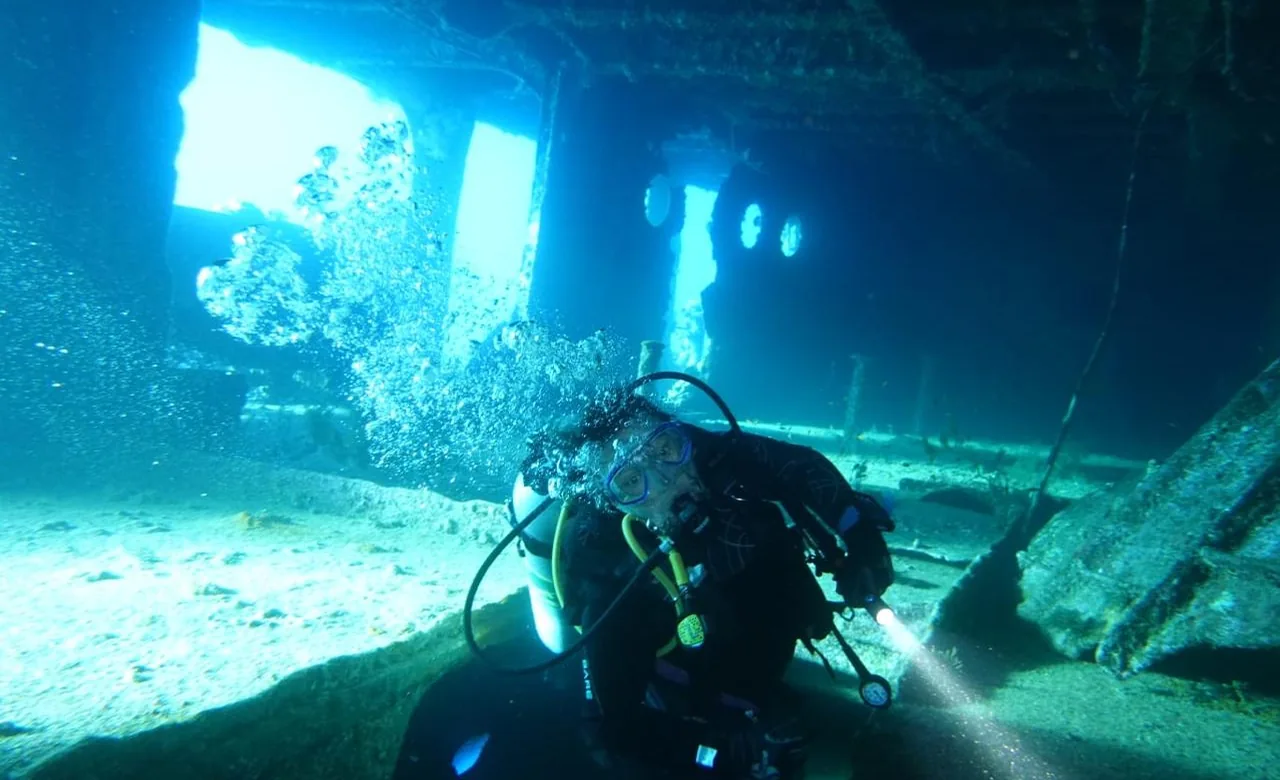
Where: Sha'ab Abu Nuhas, a reef on the north side of the Strait of Gubal, northwest of Shadwan Island. About two to two and a half hours by boat from Hurghada, or on a northern liveaboard. Depth: roughly 4–32 m across four wrecks. Level: Advanced Open Water recommended; the shallow sections suit guided Open Water divers.
Abu Nuhas lies right beside the shipping lane, and its northern face has collected at least seven wrecks — four of them classic recreational dives lined up along the reef. The usual day trip covers two.
- Giannis D (1983) — a roughly 100-metre Greek cargo ship carrying sawn timber that ran onto the reef in April 1983; everyone was rescued. She lies on her port side with the stern and engine room largely intact, the masts rising to within a few metres of the surface. The tilted engine room, with daylight filtering in, is one of the Red Sea's most photographed interiors.
- Carnatic (1869) — a P&O steamer that struck the reef on 12 September 1869 bound for Bombay with passengers, mail, copper plates and gold. She stayed afloat for about 34 hours before breaking up; around 30 people died (P&O's official return gives 30; some accounts say 31). Her wooden decking has long gone, leaving iron ribs draped in soft coral, and the reef's name is commonly linked to her copper cargo.
- Chrisoula K, the "tile wreck" (1981) — a cargo ship that hit the reef in August 1981 with a hold full of Italian floor tiles, still stacked neatly inside. Some wreck researchers believe this hull is actually her near-identical sister, the Marcus, with the Chrisoula K herself lying deeper nearby.
- Kimon M, the "lentil wreck" (1978) — a German-built freighter that ran aground in December 1978 carrying lentils from Turkey to India. She lies on her starboard side and reaches about 32 m, the deepest of the four.
Good to know: the wrecks face the prevailing wind, so trips are weather-dependent and the surface can be rough. Wreck-by-wreck detail and dive plans are in the Abu Nuhas wrecks guide.
Kingston (Shag Rock)
Where: the southern side of Shag Rock, a small reef near the entrance to the Strait of Gubal. Dived on northern liveaboards and some long day trips from Hurghada or Sharm. Depth: about 5–17 m. Level: Open Water, with care in current.
For decades divers called this wreck the "Sarah H", a name with no ship behind it. In 1996 British wreck researcher Peter Collings identified her as the Kingston, an iron steamship built in Sunderland in 1871 and roughly 80 metres long. She was carrying coal to Aden (sources disagree on whether she sailed from London or Cardiff) when she struck Shag Rock in February 1881, shortly after leaving the Suez Canal; attempts to save her failed and she sank within days.
Today she lies on a bed of hard coral, broken but recognisable: the boilers, the propeller and the rudder are clear landmarks, and the open ironwork is thick with soft corals, glassfish and lionfish. Because she is shallow, there is plenty of light and long bottom time.
Good to know: shallow does not mean sheltered — currents across Shag Rock can be strong, and the site is exposed in a north wind.
Ulysses (Gubal)
Where: the northern reef of Gubal Saghir (Small Gubal Island) in the Strait of Gubal. Usually dived on northern liveaboards or long day trips. Depth: roughly 5 m at the bow to about 28 m at the stern. Level: Open Water for the upper wreck; Advanced for the stern.
The Ulysses was a British iron cargo steamer that ran onto the reef of Small Gubal Island in August 1887 on a voyage from London to Penang with general cargo; dive accounts describe lengths of cable still visible on and around her deck. She lies on her side down the slope of the reef, broken in places but with the boiler, sections of hull, winches and the propeller shaft all easy to recognise.
This is a compact wreck that can be seen in a single relaxed dive. The upper sections are bright and shallow; the stern, at the deep end, can be entered carefully by trained divers. Glassfish, lionfish, scorpionfish and crocodilefish shelter in the structure.
Good to know: published lengths vary widely between dive references (from about 70 to 95 metres), although the builder's record lists 312 feet (about 95 m) — a reminder of how thin the documentary record is for many nineteenth-century wrecks.
El Mina (Hurghada)

Where: just outside Hurghada's harbour, about 20 minutes by boat. Depth: about 25 m at the bow to 32 m at the stern. Level: Advanced Open Water.
El Mina (also spelled El Minya) is a Soviet-built T-43-class minesweeper, around 58–60 metres long, that served in the Egyptian Navy. She was sunk at her anchorage off Hurghada by an air attack during the War of Attrition; most sources date the loss to February 1970, though some give 1969. Casualty figures are not well documented. She lies on her port side, largely intact, with a blast hole on the starboard side, the guns, the bridge and the twin propellers all recognisable.
Good to know: El Mina is one of the easiest deep wrecks to reach in Egypt and a natural first wreck for newly qualified Advanced divers. Visibility is usually lower than on the offshore reefs because of the harbour, and old ammunition still lies around the wreck — look, never touch. The El Mina wreck guide has the full profile.
Salem Express (Safaga)
Where: Hyndman Reef, off Safaga, about 60 km south of Hurghada. Dived from Safaga; Hurghada-based divers usually travel by road to a Safaga boat. Depth: the uppermost side of the hull lies at roughly 7–12 m and the seabed at about 32 m. Level: Advanced Open Water. Penetration is not appropriate.
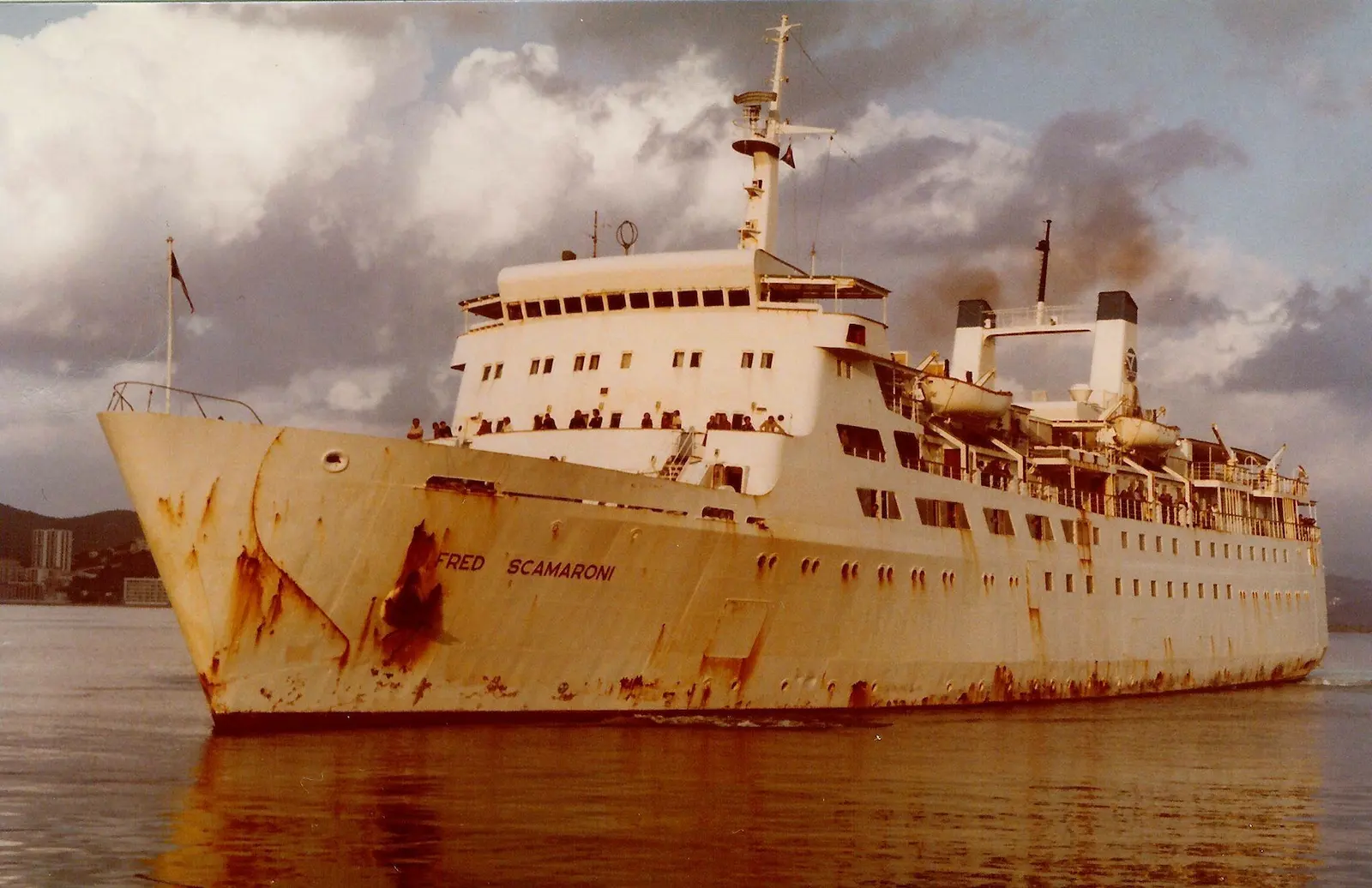
The Salem Express is the most sensitive wreck in this atlas. Built in France and entering service in the mid-1960s as the Fred Scamaroni, the 115-metre passenger and car ferry was later sold, renamed and operated on the Jeddah–Safaga route. Shortly after 11 pm on 14 December 1991, returning from Jeddah crowded with pilgrims coming home from the Hajj, she struck Hyndman Reef close to Safaga and sank within about 20 minutes. The official death toll is usually given as 464 to 470, but because the ship was heavily overcrowded and the manifest is disputed, many accounts believe the true number was far higher. Around 180 people survived.
She lies on her side on a sandy seabed, the upturned flank of the hull forming the shallowest part of the dive. Empty lifeboat davits hang from the hull, a lifeboat rests on the seabed nearby, and personal belongings remain inside. After the recovery work, access points to the lower decks were sealed and the wreck is regarded as a grave.
Good to know: many divers choose not to dive the Salem Express at all, and many operators do not take divers inside. Those who do dive her should keep to the outside of the hull, touch nothing and treat the dive as a memorial. The Salem Express guide covers the history and the ethics in full.
Dunraven
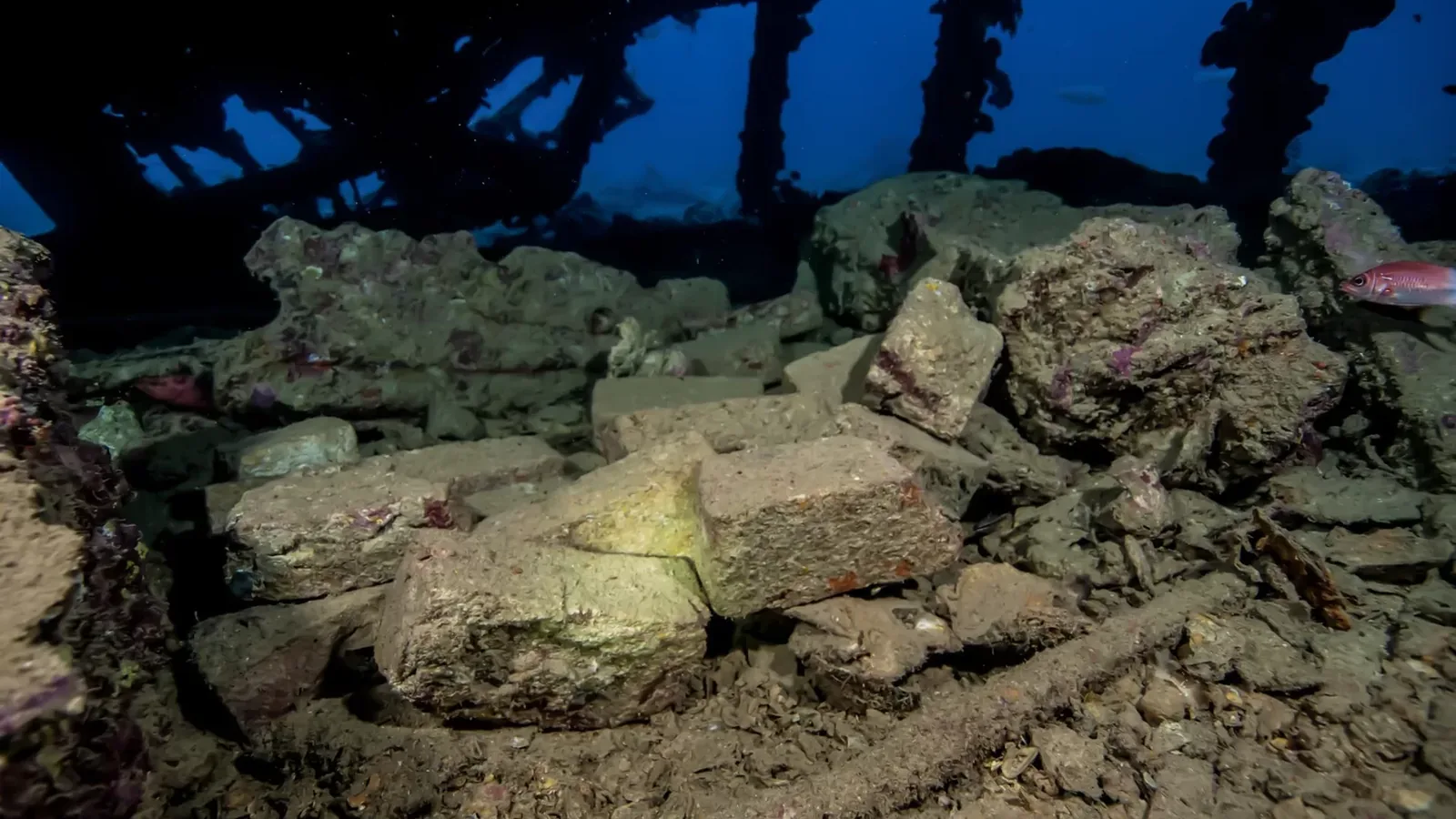
Where: Beacon Rock at Sha'ab Mahmoud, south of Ras Mohammed. Dived by boat from Sharm el-Sheikh. Depth: roughly 18–30 m. Level: Advanced Open Water, or a confident Open Water diver with a guide on the shallower parts.
The SS Dunraven was a British steam-and-sail cargo ship launched at Newcastle in December 1872. Heading home from India in April 1876 with a cargo of spices, cotton and cloth, she struck Beacon Rock, flooded and capsized; the crew survived. She was forgotten for a century until divers relocated her in 1977, and her identity was confirmed by a piece of porcelain bearing her name.
She lies upside down along the base of the reef in two main sections. The underside of the hull forms a series of easy swim-throughs where light streams in through gaps in the plating, and the inverted interior is filled with glassfish, lionfish and morays. The stern, propeller and rudder are the highlights outside.
Good to know: the Dunraven is far quieter than the Thistlegorm and a natural partner for it on a Sharm wreck day. See the Dunraven wreck guide.
Yolanda (Ras Mohammed)
Where: Yolanda Reef, part of the Shark and Yolanda dive at Ras Mohammed National Park, by boat from Sharm el-Sheikh. Depth: the cargo field lies at roughly 12–25 m; the ship herself is far deeper. Level: Advanced Open Water, because of the drift and current.
The Yolanda was a Cypriot-registered cargo ship built in 1964. On 1 April 1980 she ran onto the reef at Ras Mohammed carrying a cargo of bathroom fittings, and she stayed balanced on the reef edge for years. In a storm in 1987 the hull slid off into deep water; it was located in 2005 at roughly 145–160 metres, far beyond recreational or ordinary technical range.
What remains for divers is the cargo, spread across the reef: toilets, bathtubs, sinks and pipes now overgrown with coral, along with the remains of a car often said to have belonged to the captain. It is a surreal, much-photographed sight in the middle of one of the world's most celebrated reef dives.
Good to know: Yolanda is normally dived as part of a drift from Shark Reef; currents can be strong. The Ras Mohammed National Park guide explains the full dive.
The Tiran wrecks: Lara, Loullia, Kormoran
The Strait of Tiran, 45–60 minutes by boat from Sharm el-Sheikh, is closed off by four reefs — Gordon, Thomas, Woodhouse and Jackson — and three of its wrecks are part of the scenery on any Tiran day.
- Loullia (Gordon Reef) — a Panamanian-flagged freighter that ran aground on Gordon Reef on 29 September 1981 while sailing in ballast from Aqaba. She was abandoned days later and still sits on top of the reef, slowly collapsing. She is a landmark, not a dive, though old barrels from her lie on the reef below.
- Lara (Jackson Reef) — a Cypriot cargo ship that grounded on the northern tip of Jackson Reef in the first half of the 1980s (sources give dates from 1981 to 1985). Most of her was salvaged, leaving a rusting skeleton above the waterline and debris in the shallows. The Jackson Reef guide covers the diving around her.
- Kormoran (Laguna Reef) — the only one of the three dived as a wreck. Built in 1963 and sailing under the name Zingara when she was lost, she ran onto Laguna Reef, just northeast of Jackson, in August 1984 with a cargo of phosphate from Aqaba. Divers kept the original name because the raised letters of "Kormoran" survived on the bow. She lies broken in shallow water, roughly 10–15 m, covered in table corals and surgeonfish.
Good to know: the Kormoran is exposed and can only be dived in calm conditions; the Tiran reefs are best known for drift diving and current.
Million Hope
Where: off the Nabq coast, north of Sharm el-Sheikh. Visited on selected day trips from Sharm when the sea allows. Depth: the main deck lies at about 6 m and the seabed at roughly 22–24 m. Level: Open Water to Advanced.
The Million Hope is one of the largest wrecks in Egyptian waters: a bulk carrier of about 175 metres that ran aground on 20 June 1996, the day after leaving Aqaba with a cargo of potash and phosphate. All 25 crew were rescued. She settled upright in fairly shallow water, so her hull, holds and propeller all lie within easy recreational reach.
Her size is the attraction — huge holds, cranes and a vast propeller — together with schools of batfish, barracuda and jacks. Because she lies on an exposed stretch of coast, trips depend on calm weather.
Good to know: the shallow depth makes the Million Hope a good wreck for newer divers, but surge and swell near the surface can be strong.
The far south: Numidia and Aida
The Brothers Islands (El Akhawein) lie far offshore in the central Red Sea and are reached only by liveaboard after an overnight crossing. They are better known for sharks and walls than wrecks, but Big Brother carries two famous hulls, both falling down the island's steep wall into very deep water.
- Numidia (1901) — a British cargo steamer of the Anchor Line, launched in Glasgow in February 1901, that ran onto the north of Big Brother in July 1901 (sources give the 19th or 20th) on a voyage to Calcutta with a general cargo that, by most dive accounts, included railway wheels. The crew survived. Her broken bow lies in shallow water at around 8–10 m and the hull falls down the wall to the stern at roughly 80 m.
- Aida (1957) — an Egyptian supply vessel that was carrying supplies and staff to the island's lighthouse and garrison when she was driven onto the reef in rough weather in 1957 (a few sources say 1947). Her crew were taken off safely. The wreck lies on the wall from about 25–30 m at the bow to 60 m and beyond.
Both wrecks are spectacular — overgrown with soft corals, sea fans and black corals, and patrolled by big fish — but they combine depth with strong currents. Recreational divers see the upper sections; the deeper parts are strictly technical.
Choosing wrecks by certification level
The single most useful planning question is: which wrecks fit the certification and experience you actually have?
- Open Water (to 18 m): the Kingston, the upper Ulysses, the shallow sections of the Giannis D and Chrisoula K, the Kormoran on a calm day and the upper Million Hope — always with a guide. The Yolanda cargo field is shallow enough but usually involves a drift.
- Advanced Open Water (to 30 m): the realistic minimum for the classics — Thistlegorm, El Mina, Carnatic, Kimon M, Dunraven and the outside of the Salem Express. The PADI pathway guide explains how the levels fit together.
- Deep specialty (to 40 m): needed for the upper Rosalie Möller and the shallower parts of the Brothers wrecks.
- Technical: the full Rosalie Möller, the lower Numidia and Aida, and any dive below 40 m or with planned decompression. See the technical diving guide.
Certification is only half the picture. A diver who has not been underwater for a year, or who has never dived in current, will enjoy even an "easy" wreck more after a refresher or a check dive on a reef first.
Penetration safety and rules
Going inside a wreck — penetration — changes the dive completely. Inside, there is no direct route to the surface, light fades fast, and a careless fin kick can lift silt and rust into a cloud that drops visibility to nothing in seconds.
- Train first: a Wreck Diver course teaches buoyancy control, finning techniques that do not stir silt, and the use of a guideline. Without it, stay outside or in areas where daylight and an exit are always in view.
- Follow a guide: experienced local guides know which swim-throughs are open and safe, and which areas have collapsed or are too tight.
- Lines and light: any true penetration beyond the light zone calls for a continuous guideline to the exit and a primary and backup torch.
- Gas: turn early. A common rule for overhead environments is the rule of thirds: one third of the gas for the way in, one third for the way out and one third held in reserve.
- Sharp edges: torn metal and old cables can snag hoses and cut skin; keep equipment streamlined.
- Respect the graves: never enter the Salem Express, and remember that the Thistlegorm, the Rosalie Möller and the Carnatic also cost lives.
Currents, conditions and best season
The northern wrecks sit in some of the most exposed water in Egypt. The Strait of Gubal and the Gulf of Suez funnel the prevailing northerly wind, so Abu Nuhas, Shag Rock, Gubal and the Thistlegorm can be rough on the surface even when the coast is calm, and trips are often rescheduled when the wind is up. Currents on the Thistlegorm, the Rosalie Möller and the Tiran reefs can be strong, which is why a descent line, a surface marker buoy and a confident ascent are part of every plan.
Wreck diving is possible all year. Water is warmest in late summer and autumn, at roughly 27–29 °C, and coolest in February and March, at about 21–22 °C. Many divers find late spring through autumn gives the most reliable surface conditions for the offshore wrecks, while winter can bring excellent visibility but more wind days. Visibility on the wrecks themselves varies with plankton and silt, and harbour-side wrecks such as El Mina are usually murkier than the offshore reefs. The best time to dive the Red Sea guide breaks the year down month by month.
Why nitrox pays off on wrecks
Most of the classic wrecks have their best parts between 25 and 32 m — exactly the range where breathing air gives only a short no-decompression limit. Nitrox, air with a higher oxygen fraction, reduces nitrogen absorption and noticeably extends that limit. On a wreck such as the Thistlegorm, that can mean several extra minutes in the holds and a more relaxed second dive.
The trade-off is depth. Every nitrox mix has a maximum operating depth: with 32 percent oxygen, for example, it is about 33 metres at the usual working limit — fine for the Thistlegorm or El Mina, unsuitable for the deeper Rosalie Möller or the Brothers wrecks. A Nitrox course is short, and on a wreck trip it is one of the most useful extras a diver can carry.
Wreck etiquette and the law
Egypt's wrecks are a shared heritage, and they are fragile. Decades of souvenir hunting have already stripped many of them: portholes, bells, plates and even parts of the Thistlegorm's motorcycles have disappeared. Removing anything from a wreck is prohibited in Egyptian waters, and wrecks at Ras Mohammed and Tiran also lie inside protected areas where nothing may be taken or damaged.
- Take nothing: not a shell casing, not a bottle, not a tile. Leave artefacts where they are for the next diver.
- Touch nothing: corals on wrecks are as delicate as on reefs, and rusted structure can be unstable.
- Watch your bubbles: exhaled air trapped in enclosed spaces speeds up corrosion; do not linger in air pockets.
- Moor, do not anchor: boats should use fixed moorings where they exist; dropping anchor onto a wreck damages it.
- Remember the people: where lives were lost, behave as at any memorial.
Suggested wreck itineraries by base
The right wrecks depend on where the trip is based. A sensible order builds depth and difficulty gradually.
- From Hurghada: start with El Mina, 20 minutes from the harbour, as a first wreck. Once comfortable, add an Abu Nuhas day (typically the Giannis D and the Carnatic). Experienced divers can add a Thistlegorm day trip or a road transfer to Safaga for the Salem Express. Gubal, Shag Rock and the Rosalie Möller are most often combined on a northern wreck liveaboard. Hurghada's wreck options are listed with the other Hurghada dive sites.
- From Sharm el-Sheikh: begin with the Yolanda cargo field on a Ras Mohammed day and the Kormoran on a calm Tiran day, then the Dunraven, and finally the classic full-day Thistlegorm trip. The Million Hope is an occasional extra when the weather allows.
- On a liveaboard: a northern wreck itinerary can string together Abu Nuhas, Shag Rock, Gubal, the Rosalie Möller and the Thistlegorm (sometimes including a night dive), while southern routes reach the Brothers and the Numidia and Aida.
For a broader introduction to the region, see the complete guide to scuba diving the Red Sea, and for a definition of any term used here, the diving glossary, including wreck dive and drift dive.
Plan your Red Sea wreck days
Aquarius Diving Club is a PADI 5-Star centre with bases in Hurghada and Sharm el-Sheikh, running El Mina, Abu Nuhas, Ras Mohammed, Tiran and full-day Thistlegorm trips, plus Advanced and specialty courses for divers who want to go further.
Plan your wreck dives →Related: Go deeper on individual wrecks with the Thistlegorm guide, the Abu Nuhas wrecks guide and the Dunraven guide.
Frequently asked questions
What is the best wreck dive in the Red Sea?
The SS Thistlegorm is usually ranked the best and most famous wreck dive in the Red Sea, and often among the best in the world. The British cargo ship was bombed on 6 October 1941 and still holds trucks, motorcycles, rifles and other wartime cargo between about 16 and 32 metres. Other favourites include the Abu Nuhas wrecks, the Dunraven and, for deep divers, the Rosalie Möller.
Can Open Water divers dive Red Sea wrecks?
Yes, but the choice is narrower. Open Water divers are certified to about 18 metres, which suits the Kingston at Shag Rock, the upper parts of the Ulysses, the shallow sections of the Giannis D and Chrisoula K at Abu Nuhas, the Kormoran at Tiran and the upper decks of the Million Hope, always with a guide. The classic deeper wrecks such as the Thistlegorm, El Mina and the Dunraven call for Advanced Open Water.
How deep is the Thistlegorm?
The Thistlegorm lies on a sandy seabed at about 30 to 32 metres, with the highest parts of the wreck at roughly 16 metres. Most of the cargo holds are explored between about 25 and 30 metres, which is why Advanced Open Water is the usual minimum and nitrox is popular for extra bottom time.
Which Red Sea wrecks can be dived from Hurghada?
From Hurghada the El Mina minesweeper is only about 20 minutes from the harbour, and the four Abu Nuhas wrecks are a day trip of around two to two and a half hours each way. Long day trips also reach the Thistlegorm, and Hurghada divers can travel by road to Safaga for the Salem Express. The Rosalie Möller, Kingston and Ulysses are most often visited on northern wreck liveaboards.
Is it respectful to dive the Salem Express?
The Salem Express is a grave: the ferry sank off Safaga in December 1991 with an official death toll usually given as 464 to 470, and many believe the true toll was higher. Some divers choose not to dive it at all. Those who do should stay outside the hull, touch and take nothing, and treat the dive as a visit to a memorial. Access to its lower decks was sealed after the recovery.
Do I need a wreck course to go inside a wreck?
Going inside a wreck beyond the reach of daylight requires wreck penetration training, a guideline and proper lights. Without training, divers should stay outside or in open swim-throughs where an exit is always visible, and follow a guide who knows the wreck. A Wreck Diver specialty teaches buoyancy, silt-free finning and line use.
When is the best time of year for Red Sea wreck diving?
Wreck diving is possible all year. Water is warmest in late summer and autumn at roughly 27 to 29 degrees Celsius and coolest in February and March at about 21 to 22 degrees. Many divers find late spring to autumn gives the most reliable surface conditions for the exposed northern wrecks, while winter can bring good visibility but more days lost to wind.
Can I take a souvenir from a wreck?
No. Removing anything from a wreck is prohibited in Egyptian waters, and wrecks at Ras Mohammed and Tiran also lie inside protected areas. Decades of souvenir hunting have already stripped portholes, bells and cargo from many wrecks, so divers should take only photographs and leave every artefact where it lies.