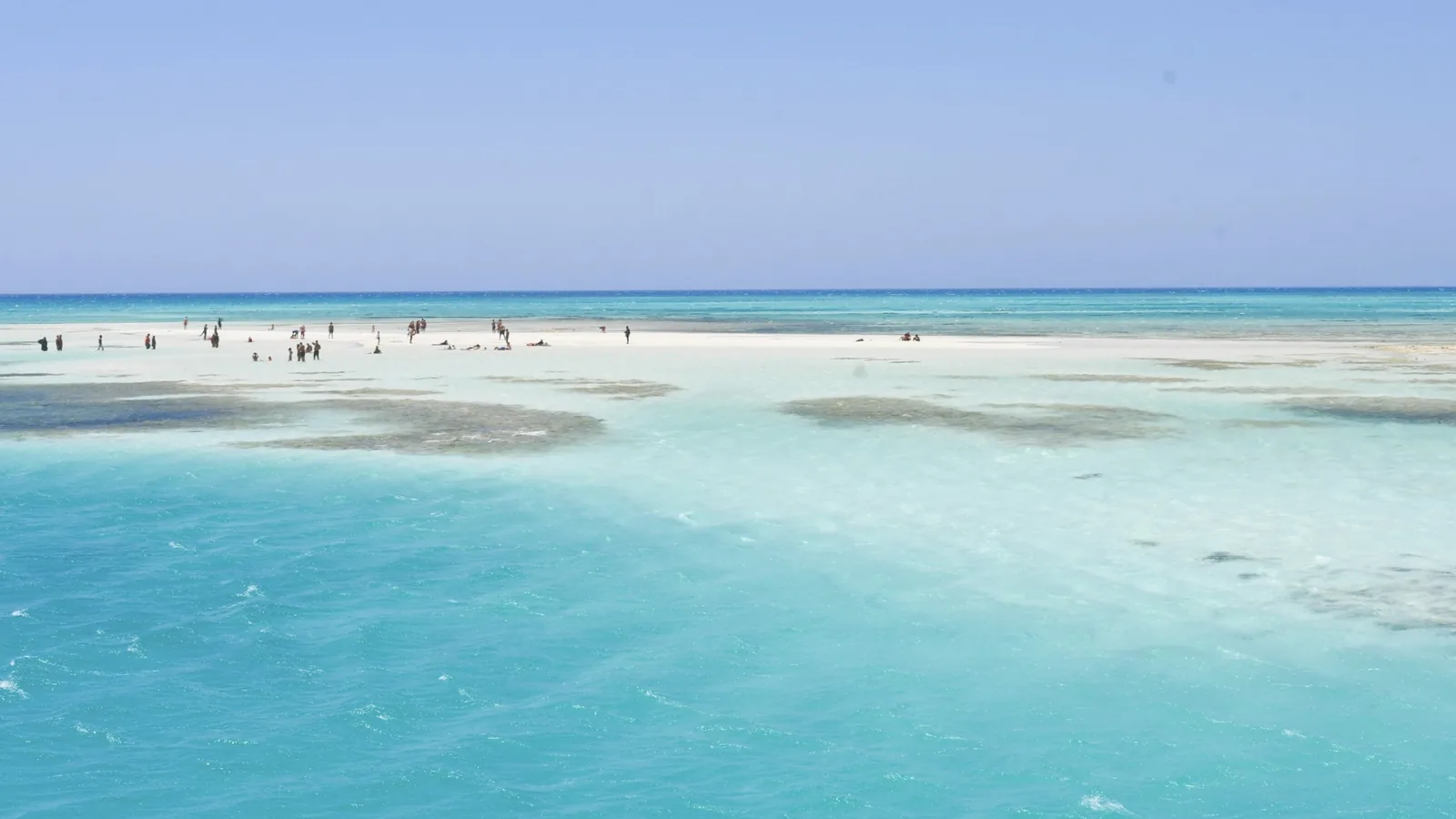
Picture a strip of blinding white sand rising out of open water, ringed by shallows the colour of a swimming pool, with nothing on it at all — no palms, no jetty, no buildings. A few hours later the sea has swallowed it whole. That is White Island, the sandbank off Sharm el-Sheikh that divers and day-trippers have nicknamed the 'invisible island' and the 'Egyptian Maldives'. It is one of the most photographed spots in the southern Sinai, and one of the strangest: a piece of land that only exists at low tide. This guide is the practical version — what it actually is, how the boat trip from Sharm works, why the tides run the whole day, what there really is to see in the water, and how to visit a protected place without harming it.
What is White Island, Sharm el-Sheikh?
White Island is not an island in the usual sense. It is a low sandbank — a bank of fine, mineral-rich white sand — lying in shallow water near the southern tip of the Sinai Peninsula, out by Ras Mohammed National Park. It sits in the stretch of sea where the Gulf of Suez and the deeper Gulf of Aqaba come together with the open Red Sea, off the very corner of Egypt.
Because it is only sand and shallows, there is nothing built on it and nothing growing on it: no trees, no shade, no shop, no jetty, no toilet. That bareness is the whole appeal. At its fullest the bank is a clean, dazzling white ribbon in the middle of turquoise water, and the total absence of anything man-made is exactly what makes visitors reach for the phrase 'the Egyptian Maldives'. The powdery pale sand and the vivid, shallow blue around it do carry a genuine Maldivian look.
It also belongs to a properly protected place. White Island lies within the Ras Mohammed National Park area — Egypt's first national park, declared in 1983, protecting around 480 square kilometres of reef, coast and desert. That protection is part of why the surrounding water is so clear and the nearby reefs so healthy, and it is why a small nature-reserve fee (roughly €5, usually built into the trip price) applies to visit. For the full underwater story of the park itself, the guide to diving Ras Mohammed National Park is the companion read to this one.
The tides — the 'invisible island'
The single most important thing to understand about White Island is that it comes and goes with the tide. The sandbank is so low and flat that it is exposed at low tide — a broad, walkable strip of white sand — and then covered by the sea at high tide, sometimes disappearing beneath the surface altogether. That is the honest reason for the nickname the 'invisible island': turn up at the wrong point in the tide cycle and there is simply no island to stand on.
This is why the whole trip revolves around the tide tables rather than a fixed clock time. A reputable operator checks the day's tides and plans the departure so that you reach the bank while it is well exposed and the water around it is calm. It is also why two trips on the same route can leave at quite different hours from one day to the next: the sea, not the schedule, decides when White Island is worth seeing. When you book, it is entirely reasonable to ask how the day is timed around low tide.
The White Island boat trip from Sharm el-Sheikh
White Island can be reached only by boat, and almost every trip leaves from Sharm el-Sheikh marina. On a speedboat the crossing is roughly 30 to 45 minutes; on a larger yacht or a standard day boat it takes noticeably longer. Exact times shift with the boat, the sea state and where you set out from, so treat those figures as a guide and confirm the day's plan when you book.
As with any Red Sea trip, the boat shapes the day. A larger day boat is the social, comfortable option, with deck space, shade and usually lunch on board, and it tends to combine White Island with a fuller Ras Mohammed programme. A smaller speedboat gets you out to the sandbank faster and is nimble around the shallow water near the bank — useful when the tide window is short. Because there is no shelter at all on White Island itself, the boat is your base for the day: your shade, your toilet, your lunch and your changing room all stay on board.
What a day at White Island looks like
A typical White Island outing is a full-day boat trip that treats the sandbank as one highlight among several, rather than the only stop. Most days have three broad parts: the sandbank itself, snorkelling or diving on the nearby reefs, and relaxed time on the boat.
The sandbank stop
The stop on White Island is usually short — often around twenty minutes — because the appeal is the setting rather than a long beach afternoon. Boats anchor off the bank in the shallows and you wade or swim ashore onto the exposed sand. It is a place to stand in the middle of the sea on a ribbon of white sand, take photographs, paddle in the warm shallows and simply enjoy the surreal setting. Remember there is no shade and no facilities out here, so a hat, sunscreen and water matter even for a brief visit.
Snorkelling and reef stops
The rest of the day is where the marine life comes in. Trips pair White Island with one or more snorkelling — or, for certified divers, diving — stops on the surrounding Ras Mohammed reefs. The crew hands out masks, snorkels, fins and life jackets, gives a short safety briefing, and you drift over shallow coral watching the reef fish. These reef stops, not the bare sandbank, are the part of the day with the colour and the fish.
Lunch and downtime on board
Full-day boats generally serve lunch with soft drinks and leave plenty of downtime between stops to dry off on deck, warm up and enjoy the crossing. It is an easy, unhurried day, most of it spent in or beside flat, clear, warm water — with one genuinely unusual moment standing on an island that will not be there by evening.
Snorkelling at White Island: what you'll see
It is worth being straight about this, because it is where expectations most often go wrong. White Island itself is sand and clear, shallow water — it is not a coral reef. Standing on the bank and swimming in the immediate shallows is about the light, the colour and the setting; you will not find dense coral gardens or big shoals of fish on the sandbank alone.
The genuinely rich marine life belongs to the surrounding reefs of Ras Mohammed National Park, which is one of the most biodiverse patches of water in the northern Red Sea — home to well over 130 species of coral and more than 1,000 species of fish. On the reef stops that a good White Island trip includes, snorkellers can expect the usual Red Sea cast over the shallow coral:
Reef fish: shoals of anthias and sergeant majors, butterflyfish, angelfish, parrotfish and wrasse over the coral, with the occasional lionfish hanging beneath a coral head. Green turtles are seen around the Ras Mohammed reefs too, if you are lucky.
Coral: hard and soft coral in good condition on the park reefs, thanks to decades of protection.
A note on expectations: the shallow, gentle snorkelling here suits families, beginners and nervous swimmers — calm water, plenty to look at, nothing intimidating. The bigger encounters (sharks, the walls, schooling pelagics) belong to the deeper Ras Mohammed dive sites and are the certified diver's domain. If you are weighing up snorkelling against learning to dive, the guide on snorkelling versus scuba diving in the Red Sea is a useful read first.
White Island and Ras Mohammed: snorkelling vs diving
White Island suits both snorkellers and divers, because it is almost always visited as part of a wider day in the Ras Mohammed area rather than as a standalone destination.
For snorkellers and non-divers — the majority of visitors — the day is the sandbank plus shallow snorkelling on the nearby reefs. It is easy, calm and family-friendly, and no diving experience is needed. The White Island stop is the memorable centrepiece; the reef stops provide the fish.
For certified divers, the real prize of the area is the diving at Ras Mohammed itself — the famous walls and drifts, the schooling fish and the celebrated Shark & Yolanda Reef. Many divers treat a White Island appearance as a beautiful surface-interval or photo stop between dives, rather than the point of the trip. If you dive, it makes sense to build your day around the Ras Mohammed dive sites and enjoy the sandbank as the bonus. The guides to the best dive sites in Sharm el-Sheikh and why divers choose Sharm el-Sheikh lay out what the diving involves. New to it all? The complete guide to scuba diving the Red Sea is the place to start.
In short: come as a snorkeller for the island and the shallows; come as a diver for Ras Mohammed, with White Island as the postcard moment in the middle.
Visiting a protected area
White Island sits inside a protected national park, and its clarity and beauty exist because the area is looked after. Keeping it that way is on every visitor:
- Pay the park fee. The small nature-reserve fee (around €5, usually included in the trip) funds the protection of Ras Mohammed — the same protection that keeps the water clear and the reefs alive.
- Never step on or touch coral. On the reef stops, keep fins and hands well clear of the coral; one careless kick can undo years of growth. Practise floating flat and still over the reef.
- Take everything away with you. There are no bins out here — every scrap of rubbish, from bottle tops to food wrappers, comes back on the boat. Leave the sandbank exactly as blank and white as you found it.
- Don't feed the fish. Feeding changes wild behaviour and damages the reef's balance; enjoy the fish as they are.
- Choose a responsible operator. Pick a boat that respects the park rules, uses moorings rather than anchoring on the reef, and is honest that the sandbank's appearance depends on the tide.
None of this lessens the day — it protects the very thing that makes White Island worth the trip.
Best time to visit White Island (and what to pack)
White Island is an easy trip to prepare for, but because the bank has no shade and no facilities, a little planning goes a long way:
- Sun protection, and plenty of it. A full day on open water plus a treeless white sandbank that reflects the sun burns skin fast — a hat, reef-safe sunscreen, sunglasses and a cover-up all earn their place. Reef-safe formulas protect the coral on the snorkelling stops too.
- Water and a hat. There is nowhere to buy anything on the bank, so bring water and keep hydrated; the boat carries drinks but you are exposed while you're ashore.
- Swimwear under your clothes so you're ready to wade ashore and snorkel, plus a towel — boats provide gear but not always towels.
- Your own mask if you have one. Rental masks fit most faces, but a personal mask guarantees a good seal for the reef snorkelling.
- A waterproof case or camera — the light on White Island is unforgettable and it is one of the most photogenic spots in the southern Sinai. And a little cash for extras or any fee not included.
Best time to go: the single biggest factor is the tide — the sandbank is at its best around low tide, which also tends to bring calmer seas, and that is often around the middle of the day or early afternoon, though it shifts daily with the tide table. The Red Sea is a year-round destination, so the sandbank appears at low tides all year; a good operator simply plans the departure around when low tide falls. For seasonal water-temperature and visibility detail, see the guide on the best time to dive the Red Sea.
Common mistakes
- Ignoring the tide. White Island only appears at low tide. Book through an operator who plans the day around the tide tables — turning up at high tide can mean no island at all.
- Expecting a reef on the sandbank. The bank is sand and shallows; the coral and fish are on the surrounding Ras Mohammed reefs. Choose a trip that includes proper snorkelling stops there.
- Underestimating the sun. There is zero shade on White Island and the white sand and water reflect fiercely. Come prepared or the day gets uncomfortable quickly.
- Treating it as a long beach day. The stop on the bank is usually short by design. Enjoy it for the photos and the strangeness, and let the reef snorkelling and the boat make up the rest of the day.
- Booking a boat that skips the tide talk. If an operator can't tell you how the trip is timed around low tide, that's a red flag for this particular excursion.
How to plan and book
White Island works for almost everyone: families with children, couples after a stand-out photo, non-divers who want an easy day on the water, and divers who fancy one surreal surface moment in the middle of a Ras Mohammed dive day. The water is calm and shallow, the setting is unlike anywhere else on the coast, and — timed properly to the tide — it delivers that one genuinely unusual experience of standing on an island that isn't there most of the day. It pairs naturally with the reefs and walls of Ras Mohammed National Park and the wider Sharm dive sites.
Aquarius Sharm el-Sheikh arranges White Island and Ras Mohammed boat trips from its Sharm base — the right boat for your group, gear, a guide who reads the tides and the reefs, the park fee handled, and transfers. If you're combining a White Island day with diving or a course, we can build the whole trip around it and around the tide window. Plan and book your Sharm el-Sheikh trip and tell us who's coming, and we'll match the day to your group.
Frequently asked questions
Where is White Island in Sharm el-Sheikh?
White Island is a small sandbank near the southern tip of the Sinai Peninsula, in the waters off Ras Mohammed National Park, close to where the Gulf of Suez and the Gulf of Aqaba meet the open Red Sea. It has no land address because it is a bare bank of white sand rather than a fixed island — it can only be reached by boat, most often on a full-day trip from Sharm el-Sheikh marina.
Why is White Island called the invisible island?
Because it appears and disappears with the tide. White Island is a low bank of fine, mineral-rich white sand that is exposed at low tide and covered by the sea at high tide. At its fullest it is a dazzling strip of white sand ringed by turquoise shallows, which is also why it has earned the nickname the 'Egyptian Maldives'; a few hours later it can be gone beneath the water entirely.
How do you get to White Island and how long does it take?
White Island is reached only by boat, almost always from Sharm el-Sheikh marina. On a speedboat the crossing is roughly 30 to 45 minutes, and longer on a larger yacht or day boat. Exact times vary with the boat, the sea state and your departure point, so confirm them when you book. Because the sandbank only surfaces at low tide, operators plan the day around the tide tables.
Is there anything to see when snorkelling at White Island?
The sandbank itself is sand and shallow, clear water — beautiful for photos and wading, but not a coral reef. The rich marine life belongs to the surrounding reefs of Ras Mohammed National Park, which holds well over a hundred species of coral and more than a thousand species of fish. Most trips pair a short stop at White Island with snorkelling or diving at the nearby Ras Mohammed sites, where reef fish and the occasional turtle are common.
Is there a fee to visit White Island?
White Island is visited within the Ras Mohammed National Park area, so a small nature-reserve fee (around five euros) usually applies. It is normally included in the price of an organised trip. The fee funds the protection of the park, which was Egypt's first national park, established in 1983 and covering roughly 480 square kilometres of reef, coast and desert.
When is the best time to visit White Island?
The best time is timed to low tide, when the sandbank is most exposed and the sea is usually calmest — often around the middle of the day or early afternoon, though it depends on the day's tide table. Because the island only appears at low tide, a reputable operator plans departure around the tides rather than a fixed clock time. There is no shade, shop or toilet on the bank, so come prepared whatever the hour.
Is White Island worth visiting?
For most visitors, yes — above all for the scenery. The white sandbank and turquoise shallows are among the most photogenic spots in the southern Sinai, and the easy, shallow snorkelling suits all ages, including non-swimmers and children. Set your expectations on two things: it is a full day with an early start, and because it is a popular trip the sandbank can get busy at peak times. The richest marine life is not at the bare sandbank itself but on the nearby Ras Mohammed reefs, so the day is most rewarding when it pairs White Island with a stop or two on those reefs.