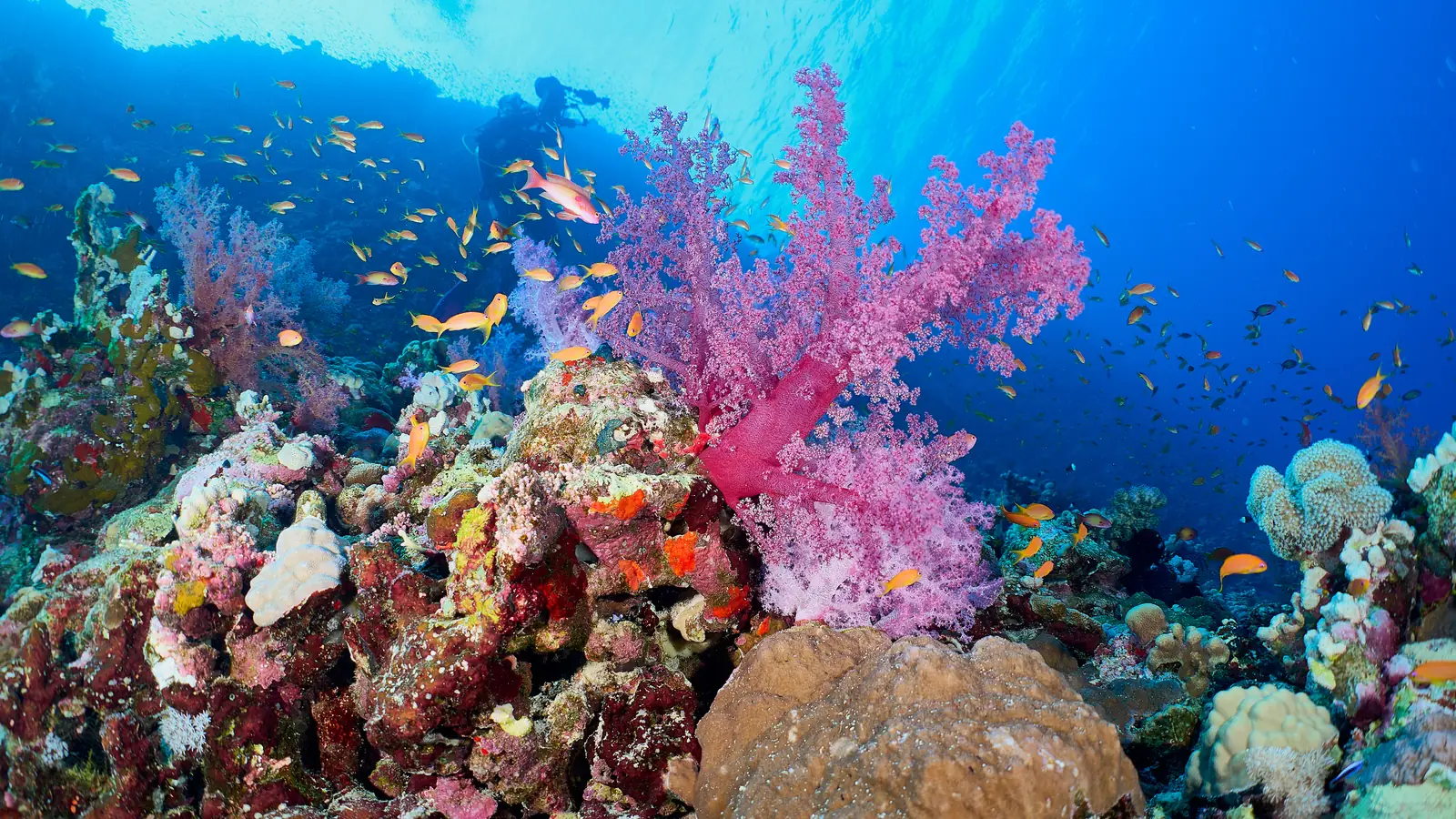
Winter in the Red Sea is the season many divers overlook. The headline summer animals are gone, the air is cooler and the wind blows harder, and yet the reefs are as colourful as ever, the wrecks are quieter, and the water is still warmer than a northern-European summer sea. This guide sets out, month by month, what the Red Sea actually offers from November to February, how cold it really gets, what to wear in and out of the water, and who the season suits best. For the full year, see the month-by-month best-time-to-dive guide; for the opposite end of the calendar, the summer diving guide.
Winter at a glance
The headline numbers for the northern Red Sea (Hurghada, Sharm el-Sheikh, Makadi Bay and Sahl Hasheesh), based on long-run sea-surface and climate averages. Daily readings vary with wind, depth and site:
| Month | Water temp | Daytime air | Visibility | Crowds |
|---|---|---|---|---|
| November | 24–26°C | 24–29°C | 30–40 m | Moderate |
| December | 22–24°C | 19–25°C | 25–35 m | Low early, high over the holidays |
| January | 21–23°C | 12–22°C | 25–35 m | Low |
| February | 21–22°C | 17–23°C | 25–35 m | Low to moderate |
The single most useful idea for planning a winter trip: the cold is mostly a surface problem. Underwater, 21–23°C water is comfortable in the right suit. The chill comes on the boat deck, in the wind, wet, between dives. Plan for that, and winter becomes a calm, uncrowded and very good-value season to dive.
Water temperatures — north vs south
The Red Sea cools gradually through autumn and reaches its lowest temperatures of the year in late winter. In the northern resort areas the pattern looks like this:
- November: about 24–26°C — still warm, with early November closer to the top of that range.
- December: about 22–24°C — the point at which most divers move to a thicker suit.
- January: about 21–23°C — cool, settled water.
- February: about 21–22°C — usually the coolest weeks of the diving year, and the low often lingers into early March.
Location matters by a degree or two. The northern Red Sea, including the Sinai coast around Sharm el-Sheikh and the Hurghada area, tends to run about one to two degrees cooler at the winter low than the far south around Marsa Alam, where February averages sit closer to 22–23°C. Sharm el-Sheikh and Hurghada themselves are very similar to each other in winter.
No thermocline. In summer, a warm surface layer sits on cooler deep water, and divers notice the drop below roughly 25–30 m. In winter the surface cools, the water column mixes, and that layering largely disappears. The practical result is that the temperature on a deep wreck or wall is close to the surface reading, so choose a suit for the deepest and longest dive of the day rather than for the first few minutes.
Air temperature, wind & surface conditions
Daytime air temperatures are pleasant by most standards: roughly 24–29°C in November, 19–25°C in December, 12–22°C in January and 17–23°C in February. Nights are noticeably cooler, with January and February lows on the Hurghada coast often around 11–14°C and a little milder in Sharm el-Sheikh. Days are also shorter: in December the sun sets around 17:00 in Hurghada, so afternoon dives finish in fading light and boats return in the cool of the evening.
Wind is the defining winter variable. The northern Red Sea is dominated by northerly and north-westerly winds for most of the year, and winter brings periodic stronger wind events linked to cold air outbreaks. On those days crossings to exposed sites can be rough, and trips to offshore targets such as the SS Thistlegorm or the more distant reefs are sometimes postponed. Between these events, calm spells of several days are common.
The sensible approach is flexibility. Operators in both Hurghada and Sharm el-Sheikh have a choice of reefs, and on windy days they generally switch to sites in the lee of islands and headlands or to inshore reefs and house reefs. A trip that builds in a spare day for a weather-dependent dive is far more likely to get it.
Visibility in winter
Visibility generally remains good through the cooler months: around 30–40 m is common in November and roughly 25–35 m from December to February on good days. Two factors pull it down from time to time:
- Wind and swell can stir sediment on exposed and shallow sites, especially in the first day or two after a strong blow.
- A natural winter plankton pulse. As the northern Red Sea loses heat in winter, the surface water cools and mixes downward, bringing nutrients up from deeper layers. Oceanographic studies of the northern Red Sea and the Gulf of Aqaba describe phytoplankton increasing after these mixing events, which can soften the blue on some days.
In practice, winter visibility is good enough for wide-angle photography and wreck diving most days, and offshore reefs usually remain clearer than shallow inshore sites.
What wetsuit to bring
Water conducts heat away from the body far faster than air does — the Divers Alert Network puts the figure at roughly 20 to 27 times faster — so even water that feels pleasant at the start of a dive cools a diver steadily over an hour, and more so over three dives in a day. Winter exposure protection is therefore worth getting right. The detailed thickness and fit guidance is in the guide to choosing a wetsuit for the Red Sea; the short version:
| Situation | Typical choice | Why |
|---|---|---|
| November | 3 mm or 5 mm full suit | 24–26°C water; a 3 mm suit suits warm-blooded divers, a 5 mm suits most others |
| December to February | 5 mm full suit | 21–24°C water; the standard winter choice for daily boat diving |
| Divers who feel the cold | 5 mm plus hood or hooded vest, or 7 mm | A hood reduces heat loss from the head and neck; a thicker suit adds insulation |
| Three or more dives a day, or long training sessions | 5–7 mm, or a semi-dry | Cooling accumulates over repeated dives and slow skill practice |
Staying warm on the boat
For many divers the coldest moment of a winter day is not underwater but the twenty minutes after a dive, sitting wet on a moving boat in a northerly breeze. Evaporation from wet skin and neoprene cools the body quickly, and a diver who starts the second dive already chilled will feel it sooner. A few simple habits make a large difference:
- Get out of the wet suit, or at least the top half, during longer surface intervals, then dry off with a towel.
- Put on a windproof layer immediately. A windproof jacket or a hooded changing robe over dry clothes is the single most useful winter item.
- Sit out of the wind. Choose the sheltered side or the cabin on the ride back.
- Drink something warm if it is available, and keep eating and drinking normally; cold weather still dehydrates divers.
- Keep a hat and a dry layer for the return trip, when the air cools as the afternoon ends.
- Watch for the early signs of getting cold — persistent shivering, clumsy hands, or loss of concentration — and sit out a dive rather than pushing on.
Winter marine life
Winter does not empty the reefs. The resident life that makes the Red Sea famous is there all year: dense reef fish, clouds of anthias over soft corals, moray eels, turtles, rays, and the hard and soft coral gardens themselves. Wrecks such as the Thistlegorm and the Salem Express dive well whenever the weather allows. A few seasonal points are worth knowing:
Oceanic whitetip sharks (Carcharhinus longimanus)
The early part of winter overlaps the best-known window for oceanic whitetips at the offshore reefs, generally reported as running from about October to December, with November often the strongest month. These are open-water sharks that approach divers and boats, and the dives are usually reached by liveaboard or on long day trips, with strict guidelines on behaviour around the animals. Sightings are never guaranteed, and offshore access depends on the weather. More in the oceanic whitetip species guide and the Red Sea shark-diving guide.
What is less likely in winter
The main whale shark season is late spring and summer, and the schooling scalloped hammerheads at Jackson Reef are a late-summer event. Both can occasionally turn up in the cooler months, but neither should be the reason for a winter trip. Divers whose priority is these animals are better served by the summer months.
Month by month — November to February
November
The gentlest way into the cooler season. The water is still warm, the air is comfortable rather than hot, and visibility is often among the best of the year. Offshore, November is a strong month for oceanic whitetips. Crowds thin once the autumn holidays end, and the second half of the month is one of the quieter periods before the festive rush. Best for: divers who want comfortable conditions without summer heat, and shark-focused trips offshore. Watch out for: the first stronger wind days of the season.
December
A month of two halves. The first three weeks are quiet, with cooling water and settled reefs. The Christmas and New Year period brings one of the busiest weeks of the year, when boats and hotels fill up. The water is now firmly in 5 mm territory, the days are short, and surface intervals call for a jacket. Best for: quiet early-December trips, and divers who want sunshine and diving over the holidays. Watch out for: festive-week demand and the cool ride home in the late afternoon.
January
After the New Year rush, January is one of the calmest months on the dive sites. The water is cool and even from top to bottom, and popular reefs and wrecks are far less busy than in spring or autumn. Wind is the main constraint: some days offshore trips are postponed and boats work the sheltered reefs instead. Best for: divers who value space on the dive sites, wreck enthusiasts with flexible dates, and budget-minded trips. Watch out for: cold surface intervals; bring proper layers.
February
Usually the coolest water of the year, often with a similar low into early March. Days start to lengthen and air temperatures creep up, but the water lags behind. School half-term holidays in some European countries can bring short busy spells. Best for: experienced divers comfortable in a 5–7 mm suit who want quiet sites. Watch out for: the year's coolest water; divers who feel the cold may prefer November or late March onward.
Crowds, festive weeks & value
Winter has two distinct demand patterns. For most of the season — late November, the first three weeks of December, and January and February — it is one of the quietest and best-value periods of the Red Sea year. Boats carry fewer divers, popular sites are less busy, and accommodation is easier to find at short notice.
The exception is the Christmas and New Year period, roughly from just before Christmas into the first days of January. Demand then is comparable to the busiest weeks of summer, hotels near the dive centres fill early, and rates rise accordingly. Anyone planning a festive-season dive trip should book months in advance; anyone with flexible dates will find the weeks either side of the holidays much quieter.
Who winter diving suits
| Winter is great if you... | Consider another season if you... |
|---|---|
| Want quiet reefs and uncrowded boats | Feel the cold easily and dislike thick wetsuits |
| Prefer warm, sunny days to summer heat on land | Have your heart set on whale sharks or summer hammerhead schools |
| Are looking for good value outside the festive weeks | Need guaranteed access to exposed offshore sites on fixed dates |
| Want a break from a northern-European winter, with diving included | Plan long snorkelling days for children who chill quickly |
Winter also works well for training. Water of 21–23°C is comfortable for an Open Water course in a 5 mm suit, and quieter sites mean more space for skills. For confident certified divers, the season is a good time for wrecks and for long, relaxed reef dives without the summer crowds.
Winter packing list
- Exposure protection: a 5 mm full suit (or plan to rent one), plus a hood or hooded vest if you feel the cold.
- Windproof jacket or changing robe for surface intervals and the ride home.
- Warm dry layers: a fleece or sweater, long trousers, and a beanie for early mornings and evenings.
- Two towels, so there is always a dry one for the second dive.
- Sunglasses and sunscreen — winter sun on the water is still strong; choose a reef-safe mineral formula.
- Reusable water bottle, and a flask for something warm if you like a hot drink between dives.
- Certification card and logbook, and a spare mask strap or other small spares.
- Seasickness remedy if you are prone to it, since winter crossings can be choppier.
Winter vs summer — an honest comparison
Neither season is simply better; they suit different divers. The summer guide covers June to September in the same detail.
| Winter | Summer | |
|---|---|---|
| Water temperature | About 21–26°C, coolest in February | About 26–30°C, warmest in August |
| Thermocline | Largely absent; even top to bottom | Forms from June, cooler below ~25–30 m |
| Typical suit | 5 mm full suit, hood optional | Rashguard to 3 mm; 3 mm for deep dives |
| On the boat | Cool and sometimes windy; layers needed | Hot; shade and hydration needed |
| Headline animals | Oceanic whitetips offshore (Oct–Dec) | Whale sharks, Jackson Reef hammerheads |
| Crowds | Quiet, except the festive weeks | Busiest in July and August |
For the whole year side by side, the best time to dive the Red Sea guide ranks every month by water temperature, visibility, crowds and marine life.
Plan your winter Red Sea trip
Share your dates and how you like to dive, and the Aquarius team will suggest the right base, the right suit and a plan that keeps you warm between dives.
Contact Aquarius →Frequently asked questions
How cold is the Red Sea in winter?
Cool rather than cold. Surface water in the northern Red Sea around Hurghada and Sharm el-Sheikh typically runs about 24–26°C in November, 22–24°C in December and 21–23°C in January and 21–22°C in February, with the year's lowest readings usually in late February and into March. The far south, around Marsa Alam, tends to stay a degree or two warmer. Because the summer thermocline disappears in winter, the temperature is much more even from the surface to depth.
What wetsuit do I need for the Red Sea in winter?
In November a 3 mm or 5 mm full suit usually works, depending on how easily you feel the cold. From December to February a 5 mm full suit is the standard choice. Divers who chill easily, or who plan three or more dives a day, often add a hood or hooded vest, and some step up to a 7 mm suit or a semi-dry. A windproof jacket for the boat matters almost as much as the wetsuit.
Is visibility good in the Red Sea in winter?
Generally yes. Visibility of around 30–40 m is common in November and about 25–35 m from December to February on good days. Strong winds can stir up the water on exposed and shallow sites, and the northern Red Sea also has a natural winter plankton pulse when cooling mixes nutrients up from deeper water, so conditions vary from day to day and site to site.
Is it windy in the Red Sea in winter?
Wind is the main winter variable. The northern Red Sea is dominated by northerly and north-westerly winds, and winter brings periodic stronger wind events that can make crossings rough and occasionally cancel trips to exposed offshore sites such as the Thistlegorm or the more distant reefs. Calm spells between these events are common, and operators usually switch to more sheltered reefs when the wind picks up, so a flexible dive plan is the best defence.
What marine life can I see in the Red Sea in winter?
The resident reef life — reef fish, moray eels, turtles, rays and corals — is there all year, and wrecks dive well in winter. November is widely reported as a strong month for oceanic whitetip sharks at offshore reefs such as the Brothers, Daedalus and Elphinstone, with the season generally running from about October to December. Whale sharks and the summer hammerhead schools at Jackson Reef are not winter highlights; sightings of those are occasional at best.
Is winter a cheap time to dive the Red Sea?
Outside the festive season, yes. Late November, early December and most of January and February are among the quietest and best-value periods of the year. The Christmas and New Year weeks, roughly from just before Christmas into the first days of January, are the exception: demand is high, boats and hotels fill up and rates rise, so those dates should be booked well in advance.
Is winter diving in the Red Sea suitable for beginners?
Yes. Water of 21–23°C is comfortable for training in a 5 mm suit, sheltered house reefs and inshore sites are available on windy days, and quieter boats mean more space and attention. The main adjustments are warmer exposure protection, a jacket for the boat, and accepting that a few days may be switched to calmer sites. Beginners who feel the cold may find November or March more comfortable than January or February.