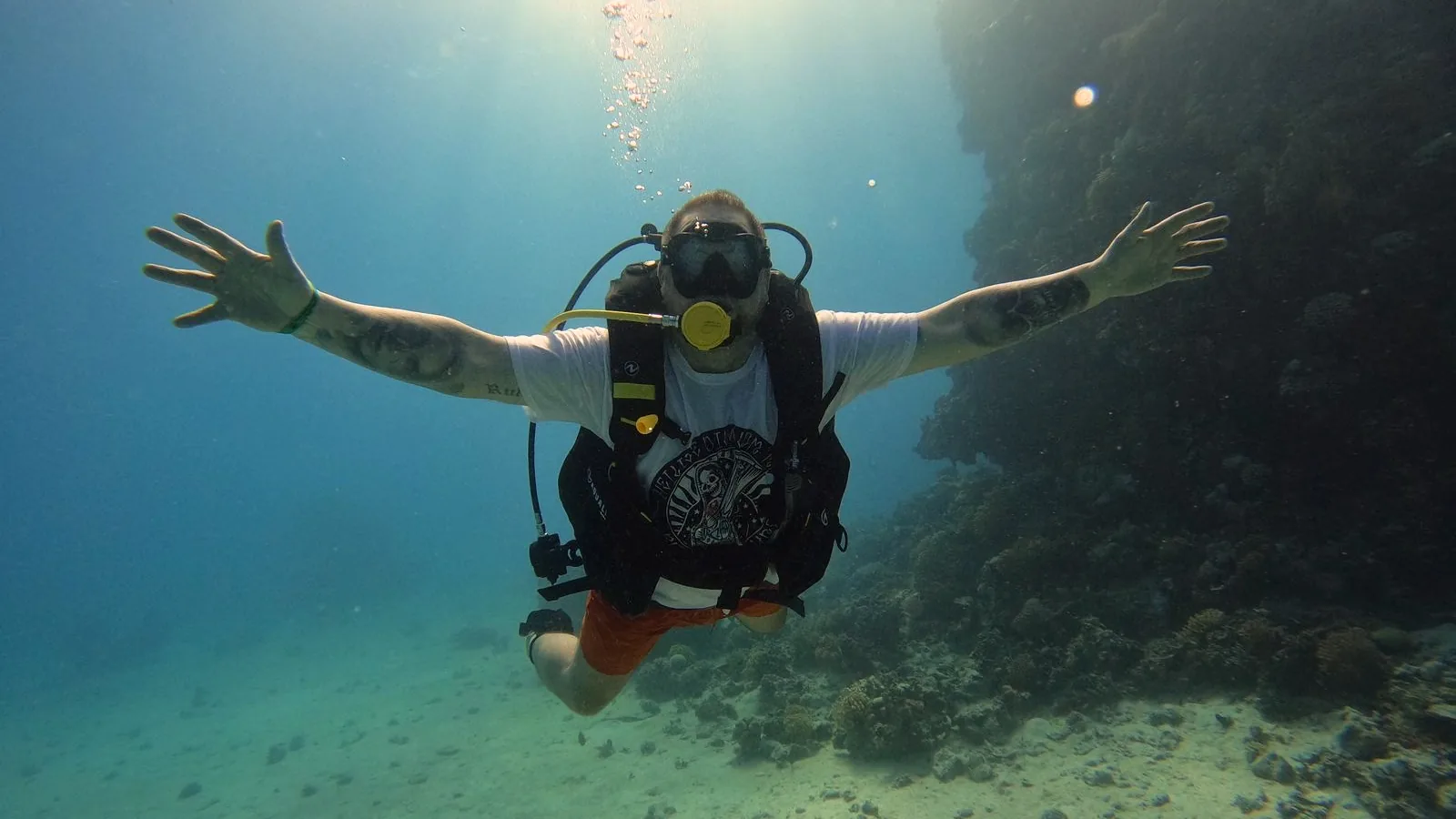
Ask experienced divers which single skill changed their diving the most and the answer is almost always the same: buoyancy. It is the difference between fighting the water and floating in it. A diver with good buoyancy control hovers a hand's width above a coral head without touching it, rises a metre by breathing in and settles back by breathing out, and finishes the dive with more air than the buddy who spent it kicking up and down. This guide explains what neutral buoyancy is, the physics that keep changing it during every dive, how to find the right amount of weight, how to use the breath and the BCD for fine control, why trim matters, which drills build the skill fastest and the mistakes that hold most divers back.
Safety note: this is general information for recreational divers, not a substitute for training. Practise new skills under the supervision of an instructor or guide, and see a doctor (ideally a diving doctor) about any ear or health problems.
What neutral buoyancy is and why it matters
Any object in water is pushed upwards by a force equal to the weight of the water it displaces — Archimedes' principle. If the diver and all their equipment weigh more than the water they displace, they sink (negative buoyancy); if they weigh less, they float (positive buoyancy). Neutral buoyancy is the balance point where the two are equal, so the diver neither sinks nor rises and can stay at one depth without kicking. The glossary entry on neutral buoyancy gives the short definition; the rest of this guide is about how to reach that point and stay there.
It is worth the effort because almost every part of a dive improves with it:
- Air lasts longer. A diver who is constantly finning to stay up, or dumping and adding air, works harder and breathes more. Neutrally buoyant divers move slowly and breathe calmly, which is the single biggest factor in reducing air consumption.
- The reef survives. Coral grows slowly and is easily broken or smothered by sand kicked up by fins. Most diver damage to reefs comes from accidental contact — knees, fins, hands and dangling gauges — and good buoyancy is what prevents it. Delicate animals such as nudibranchs are only safe around divers who can hover.
- Ascents and safety stops are safer. Uncontrolled ascents are a recognised risk factor for decompression sickness and lung over-expansion injuries. A diver in control can rise slowly and hold a safety stop at around 5 metres for three minutes without drifting.
- Equalising is easier. A slow, controlled descent gives the ears time to adjust, which is why buoyancy and ear equalisation go hand in hand. Plummeting fast makes it far harder to keep up.
- Photos are sharper and the dive is calmer. Stillness means steady framing, no sand clouds and fish that are not scared off. It also simply feels better: hovering weightless is the experience most people learned to dive for, as described in what learning to dive feels like.
What changes your buoyancy during a dive
Buoyancy is not something set once at the start of a dive. Several things change it continuously, and understanding them is what turns buoyancy from guesswork into anticipation.
Gas compresses and expands with depth
Water pressure increases by about one atmosphere for every 10 metres of seawater. By Boyle's law, the volume of a flexible gas space shrinks as pressure rises: air at the surface takes up half its volume at 10 metres, a third at 20 metres and a quarter at 30 metres. The largest relative change happens in the shallowest water — going from the surface to 10 metres doubles the pressure, while going from 20 to 30 metres raises it by only a third. That is why buoyancy feels most unstable near the surface and during the final metres of an ascent and the safety stop.
Three gas spaces matter to a diver: the air in the BCD, the gas in the lungs and the tiny bubbles trapped inside the neoprene of a wetsuit. All three shrink on the way down and grow on the way up. In practice this means a diver needs to add a little air to the BCD while descending and release it while ascending; if they do not, they become heavier as they go down and lighter as they come up, and both effects feed themselves.
The wetsuit loses buoyancy at depth
Neoprene is a foam full of gas cells, so a wetsuit is buoyant at the surface and compresses with depth. Measurements on wetsuit neoprene suggest a third to a half of its surface buoyancy is lost in the first 10 metres, with further losses deeper down. The thicker the suit, the bigger the effect: a 7 mm suit changes far more than a 3 mm shorty, and an old, well-used suit compresses differently from a new one. The guide to choosing a wetsuit for the Red Sea covers which thickness suits which season.
The cylinder gets lighter as gas is used
Compressed air has weight. At the surface, a litre of air weighs about 1.2 grams, and a full 12-litre or aluminium 80 cylinder holds roughly 2,200 to 2,400 litres of it — around 2.5 to 3 kilograms of gas. As that gas is breathed, the cylinder becomes lighter. A typical aluminium 80 is slightly negative when full (about −0.8 to −0.9 kg in seawater) and clearly positive when nearly empty (around +1.7 to +2 kg), a swing of about 2.5 kg. Steel cylinders lose the same weight of gas for the same volume used, but most stay negative even when empty. This is why a diver who is perfectly weighted at the start of the dive can struggle to stay down at the end.
Salt water versus fresh water
Seawater is about 2.5 percent denser than fresh water, so it pushes up harder on the same diver. A common starting point is to add roughly 2.5 percent of the diver's total weight with gear when moving from fresh water to the sea — often 2 to 3 kilograms for an average adult. The Red Sea is among the saltiest seas in the world: surface salinity in the north is typically around 40 parts per thousand, compared with roughly 35 in the open ocean. That makes its water slightly denser again, although warm water is a little less dense than cold, which partly offsets it. The difference compared with other tropical seas is small — usually a fraction of a kilogram — but divers coming from lakes, quarries or swimming-pool training should expect to need noticeably more lead than they are used to.
Getting your weight right: the weight check
No amount of technique makes up for the wrong weight. The goal is the least weight that still allows a controlled safety stop at the end of the dive, when the cylinder is at its lightest. Weight can be carried on a belt, in integrated BCD pockets or in trim pockets; the weight system entry explains the options.
The surface weight check
- Enter the water in full gear, in water too deep to stand in, next to the boat or a line.
- Deflate the BCD completely, keeping the inflator in the hand.
- Hold a normal breath — not a full gulp — and stay still, with no kicking or sculling with the hands.
- A correctly weighted diver floats with the water at about eye level.
- On a normal exhale, the diver should begin to sink slowly.
- If the head stays well above the water, add weight in small steps (about 1 kg at a time); if the diver sinks while holding a breath, remove some.
This is the check taught on the Open Water course, and it should be repeated whenever something changes: a different suit, a different cylinder, a move from fresh to salt water, a change in body weight or simply the first dive of a holiday.
Allowing for the gas that will be used
A surface check with a full cylinder does not account for the 2.5 to 3 kilograms of gas that will be breathed. There are two common ways to handle this. One is to do the check near the end of a dive, with about 50 bar left. The other is to do it with a full cylinder and then add roughly the weight of the gas that will be used. Either way, the confirmation comes at the safety stop: at 5 metres, with about 50 bar remaining and an empty or nearly empty BCD, a properly weighted diver can hover with normal breathing. If they need to hold on to a line to stay down, they need a little more weight; if they need air in the BCD to stay up, they can probably remove some.
It is good practice to log the amount of weight, the suit and the cylinder after every dive. After a few dives, the logbook gives a reliable starting figure for any trip.
Fine control: breath, BCD and anticipation
Once the weight is right, buoyancy control is about two tools used in the right order: the BCD for big changes and the lungs for small ones.
The BCD sets the baseline
The BCD is for compensating changes in depth, not for steering. On descent, add air in short bursts — a press of a second or less — as the suit compresses, aiming to arrive at the planned depth already close to neutral. On ascent, release air early and in small amounts so the expanding gas never builds up. After every adjustment, wait a few seconds: the effect of a change in volume takes time to show, and impatience is what creates the yo-yo pattern.
The breath does the fine-tuning
Every litre of gas in the lungs displaces about a kilogram of seawater. An adult's normal breath is around half a litre, and the gap between full and nearly empty lungs is several litres, so breathing alone can move a diver up or down. Experienced divers use this constantly: a slightly deeper breath lifts them over a coral head, a longer exhale lets them settle towards the sand. The trick is to breathe slowly and deeply, with a slightly longer exhale, and to make buoyancy corrections through the breathing pattern rather than through the inflator.
One rule never changes: never hold the breath, and especially never while ascending. Breath control means shifting the average lung volume a little, not stopping breathing.
Anticipate rather than react
Good buoyancy looks effortless because the diver is always slightly ahead of the water. They know that rising two metres means releasing a little air, that a coral pinnacle ahead means a deeper breath now rather than a kick later, and that the last part of the ascent needs the most care. A dive computer helps by showing depth and ascent rate precisely; the guide to dive computers explains the ascent-rate warning and how to read it. A slow ascent of around 9 to 10 metres per minute, followed by a safety stop, is the widely recommended target.
Trim: diving flat and streamlined
Buoyancy decides whether a diver rises or sinks; trim decides which way they point while doing it. Good trim is roughly horizontal — body flat, knees bent, fins slightly raised and head looking forward — like a skydiver in freefall.
Trim matters for three reasons. A horizontal diver presents the smallest profile to the water, so they use less effort and less air to move. Their fins push water backwards rather than down, so they do not stir up sand or hit the reef. And in a horizontal position, the diver can see where they are going and stop precisely.
Trim is mostly set by where the weight sits relative to the centre of buoyancy (the air in the BCD and the lungs):
- Feet sinking? Moving some weight higher up — into trim pockets on the cylinder band, for example — or raising the cylinder slightly in the BCD can help. Heavy fins and steel cylinders tend to pull the legs down.
- Head down, fins up? The opposite: move weight lower, towards the hips.
- Rolling to one side? Spread weight evenly left and right, and check that gauges and accessories are clipped close to the body.
Streamlining helps too: a gauge or octopus hanging loose adds drag and is the gear most likely to drag across coral. The guide to what scuba gear you need covers how kit is usually configured.
Drills that build hovering skill
Buoyancy improves with deliberate practice, not just with more dives. These drills are usually practised over sand at a safe depth, with a buddy or an instructor and well away from the reef.
- The fin pivot. Lying face down on the sand with fin tips touching the bottom, add tiny amounts of air until a slow, deep breath lifts the upper body and an exhale lowers it again. It teaches how much a single breath really changes buoyancy.
- The timed hover. Stay motionless at one depth, in horizontal trim, for 30 seconds and then 60 seconds, without moving hands or fins. Watching the depth gauge shows how far a small breathing change moves the diver.
- The cross-legged hover. Sitting upright with legs crossed removes the option of finning, so all control has to come from the breath.
- Up a metre, down a metre. From a hover, rise one metre using breath only, hold, then sink back. Then do the same with a small BCD adjustment instead.
- The stationary safety stop. Hold 5 metres for three minutes without a line or a reference, ideally near the end of a dive when the cylinder is light.
- Slow-motion finning. Practising the frog kick and back-kick keeps fins high and the water behind the diver clear, which matters on sandy sites and around wrecks.
Ten minutes of drills at the end of a fun dive, repeated over a week of diving, often changes buoyancy more than a dozen dives spent simply following the guide.
Common buoyancy mistakes and how to fix them
- Overweighting. The most common mistake of all, often because extra lead feels "safe" on a first descent. It means more air in the BCD, larger volume swings, more drag and higher air consumption. Fix: a proper weight check and, after it, try removing one kilogram at a time.
- The yo-yo. Rising, dumping air, sinking, adding air and repeating. Fix: smaller adjustments, a pause after each one, and more use of the breath.
- Finning to stay up. A diver who is slightly negative and kicks to compensate often ends up upright, "bicycling" and kicking sand. Fix: add a short burst of air and get horizontal.
- Using the hands. Sculling with the hands is a sign of balance or weighting problems and wastes energy. Fix: fold the arms, clasp the hands or hold a light, and let the breath do the work.
- Forgetting the end of the dive. A diver weighted with a full cylinder can find themselves too light at the safety stop. Fix: weight for the end of the dive and vent the BCD early on the ascent.
- Shallow, fast breathing. Nerves or cold change the breathing pattern, and with it buoyancy. Fix: slow, deep breaths with a long exhale; if anxiety is a factor, the guide to checking whether diving is right for you covers fitness and comfort in the water.
Buoyancy in the Red Sea and the Peak Performance Buoyancy course
The Red Sea is one of the most rewarding places to work on buoyancy. Visibility is often 20 to 30 metres or more, so divers can see their depth relative to the reef; water temperatures of about 21–29 °C through the year (up to around 30 °C in late summer) mean that a 3 mm or 5 mm wetsuit is usually enough, which keeps suit compression manageable; and many dive sites combine sandy patches for drills with coral gardens and pinnacles that reward precise control.
A few local factors are worth knowing:
- Salty water. As above, divers who learned in fresh water or in a pool usually need more weight here than they expect. A weight check on the first dive is the quickest way to find out how much.
- Shallow reef tops and pinnacles. Many Red Sea sites rise to within a few metres of the surface. This is where buoyancy is hardest to control and where coral is most exposed, so slow, deliberate movement pays off. The Red Sea coral refuge article explains why these reefs are so valuable.
- Wrecks and swim-throughs. Good buoyancy and trim are what make wrecks such as those in the Red Sea Wreck Atlas enjoyable rather than silty and stressful.
- Currents. On drift dives and at exposed sites, neutral buoyancy lets the diver ride the current with minimal effort; a reef hook is sometimes used to stay still in strong flow.
- Marine life up close. The best encounters — a lionfish hunting at dusk, a giant clam closing its mantle — happen to divers who can stay still at a respectful distance.
The PADI Peak Performance Buoyancy specialty
For divers who want structured coaching, the PADI Peak Performance Buoyancy specialty is designed for exactly this skill. It is open to certified divers from age 10, usually takes a day and includes two open water dives covering precise weighting, trim, hovering in different positions and streamlining. The first dive can also count as one of the Adventure Dives in the Advanced Open Water course. Other training agencies offer comparable buoyancy and trim courses. The PADI pathway from Open Water to Divemaster shows where it fits in a diver's progression.
New divers can start practising from the very first session: buoyancy is part of the beginner courses, and the Discover Scuba Diving experience already introduces the basic feel of hovering.
Practise your buoyancy in the Red Sea
Aquarius Diving Club is a PADI 5-Star centre with bases in Hurghada, Makadi Bay, Sahl Hasheesh and Sharm el-Sheikh, running daily boats, refreshers and buoyancy specialties for divers who want to float like a pro.
Plan your dives →Related: Keep improving with the guides to air consumption, ear equalisation and dive computers.
Frequently asked questions
How do I know if I am wearing the right amount of weight?
Do a weight check at the surface: with an empty BCD and a normal breath held, a correctly weighted diver floats at about eye level and sinks slowly on a normal exhale. Because the cylinder gets lighter as gas is used, the real test comes at the end of the dive: with roughly 50 bar left, an empty BCD and normal breathing, the diver should be able to hold a safety stop at 5 metres without sinking or drifting up.
How much weight do I need for diving in the Red Sea?
There is no fixed number, because it depends on body composition, wetsuit thickness, cylinder type and other gear. Many divers in a 3 mm or 5 mm wetsuit with an aluminium cylinder end up somewhere around 4 to 8 kilograms, but the only reliable answer is a proper weight check on the first dive. Divers who normally dive in fresh water usually need more lead in the sea, roughly 2.5 percent of their total weight with gear.
Why do I keep going up and down during a dive?
The up-and-down "yo-yo" usually comes from reacting late. Air added to the BCD keeps expanding as the diver rises, and air left in it compresses as the diver sinks, so a big correction overshoots. The fixes are small bursts of air, a pause of a few seconds to see the effect, using the breath for fine adjustment and, very often, carrying less lead so there is less air in the BCD to manage.
Is it better to be overweighted or underweighted?
Neither. Overweighting means more air in the BCD, larger volume swings, more drag and higher air consumption, and it is the most common buoyancy problem among recreational divers. Underweighting makes it hard to descend and, more seriously, to hold a slow ascent and safety stop when the cylinder is nearly empty. The goal is the least weight that still allows a controlled stop at 5 metres at the end of the dive.
Does breathing really change buoyancy?
Yes. Every litre of air in the lungs displaces about a kilogram of seawater, so the difference between a full breath and an empty one can move a diver up or down by several kilograms. A normal breath is around half a litre, which is enough to rise or sink gently. Divers use slightly deeper or shallower breathing for fine control, but should never hold their breath, especially while ascending.
What is trim in scuba diving?
Trim is the diver's body position in the water. Good trim is roughly horizontal, with the fins slightly raised and the knees bent, so the diver moves forward with the least drag and the fins push water backwards rather than down onto the reef or sand. Trim depends on where weight is carried and how the cylinder and BCD are set up, as well as on posture.
What is the PADI Peak Performance Buoyancy course?
Peak Performance Buoyancy is a PADI specialty for certified divers from age 10 that usually takes one day and two open water dives. It covers fine-tuning weighting, trim, hovering, streamlining and the effect of the breath on buoyancy. The first dive can also be credited as an Adventure Dive towards the Advanced Open Water course.
Can I master buoyancy as a beginner?
Most new divers find buoyancy the hardest skill at first and then improve quickly over their first 20 to 50 dives. Regular diving, correct weighting, a relaxed breathing pattern and deliberate practice such as hovering drills make the biggest difference. A refresher or a buoyancy-focused dive with an instructor is worthwhile after a long break.