The Red Sea's Big 7: The Marine Encounters Every Diver Dreams Of
13 min read
Published: August 31, 2026 Verified: August 31, 2026New 13 min read
Every ocean has its headline acts, but few places pack as many into one warm, accessible sea as the Egyptian Red Sea. Borrowing the idea of Africa's safari "Big Five", divers have long kept an informal bucket list of the marine encounters that define a Red Sea diving life. This guide maps seven of them honestly — what each animal is, where in the Red Sea it lives, the season that gives the best odds, how divers (and often snorkellers) actually meet it, and one fact worth carrying underwater. It is a hub: each animal links to a deeper species guide for the full story, and to the month-by-month season guide for planning.
What is the Red Sea's "Big 7"?
There is no official register of a Red Sea "Big 7" — it is an editorial short-hand, the diving equivalent of a safari bucket list. But the seven animals below are the ones that fill divers' logbooks and dreams: three sharks, two mammals, one ray and the reptiles of the reef. Some are close to reliable in the right season; others are a genuine stroke of luck. Here is the whole cast at a glance:
The Red Sea's Big 7 — where and when, at a glance
Encounter
Where in the Red Sea
Best season
How you dive it
Scalloped hammerhead
Straits of Tiran, Ras Mohammed; Brothers & Daedalus
Jun–Sep (Jul–Sep peak) 25–40 m Tiran, Ras Mohammed, Brothers AOWD for the blue
The scalloped hammerhead is the Red Sea's most famous "in the blue" encounter — schools of five to thirty or more, cruising the open water off a reef wall, their bodies stacked at the thermocline where cooler water meets warm. Divers see them most often at 25–35 m, hanging in the blue and facing out.
Where: the classic day-boat site is Jackson Reef in the Straits of Tiran, 45–60 minutes from Sharm El Sheikh; Ras Mohammed and the other Tiran reefs also produce them. The largest historic schools form at the offshore central reefs — the Brothers Islands and Daedalus — reached only by liveaboard. When: summer, with sightings becoming realistic from June and peaking through the warmest months, roughly July to September, when the animals gather to cool at the thermocline.
How you dive it: descend to the back of an exposed reef, hover in open blue, keep your group tight and your bubbles calm — hammerheads are shy of noise and shy of divers, so the encounter is almost always at a respectful distance. The dive is weather-dependent and sometimes doesn't run. One fact worth carrying down: the wide "hammer" (properly a cephalofoil) spreads the shark's eyes and its electro-sensing pores far apart, giving it a broader field of vision and a wider sweep for detecting prey buried in the sand. Scalloped hammerheads are Critically Endangered globally, which makes a Red Sea school all the more precious. Divers are usually looking at animals of 2–2.5 m, though the species reaches over 3.5 m.
2. Manta ray — the ocean's gentle giant
Manta Ray (Mobula alfredi & Mobula birostris)
Summer plankton (May–Oct) 5–25 m Elphinstone, Daedalus, Brothers OWD+ when shallow
Few sights in diving match a manta ray banking overhead, wings spread and mouth agape as it strains plankton from the water. Two species swim in Egyptian waters: the smaller reef manta (Mobula alfredi, IUCN Vulnerable) along the shallower mainland coast from Hurghada to Marsa Alam, and the giant oceanic manta (Mobula birostris, IUCN Endangered) at the deeper offshore reefs.
Where: the most reliable manta sites are the offshore reefs — Elphinstone, Daedalus and the Brothers — with the far-southern reefs (St John's, Zabargad and Rocky Islands) adding to the odds. Elphinstone, off the Marsa Alam coast, is one of the few offshore sites reachable by speedboat in season. When: summer, when plankton blooms draw mantas to feeding zones and cleaning stations — roughly May to October. Encounters can be shallow enough for any certification level, though most of the best sites are liveaboard.
One fact worth carrying down: the giant oceanic manta has a wingspan that can reach around 7 metres, making it the largest ray on Earth, and it carries the largest brain of any fish. Every manta's belly is patterned with unique spots — a natural fingerprint that lets researchers recognise individuals for life.
The whale shark is the world's largest fish — and, despite the name, a true shark, a filter-feeder that eats only plankton and small fish. Encounters are gentle, usually near the surface, and open to snorkellers and divers of any level because the animal so often feeds in shallow water.
Where: the Red Sea's whale sharks are most often met at the offshore reefs — the Brothers, Daedalus and Elphinstone — with occasional passes at the Tiran reefs (Jackson, Woodhouse) and along the Deep South. When: late spring and summer, roughly May to August, with the north's best window around May and June; sightings track short-lived plankton blooms and can cluster over a week or two. Be honest with your expectations: the Red Sea is not a dependable whale-shark destination in the way the Maldives or Mexico are, and even in peak months a sighting is luck, not a promise.
One fact worth carrying down: whale sharks routinely reach 8–12 metres, with the largest reliably measured at around 12–14 metres (bigger sizes are reported but unconfirmed), yet they are harmless filter-feeders. As with mantas, each animal wears a unique constellation of spots behind the gills — a lifelong fingerprint that researchers use to track individuals across whole oceans.
4. Spinner dolphin — the resting pods
Spinner Dolphin (Stenella longirostris)
Year-round Surface Sha'ab Samadai, Sataya, Sha'ab El Erg Snorkel-friendly
Wild spinner dolphins gather to rest by day in the calm of sheltered coral lagoons, and a good encounter — a pod of twenty or more drifting slowly through clear shallows — is one of the Red Sea's most joyful experiences. It is largely a snorkelling one, on the dolphins' terms.
Where: the classic resting reefs are in the south — Sha'ab Samadai ("Dolphin House"), a horseshoe reef about 15 km south-east of Marsa Alam, and Sataya in the Fury Shoals — while Sha'ab El Erg near Hurghada holds its own resident pod. At Samadai the reef is zoned to protect the animals: a no-entry resting core, a guided-snorkel zone, and a diving-and-mooring zone. When: year-round — the pods use the lagoons almost every day.
One fact worth carrying down: spinner dolphins are named for the exuberant spinning leaps they make, rotating as many as seven times around their own axis in a single jump. They rest and socialise in the sheltered shallows by day and head to deep water to hunt at night. The rule for divers and snorkellers is simple — never chase, crowd or touch; let the pod come to you.
5. Sea turtles — green & hawksbill
Green & Hawksbill Turtles
Year-round 3–20 m Abu Dabbab, Marsa Mubarak & reefs All levels / snorkel
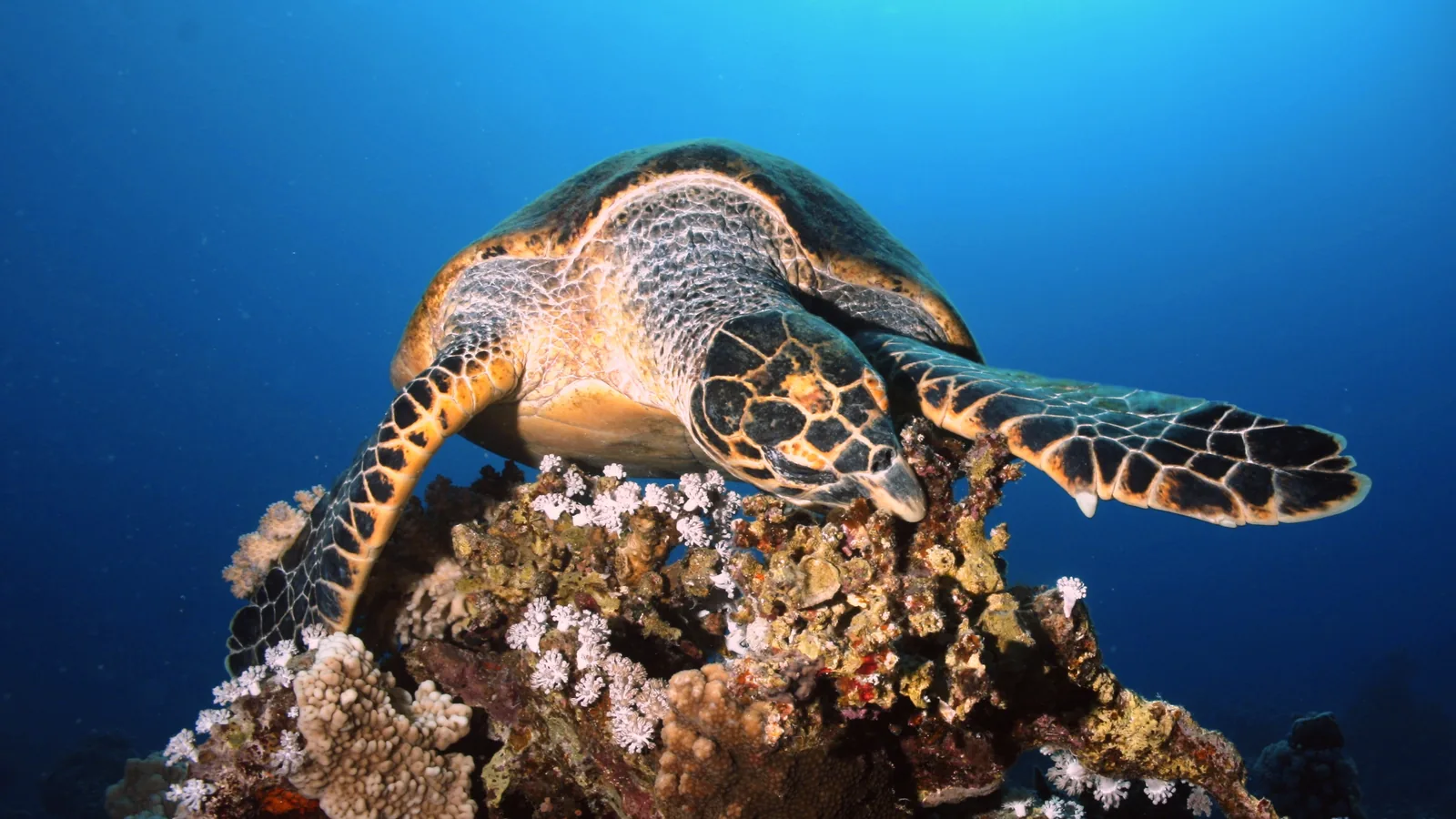
Two turtle species make the Big 7, and both are among the most approachable of all the animals here. The green turtle (Chelonia mydas) is a seagrass grazer; the hawksbill (Eretmochelys imbricata) is a reef-dweller with a hooked beak and overlapping, tortoiseshell-patterned scutes.
Where: green turtles gather to feed in the seagrass bays of Marsa Alam — Abu Dabbab and Marsa Mubarak are famous for them — while both species turn up on reefs the length of the coast, from Hurghada and Sharm to the south. When: year-round; turtles are residents, not seasonal visitors. Encounters are usually of an animal grazing or resting, often quite unbothered by the divers and snorkellers around it.
The two species diverge sharply on conservation: the green turtle was reassessed to Least Concern globally by the IUCN in 2025 as several nesting populations recover, while regional numbers still need protection; the hawksbill remains Critically Endangered. One fact worth carrying down: a green turtle's body fat turns green from its seagrass diet — which is where the name comes from — and adults typically weigh 135–200 kg, the largest topping 300 kg.
6. Oceanic whitetip — autumn on the offshore reefs
If hammerheads are the Red Sea's most famous shark, the oceanic whitetip is arguably its most thrilling. This bold pelagic shark, with its distinctive rounded, white-tipped fins, is the shark of the open ocean — and unlike the shy hammerhead it approaches divers with slow, unflinching curiosity, often making several passes.
Where: the far offshore reefs are the place — the Big and Small Brother and Daedalus, 60–90 kilometres out and liveaboard territory, while Elphinstone (off Marsa Alam) is close enough to reach by day boat. Elphinstone is among the most reliable oceanic-whitetip sites on the planet in season. When: October to December, peaking in October and November, when cooler water brings the sharks in. Standard protocols keep the encounter safe: no feeding or baiting, a calm horizontal posture, keeping the shark in sight, and a tight group ascent. See the full Red Sea shark-diving guide for site-by-site detail.
One fact worth carrying down: the oceanic whitetip was once thought to be the most abundant large animal on the planet, ranging across every tropical ocean. Longline fishing collapsed its numbers by more than 95%, and it is now Critically Endangered — the Red Sea, where Egypt bans commercial pelagic longlining, is one of the last places on Earth to meet one reliably.
7. Dugong — the rarest of all
Dugong (Dugong dugon)
Year-round (rare) 5–12 m Seagrass bays near Marsa Alam Snorkel / dive
The dugong — the gentle "sea cow" of the seagrass meadows — is the hardest of the seven to find, and for many divers the most magical precisely because of it. It is a slow, placid grazer, and an encounter is a matter of genuine luck rather than planning.
Where: in Egypt, dugongs are seen at only a handful of seagrass bays near Marsa Alam, above all Abu Dabbab and Marsa Mubarak; they are essentially absent from the northern resorts. Fewer than a hundred are thought to remain in Egyptian waters — a 2024 survey estimated 73–97. When: year-round in theory, but sightings are rare and unreliable, and the animals are easily disturbed by boats and crowds. If one appears, the etiquette is strict: keep your distance, stay quiet, and never block its path to the surface.
One fact worth carrying down: the dugong is the only fully herbivorous marine mammal, feeding almost entirely on seagrass, and it is a close relative of the manatee. Its unhurried grazing at the surface, glimpsed by sailors of old, is widely believed to be the origin of the mermaid legend.
Where you're most likely to see them
No single week delivers all seven — the Big 7 span the whole Egyptian coast, from the northern reefs of Tiran to the seagrass bays of the deep south. Broadly, this is how the animals map to regions and bases:
Season is everything for the migratory animals and irrelevant for the residents. Turtles and dolphins are there whenever you visit; the sharks, mantas and whale sharks follow the calendar. The two prime windows are summer (hammerheads, whale sharks, mantas) and autumn (oceanic whitetips), which is why serious big-animal divers often make two trips a year.
Best months for each of the Big 7
Encounter
Best months
Reliability in season
Scalloped hammerhead
Jun–Sep (Jul–Sep peak)
Good at the right sites
Manta ray
May–Oct (summer plankton)
Variable, plankton-driven
Whale shark
May–Aug (May–Jun peak)
Lucky — never guaranteed
Spinner dolphin
Year-round
Near-daily at resting reefs
Sea turtles
Year-round
Reliable at seagrass bays
Oceanic whitetip
Oct–Dec (Oct–Nov peak)
Good on offshore liveaboards
Dugong
Year-round
Rare and unpredictable
Planning verdict: for the summer trio (hammerheads, whale sharks, mantas) aim for June to September; for oceanic whitetips come in October or November. Turtles and dolphins can be added to almost any trip. For a month-by-month breakdown, see the best time to dive the Red Sea guide.
Do you need to be experienced?
Not for all of it — the Big 7 spread across every level of diving. Turtles, reef sharks, spinner dolphins, whale sharks and the inshore reef manta are all within reach of Open Water divers, and several are regularly seen by snorkellers. What raises the bar is the pelagic, "in the blue" side of the list: schooling hammerheads, oceanic whitetips and the offshore giant manta live on exposed reefs at 25–40 m, usually with current, and typically call for an Advanced Open Water certification and a liveaboard.
Snorkellers, meanwhile, are far from shut out. The spinner-dolphin lagoons at Sha'ab Samadai and Sataya, the green turtles of Abu Dabbab, a whale shark feeding at the surface, and even the elusive dugong are all surface encounters. The honest divide is simple: the mammals, turtles and surface-feeding sharks are for everyone; the deep-blue sharks and offshore mantas are for scuba divers with the right certification.
Diving the Big 7 with Aquarius
Aquarius is a PADI 5-Star Resort & IDC operating across four Egyptian Red Sea bases, with day boats and access to the offshore liveaboard routes. Which base suits a Big 7 trip depends on the animal:
Sharm El Sheikh base — Day boats to the Straits of Tiran make summer hammerheads a realistic single-day target, with turtles and reef sharks year-round. Sharm daily diving shows current schedules.
Makadi Bay base — A calmer resort area with day boats to the northern Hurghada reefs; ideal for divers travelling with non-diving partners.
Sahl Hasheesh base — A luxury resort cluster with day boats by transfer to the Hurghada north sites.
The two southern specialists — the dugong and the reliable green-turtle seagrass bays — sit around Marsa Alam, best reached on a deep-south liveaboard. For any big-animal trip, it is worth confirming the target species can be matched to the travel window before booking, since the seasons are narrow.
Plan your Red Sea big-animal trip
Tell the Aquarius team which of the Big 7 you're dreaming of and your travel dates, and they'll match you to the right base, boat and month.
The Red Sea is one of the world's richest warm-water diving regions. Alongside vast coral reefs and hundreds of reef-fish species, divers can encounter the Big 7 large animals: scalloped hammerhead sharks, manta rays, whale sharks, spinner dolphins, green and hawksbill turtles, oceanic whitetip sharks and the rare dugong. Reef sharks, moray eels, octopus, barracuda and stingrays are common too.
When is the best time to see hammerheads, mantas and whale sharks in the Red Sea?
These three are summer animals. Scalloped hammerheads school at the Straits of Tiran and offshore reefs from roughly June to September, peaking in the warmest months. Manta rays follow the summer plankton blooms at offshore reefs such as Elphinstone and Daedalus, mainly May to October. Whale sharks pass through in late spring and summer, around May to August, though sightings are unpredictable.
When can you see oceanic whitetip sharks in the Red Sea?
Oceanic whitetips are an autumn and early-winter encounter. They gather at the offshore reefs — Elphinstone, the Brothers Islands and Daedalus — from October to December, peaking in October and November when cooler water draws them in. These sites are reached by liveaboard, and the sharks are Critically Endangered, so the Red Sea is one of the last reliable places on Earth to see them.
Are Big 7 sightings guaranteed?
No. Every animal on this list is wild and unbaited, so no reputable operator can promise a sighting. Some encounters are close to reliable in season — turtles, reef sharks and resting dolphin pods are seen most days at the right sites — while others, especially whale sharks and dugongs, are genuinely lucky. Choosing the right site, season and itinerary is what shifts the odds in your favour.
Where in the Red Sea are you most likely to see the big animals?
It depends on the animal. Hammerheads are best from Sharm El Sheikh via day boats to the Straits of Tiran in summer. Oceanic whitetips, offshore mantas and whale sharks draw divers to the offshore reefs — the Brothers and Daedalus by liveaboard, or Elphinstone by day boat from Marsa Alam. Green turtles and the rare dugong graze the seagrass bays around Marsa Alam, such as Abu Dabbab and Marsa Mubarak. Dolphins rest daily in sheltered lagoons like Sha'ab Samadai.
Do you need to be an experienced diver to see the Big 7?
Not for all of it. Turtles, reef sharks, dolphins, whale sharks and inshore mantas are within reach of Open Water divers and are often seen by snorkellers. The pelagic in-the-blue encounters — schooling hammerheads, oceanic whitetips and offshore mantas — sit at 25 to 40 metres on exposed offshore reefs and typically require an Advanced Open Water certification and a liveaboard.
Can snorkellers see any of the Big 7?
Yes. Snorkellers have excellent chances with spinner dolphins in the resting lagoons at Sha'ab Samadai and Sataya, green turtles grazing the shallow seagrass at Abu Dabbab, whale sharks feeding at the surface, and — with patience and luck — the dugong. The deeper shark and offshore manta encounters, however, are for scuba divers.