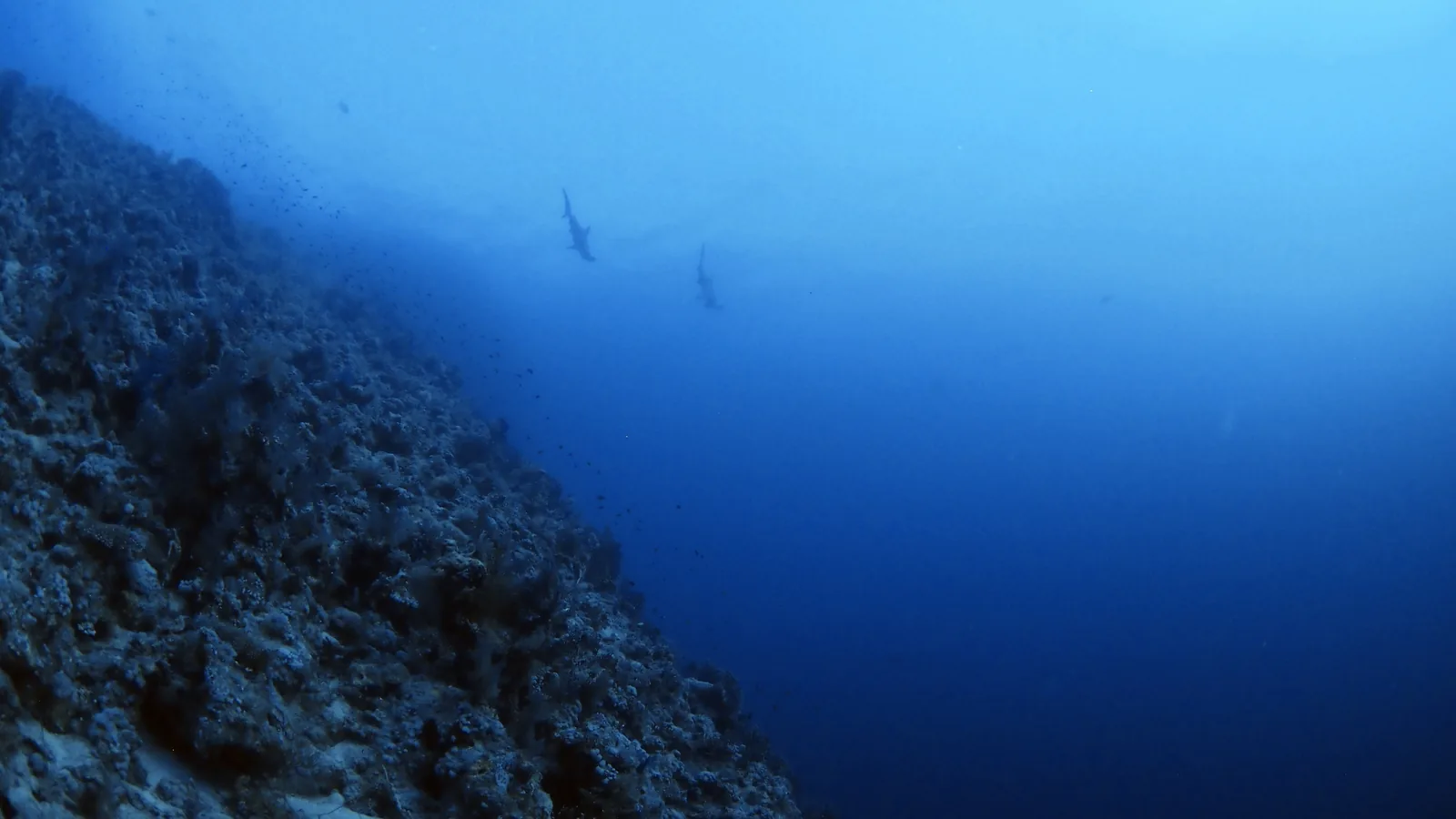
Divers arriving in Egypt for the first time tend to say the same thing as the boat leaves the harbour: the water looks unreal. A deep cobalt blue offshore, turquoise over the sand, and so transparent that a reef wall can be followed with the eye from the surface down into the blue. Then they jump in and discover it is warm, and that they float a little more easily than at home. None of this is luck. The clarity, the saltiness and the warmth of the Red Sea all come from the same handful of facts about geography, climate and geology. This guide explains each of them in plain language, sorts the solid science from the popular myths, and finishes with what it all means for planning a dive.
The Red Sea in numbers
The figures below come from oceanographic studies and are rounded. Different studies measure different places and seasons, so ranges are given where sources disagree.
| Measure | Red Sea | For comparison |
|---|---|---|
| Surface salinity | About 36 in the south rising to about 40–41 in the north | Global ocean average about 35 |
| Evaporation | Roughly 1.75–2.3 m of water per year | Rainfall over the sea only a few centimetres a year |
| Permanent rivers flowing in | None | Most seas receive large river inputs |
| Deep water temperature | About 21–22 °C from a few hundred metres to the bottom | Most ocean deep water is a few degrees above freezing |
| Surface temperature, Egyptian coast | About 21–29 °C through the year (up to around 30 °C in late summer) | Warmer still in the southern Red Sea |
| Connection to the ocean | Bab el-Mandeb, about 26 km wide at its narrowest, with a sill only about 140–160 m deep | Open oceans exchange water freely at depth |
| Typical diving visibility | About 20–40 m offshore, often 30 m+ | Lower near harbours, sandy shores and after strong wind |
Why the Red Sea is so clear
Water looks cloudy for two main reasons: particles washed in from land, and living particles — plankton — growing in the water itself. The Red Sea is short of both.
Almost nothing washes in
The Red Sea lies in a long trench between the deserts of north-east Africa and the Arabian Peninsula. Rainfall over the sea averages only a few centimetres a year, and coastal towns such as Hurghada record just a few millimetres in a typical year. No permanent river flows into the Red Sea at all. In most of the world's coastal seas, rivers deliver enormous loads of mud, silt and dissolved organic matter that scatter and absorb light. Here that supply is essentially switched off. Occasional flash floods down the desert wadis and wind-blown dust do bring some material in, but compared with a river-fed coastline the input is tiny.
Nutrient-poor water keeps plankton scarce
The second and bigger reason is biological. The surface waters of the northern and central Red Sea are oligotrophic — very poor in nutrients. Surveys of the northern Red Sea have measured nitrate and phosphate in the sunlit upper layer at only trace levels, and chlorophyll, the standard measure of how much phytoplankton is present, at very low concentrations; one central Red Sea study found it rarely exceeded 0.1 micrograms per litre in the upper mixed layer. Without fertiliser, microscopic algae cannot multiply into the dense green soup that makes temperate seas murky. The result is water that lets sunlight travel unusually far, which is also why the colour offshore is such a deep blue: clean water absorbs red light and scatters blue.
For much of the year the water column is strongly layered, with warm, light surface water sitting on top of denser water below. That layering stops nutrients from being mixed upward. Where phytoplankton does gather, it often concentrates in a deep band some 60–80 metres down, well below where recreational divers swim. Satellite studies show blooms appear mainly where currents or eddies bring nutrients to the surface, which is the exception rather than the rule.
There is an apparent paradox here: how can such nutrient-poor water support some of the richest coral reefs on the planet? The answer is that reefs are superb recyclers. Reef-building corals host symbiotic algae (zooxanthellae) that make food from sunlight and pass it to the coral, while nutrients are passed around tightly within the reef community rather than floating free in the water. Clear water is not a sign of an empty sea — it is part of what lets light-hungry corals grow so well. The Red Sea's headline marine life lives in exactly this balance.
How far can you see? Visibility and what reduces it
Diving guides and operators usually quote 20–40 metres of visibility for the Egyptian Red Sea, and on a good day on an offshore reef 30 metres or more is normal. That is far beyond what most divers experience at home. It is not guaranteed everywhere, though, and it helps to know what lowers it:
- Harbours and shallow sandy shores: sites close to marinas or over fine sand are usually less clear than offshore reefs, because boat traffic and wave action keep fine particles suspended.
- Strong wind: the northern Red Sea is often windy, and days of strong wind stir up the shallows and churn sediment on exposed sites.
- Plankton: occasional, localised plankton blooms can reduce clarity. In winter, cooling surface water mixes deeper and brings up a little more nutrient, which can add some plankton; in summer, local blooms sometimes occur. Neither is usually dramatic.
- Depth and light: visibility feels shorter early in the morning, late in the day and under cloud, simply because there is less light to see by.
Many divers find spring and autumn give the most consistent conditions. The month-by-month picture, including water temperature and wind, is in the best time to dive the Red Sea guide. One thing worth knowing: plankton is food, so a slightly less clear day can also be the day plankton-feeders such as manta rays and whale sharks turn up.
Why the Red Sea is so salty
Salinity is a balance between fresh water coming in and fresh water leaving. The Red Sea loses on both counts.
Evaporation wins by a huge margin
Hot sun, dry desert air and steady winds evaporate an estimated 1.75 to 2.3 metres of water from the surface every year. Against that, rainfall adds only a few centimetres and rivers add nothing. Evaporation removes water but leaves the salt behind, so the sea is constantly being concentrated.
A narrow door to the ocean
The only connection to the open ocean is the Strait of Bab el-Mandeb at the southern end, between Yemen and Djibouti and Eritrea. It is only about 26 kilometres wide at its narrowest and, crucially, shallow: the sill that controls the exchange lies only about 140–160 metres down, depending on how it is measured. (In the north, the Suez Canal links to the Mediterranean, but it carries very little water.)
Through this gap the Red Sea works like a slow, two-layer pump. Less salty surface water from the Gulf of Aden, at roughly 36.5, flows in to replace what evaporates, while the heavy, salty Red Sea water — around 40.5 — slides out along the bottom of the strait and sinks into the Gulf of Aden. Because the water entering is gradually concentrated as it travels north, salinity climbs along the length of the sea: about 36 near Bab el-Mandeb, around 40–41 off the Egyptian coast and in the Gulf of Suez. The surface layer is replaced only every few years on average, so each parcel of water has plenty of time to become saltier.
For perspective, the world ocean averages about 35, and even the saltiest parts of the open Atlantic rarely exceed about 37–38. The Red Sea is not in the league of the Dead Sea, which is a land-locked lake roughly ten times saltier than the ocean, but among seas connected to the open ocean it is one of the saltiest anywhere.
Why it is warm all year, even 2,000 m down
The surface warmth is easy to explain: the Red Sea sits in the subtropics under intense sun, and in Egypt surface water is about 21–29 °C through the year (up to around 30 °C in late summer), with the southern Red Sea warmer still. What surprises oceanographers is what happens below.
The warmest deep water on the planet
In almost every ocean, the deep water is cold — a few degrees above freezing — because it originates in the polar regions and creeps along the sea floor. The Red Sea is different. From a few hundred metres down to the bottom, more than 2,000 metres deep in its central trough, it is filled by a single, almost uniform water mass known as Red Sea Deep Water, at about 21–22 °C and a salinity of about 40.5. Researchers describe it as the warmest deep water anywhere in the world ocean.
The reason is the same shallow sill at Bab el-Mandeb. Cold deep water from the Indian Ocean simply cannot climb over it. Instead, the Red Sea makes its own deep water: in the far north in winter, the surface cools a little while staying extremely salty, becomes heavy enough to sink, and spreads along the bottom. Because it started out as warm subtropical surface water, it stays warm. Recent research suggests this deep water is renewed more often than once thought — large parts were replaced within roughly a decade in the 1980s and 1990s.
Hot brine pools on the sea floor
The strangest water lies even deeper. Along the central rift, hollows in the sea floor more than 2,000 metres down hold pools of hot, extremely salty brine fed by hydrothermal activity. The best known, the Atlantis II Deep, has a bottom layer at around 68 °C with roughly seven times the salt content of normal seawater, and it has been slowly warming since it was first measured in the 1960s. Nobody dives there, of course, but it is a vivid reminder that this sea sits on top of an active rift.
A young ocean in the making
The Red Sea is not just a sea; geologists regard it as an ocean in the earliest stages of being born. The Arabian Plate is moving away from the African (Nubian) Plate, and the Red Sea fills the widening crack between them. Continental rifting began more than 20 million years ago, and in the south true oceanic crust — the same kind that floors the Atlantic — has formed along a central spreading axis. Estimates vary between studies and along the sea, but it is widening by up to about 1.5 centimetres a year, faster in the south than in the north.
That youth explains a lot of what divers see. The rift's steep margins are why so many Egyptian reefs are fringing reefs that drop away as walls into very deep water close to shore, why depth arrives so quickly off the coast, and why the deep central trough sits so close to dive sites. It is the reason a diver on a reef wall can look down into hundreds of metres of open blue — the view in this guide's opening photograph, with reef sharks patrolling the edge.
Corals that cope with heat
Warm water is usually bad news for coral. When the sea stays too hot for too long, corals expel their symbiotic algae and turn white — coral bleaching. Yet the corals of the northern Red Sea have shown an unusually high tolerance. A 2013 study led by marine biologist Maoz Fine measured an exceptionally high bleaching threshold in corals from the Gulf of Aqaba and proposed an explanation tied to the sea's geography: coral larvae that colonised the northern Red Sea after the last ice age had to pass through the very hot southern Red Sea, which may have selected for heat-tolerant genotypes. In the cooler north, those corals now live well below their limit.
That has made the northern Red Sea a candidate "coral refuge", one of the places most likely to keep healthy reefs as the oceans warm. It is not immunity: recent marine heatwaves have pushed temperatures higher for longer, sporadic bleaching has been reported in the shallows, and pollution and physical damage remain threats. The full story is in the guide to the Red Sea coral refuge.
Why is it called the Red Sea?
The water is blue, so where did the name come from? The honest answer is that nobody knows for certain. The name is ancient: the Greeks called it the Erythra Thalassa and the Romans Mare Erythraeum, both meaning "red sea" (in antiquity the term also covered waters beyond it, towards the Arabian Sea). The main theories are:
- Red algae blooms: the most popular explanation points to the cyanobacterium Trichodesmium erythraeum, which forms blooms at the surface that can tint the water reddish brown and are sometimes called "sea sawdust". It is a real and visible phenomenon. One caution: the organism was named in 1830 after the sea, not the other way round, so its name is not evidence for the theory.
- A colour for a direction: some historians and linguists argue that several ancient Asian and Near Eastern traditions used colours for the points of the compass, with red for south and black for north. In Turkish the Red Sea is Kızıldeniz and the Black Sea, to the north, is Karadeniz, which fits the pattern, though it does not prove the origin.
- Red land and red mountains: others link the name to the reddish desert mountains along parts of the coast, or to the ancient Egyptian idea of the desert as the "red land".
Treat all of these as theories. None has been settled, and the name may well have more than one root.
What it all means for divers
The science translates directly into practical advice:
- Expect to float a little more. Saltier water is denser and gives more lift, so many divers need slightly more weight than in average ocean water. The difference is modest — not a big change — and depends on build, wetsuit and cylinder. A weight check at the surface on the first dive is the reliable way to set it; the buoyancy and weighting guide explains how. Being correctly weighted matters most at the end of the dive, during the safety stop, when the cylinder is lighter.
- Plan your exposure suit by season, not by depth. Because the deep water stays at about 21–22 °C, recreational divers do not hit a deep cold layer, though seasonal thermoclines of a few degrees can occur in the upper layer. The surface temperature through the year is what decides the suit; the Red Sea wetsuit guide gives month-by-month advice.
- Use the visibility, but watch the depth. Clear water makes depth look shallower than it is, and it is easy to drift deeper along a wall without noticing. Keep an eye on the gauge or dive computer.
- Drink plenty of water. The same dry, hot climate that makes the sea so salty dries divers out on a boat. Staying well hydrated between dives is simple, sensible practice.
- Protect the reef. Clear water and heat-tolerant corals are a rare combination. Good buoyancy, no touching and reef-safe habits keep it that way.
For first-timers, the clarity is a gift: being able to see the reef, the boat and the guide from far away makes learning calmer. The Open Water course guide explains what learning here involves, and the complete guide to scuba diving the Red Sea gives the wider picture.
Dive the clearest water of your life
Aquarius Diving Club is a PADI 5-Star centre with bases in Hurghada, Makadi Bay, Sahl Hasheesh and Sharm el-Sheikh, running daily boats to offshore reefs, wrecks and walls, plus courses for every level.
Plan your Red Sea dives →Related: Read more about the reefs this water supports in the Red Sea coral refuge guide, see the sea's famous residents in the Red Sea Big 7, and check common misconceptions in Red Sea diving myths, busted.
Frequently asked questions
Why is the Red Sea so clear?
The Red Sea is clear mainly because almost nothing clouds it. It sits in one of the driest regions on Earth, receives very little rain and has no permanent rivers flowing into it, so very little mud or silt arrives from land. Its surface water is also very low in nutrients, which keeps plankton, the main cause of murky water in most seas, scarce. Visibility of 20 to 40 metres is common on offshore reefs.
How salty is the Red Sea?
The Red Sea is one of the saltiest seas connected to the open ocean. Surface salinity rises from about 36 near the southern entrance at Bab el-Mandeb to around 40 to 41 in the north, compared with a global ocean average of about 35. Its deep water is about 40.5. Evaporation of roughly two metres of water a year, almost no rain or river input and a narrow, shallow link to the Indian Ocean keep it that salty.
Why is the Red Sea warm even in deep water?
Below roughly 200 to 300 metres the Red Sea is filled with a single warm, salty water mass at about 21 to 22 degrees Celsius, all the way to the bottom more than 2,000 metres down. In most oceans deep water is only a few degrees above freezing. The shallow sill at Bab el-Mandeb blocks cold deep water from the Indian Ocean, so the Red Sea's deep water forms locally from warm surface water that sinks in the north in winter.
What is the water temperature in the Red Sea?
In the Egyptian Red Sea the surface water typically ranges from about 21 to 23 degrees Celsius in February and March to about 28 to 30 degrees in August. The southern Red Sea is warmer still. Because the deep water stays around 21 to 22 degrees, the sea never gets as cold as most other seas at the same latitude.
Why is it called the Red Sea if the water is blue?
Nobody knows for certain. The most popular theory links the name to occasional blooms of the cyanobacterium Trichodesmium erythraeum, which can tint the surface reddish brown. Another widely discussed theory is that red once stood for south, just as black may have stood for north in the name of the Black Sea. Others point to the red mountains along the coast. The name goes back at least to the Greek Erythra Thalassa.
Do you need more weight when diving in the Red Sea?
Often slightly more. Saltier water is denser, so it supports a diver more than average ocean water does. The difference is small, usually a modest addition rather than a big change, and it depends on body type, wetsuit and cylinder. The reliable answer is a proper weight check at the surface with a near-empty cylinder on the first dive of the trip.
When is visibility best in the Red Sea?
Visibility is good all year on most offshore reefs. Many divers find spring and autumn give the most consistent conditions, often 30 metres or more, while winter mixing can bring a little more plankton and summer can bring local blooms. Visibility is usually lower close to harbours and sandy shores and after strong winds stir up the shallows.
Is the Red Sea getting wider?
Yes. The Red Sea is a young ocean forming where the Arabian Plate is pulling away from Africa. Continental rifting began more than 20 million years ago, and the sea is still widening by up to about 1.5 centimetres a year, faster in the south than in the north. Scientists often describe it as an early-stage version of the Atlantic Ocean.