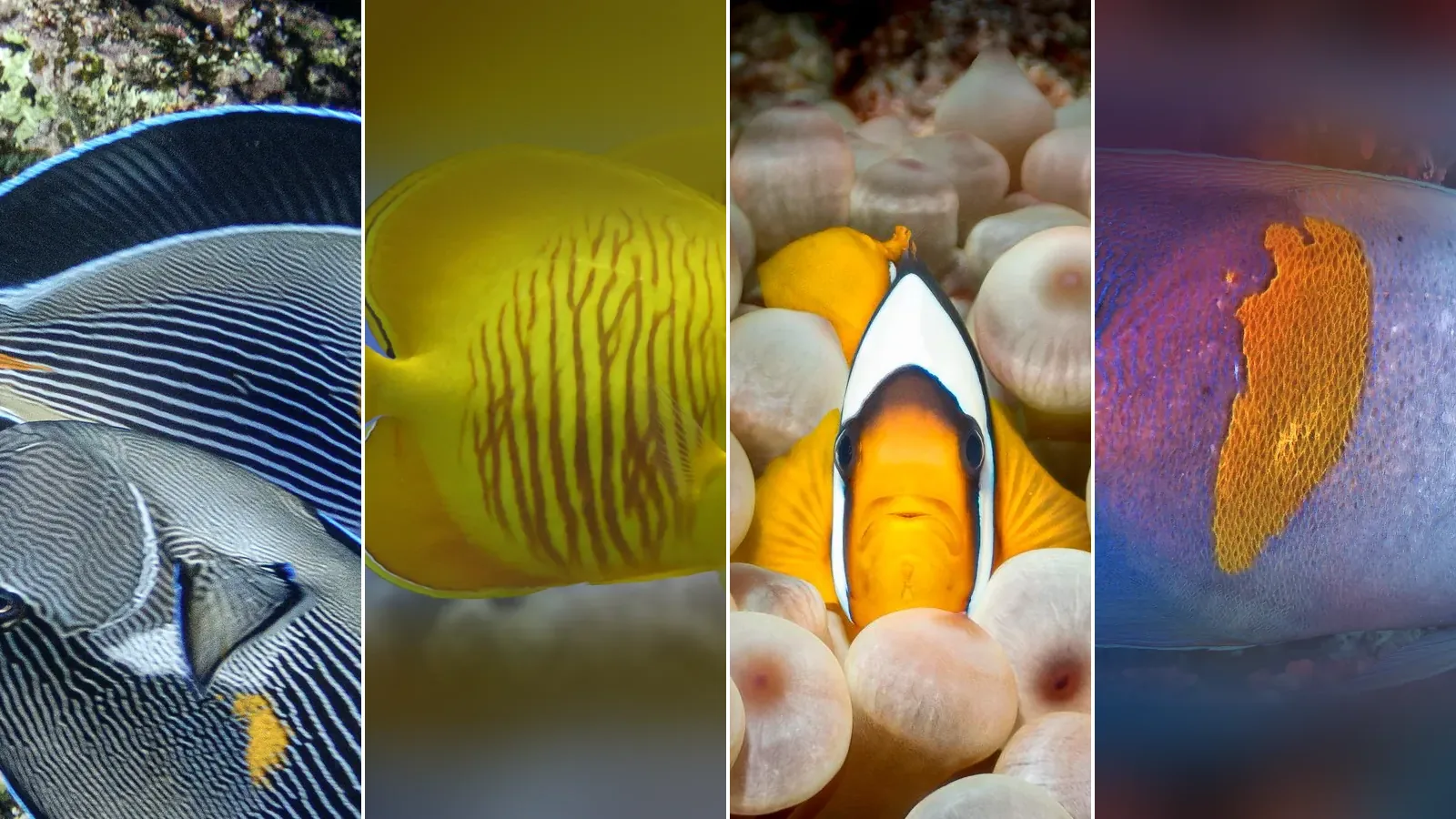
Divers who arrive in Egypt after reef trips to Thailand, Indonesia or the Maldives often notice that something is slightly off. The butterflyfish are the wrong colour, the anthias carry stripes they have never seen, and the clownfish in the anemone does not match the one in the film. They are not imagining it. The Red Sea is one of the world's great centres of marine endemism: a sizeable share of the fish on its reefs exists nowhere else on Earth, or only here and in the waters just outside its southern entrance. This guide explains how high the endemism rate really is, why a young, salty, half-enclosed sea produced so many unique species, and which endemic fish a diver or snorkeller can realistically expect to see on an ordinary Red Sea dive. It also separates the true endemics from the regional specialities that are often described as "found only in the Red Sea" but in fact range further.
Endemic and near-endemic fish at a glance
"Endemic" has a precise meaning: a species found in one region and nowhere else. Here it means the Red Sea itself, including the Gulfs of Aqaba and Suez. Fish found only in the Red Sea and the adjacent Gulf of Aden are called near-endemics, and the table also lists four well-known fish whose ranges are wider but still centred on the Arabian region. Ranges follow FishBase and the endemic-species lists published by Bogorodsky and Randall (2019); where sources differ, the wider range is given.
| Species | Scientific name | Range | Where divers see it | Profile |
|---|---|---|---|---|
| Klunzinger's wrasse | Thalassoma rueppellii | Red Sea only | Shallow reef tops and slopes, everywhere | Below |
| Striped (Red Sea) anthias | Pseudanthias taeniatus | Red Sea only | Steep reef slopes, usually 20–40 m | Anthias |
| Orchid dottyback | Pseudochromis fridmani | Red Sea only | Vertical rock faces and overhangs | Below |
| Red Sea harlequin filefish | Oxymonacanthus halli | Red Sea only | Among branching Acropora corals | Below |
| Masked pufferfish | Arothron diadematus | Red Sea (some sources add the Gulf of Aden) | Coral-rich reefs, surface to about 20 m | Masked pufferfish |
| Red Sea garden eel | Gorgasia sillneri | Red Sea only | Sandy slopes, about 10–45 m | Garden eels |
| Red Sea roving coral grouper | Plectropomus marisrubri | Red Sea only | Reef slopes and coral heads | Below |
| Masked butterflyfish | Chaetodon semilarvatus | Red Sea and Gulf of Aden (scattered records to Oman) | Under table corals, usually in pairs | Masked butterflyfish |
| Red Sea bannerfish | Heniochus intermedius | Red Sea and Gulf of Aden | Coral slopes and drop-offs | Bannerfish |
| Two-banded anemonefish | Amphiprion bicinctus | Red Sea and Gulf of Aden, with records to Socotra and Chagos | In host anemones on almost every reef | Red Sea anemonefish |
| Diagonal (striped) butterflyfish | Chaetodon fasciatus | Red Sea and Gulf of Aden | Shallow coral reefs, often in pairs or groups | Below |
| Exquisite butterflyfish | Chaetodon austriacus | Red Sea and Gulf of Aden | Coral-rich shallows, 1–15 m | Below |
| Fourline wrasse | Larabicus quadrilineatus | Red Sea and Gulf of Aden | Shallow coral reefs to about 15 m | Below |
| Red Sea goatfish | Parupeneus forsskali | Red Sea and Gulf of Aden | Sand patches and reef edges | Below |
| Sohal surgeonfish | Acanthurus sohal | Red Sea to the Persian Gulf | Surge-swept reef edges, 0–20 m | Sohal surgeonfish |
| Picasso triggerfish | Rhinecanthus assasi | Red Sea to the Gulf of Oman | Reef flats and shallow lagoons | Picasso triggerfish |
| Arabian angelfish | Pomacanthus asfur | Red Sea and Gulf of Aden, south to Zanzibar | Coral slopes, 3–30 m | Below |
| Yellowbar angelfish | Pomacanthus maculosus | Persian Gulf and Red Sea to Mozambique | Coral slopes and walls | Yellowbar angelfish |
The full encyclopedia of Red Sea species, endemic or not, is in the marine life guide.
How many Red Sea fish are endemic?
The best modern figures come from two major reviews. In 2016 a team of scientists led by Joseph DiBattista, published in the Journal of Biogeography, compiled records of 1,071 shallow-water fish species from the Red Sea and found that 12.9% were endemic to the Red Sea, rising to 14.1% when species shared only with the Gulf of Aden were added. In 2019 the ichthyologists Sergey Bogorodsky and John Randall, using their own updated species lists, counted 1,120 coastal fish species (0–200 m), of which 165 are found only in the Red Sea — 14.7% — and a further 51 are restricted to the Red Sea and Gulf of Aden. Together that comes to 19.3%, almost one fish in five.
Put in a global context, Bogorodsky and Randall rank the Red Sea third among the regions they compared, behind the Hawaiian Islands (30.7%) and Easter Island (21.7%) and ahead of the Marquesas (13.7%). The difference is that Hawaii and Easter Island are remote oceanic islands thousands of kilometres from the nearest continent, whereas the Red Sea sits beside Africa and Arabia and is joined to the Indian Ocean. That is what makes its endemism remarkable.
The rate is not even across fish families. Endemism is highest among small, bottom-dwelling fish that lay eggs on the reef rather than releasing them into open water, because their young do not drift far. The dottybacks (Pseudochromidae) are the extreme case: Bogorodsky and Randall list around 83% of the Red Sea's species in that family as endemic. Gobies contribute the largest number of endemic species, 36 of 139 recorded. By contrast, there are no endemics among the highly migratory open-ocean fish such as tunas, and only two of the 165 endemic species are sharks or rays.
Fish are not the only group. The 2016 review found that about 5.5% of the Red Sea's reef-building corals (19 of 346 species) are endemic, and that endemism among bristle worms, echinoderms and sea squirts ranged from about 8% to 16.5%. Older guidebooks often quote a round figure of "about 10%" or "17%"; the differences mostly reflect how many species were known at the time and whether the Gulf of Aden is counted. Every recent study agrees that new survey work keeps adding species, so the exact percentage will continue to move.
Why the Red Sea produces its own species
The Red Sea is a young ocean. It began opening along a tectonic rift between Africa and Arabia tens of millions of years ago, and its connection to the Indian Ocean through the south took its present form around five million years ago, when Indian Ocean corals, fish and invertebrates colonised it. Ever since, that connection has been the key to its biology.
A narrow, shallow gateway. The only link to the open ocean is the strait of Bab el-Mandeb between Yemen and Djibouti and Eritrea. The sea itself is deep, averaging about 490 m and plunging below 2,000 m in the central trough, but at the Hanish Sill near the southern entrance the sea floor rises to only about 137 m below today's surface. (Estimates of the depth that controls water exchange range from roughly 110 to 165 m depending on how it is measured, as explained in the guide to why the Red Sea is so clear.)
Ice-age sea levels. During the Pleistocene ice ages, so much water was locked into ice sheets that global sea level fell by as much as about 130 m. With the sill only a little deeper than that, the Red Sea was repeatedly reduced to a near-closed basin connected to the Indian Ocean by a thin, shallow channel. Each glacial cycle cut populations inside off from their relatives outside for thousands of years.
Salt. The Red Sea loses roughly two metres of water a year to evaporation and receives almost no rain or river water, so its salinity already rises to about 40–41 off Egypt, against an ocean average of about 35. When the gateway nearly closed, there was too little inflow to dilute it. Sediment records suggest salinity exceeded about 50 during the last glacial maximum; at those levels most plankton disappeared from large parts of the central sea, a state geologists call an "aplanktonic" zone. A 2025 study of deep-water corals argues the sea did not fully collapse, but conditions were clearly harsh.
Refuges and a second barrier. The 2016 review on the origin of Red Sea endemics concluded that reef life probably survived these crises in refuges, with the Gulf of Aqaba and the southern Red Sea the leading candidates, and then spread back out as conditions improved. It also pointed to a second barrier outside the strait: cold, nutrient-rich upwelling where the Gulf of Aden meets the Arabian Sea, which tropical reef larvae struggle to cross. That helps explain why so many near-endemics extend into the Gulf of Aden but stop there.
Old lineages, not just recent ones. Genetic studies show that many Red Sea endemics split from their Indian Ocean relatives well before the most recent ice age, so the high endemism has more than one origin. Some species formed through repeated isolation; others are older lineages that survived in the region while their relatives elsewhere changed. The Gulf of Aqaba, cut off again behind the shallow Strait of Tiran, is the most distinctive sector, with 22 endemic coastal fish of its own (counting the Ras Mohammed area) according to Bogorodsky and Randall.
The same history matters for corals. The northern Red Sea's corals are among the most heat-tolerant known, a story told in the guide to the Red Sea coral refuge.
True Red Sea endemics divers actually see
Many of the 165 strict endemics are tiny gobies, blennies and cardinalfish that only specialists ever identify. The species below are the ones a recreational diver or snorkeller has a realistic chance of seeing and recognising on a normal reef dive in Egypt.
Klunzinger's wrasse (Thalassoma rueppellii)
Probably the commonest endemic of all, and the one most divers see without realising it. This green wrasse, up to about 20 cm long, has pink-purple bars and lines on the head and a blue-edged tail, and males in particular shuttle constantly across the reef top, usually between about 1 and 30 m. Its common name honours the 19th-century physician and naturalist Carl Benjamin Klunzinger, who described it in 1871 from fish collected on the Egyptian coast, while its scientific name honours the explorer Eduard Rüppell. It has been reported to hybridise with the widespread moon wrasse (Thalassoma lunare), which shares its reefs.
Striped anthias (Pseudanthias taeniatus)
Mixed in with the orange clouds of anthias on steeper reef slopes, males of this species stand out with bold horizontal bands and a mostly white tail. It is a Red Sea species that usually lives deeper than the common scalefin anthias, typically between 20 and 40 m, so it is a reward for divers rather than snorkellers. The anthias profile explains how to tell the two apart.
Orchid dottyback (Pseudochromis fridmani)
A brilliant violet fish only about 6 cm long, with a thin dark line through the eye, the orchid dottyback is the poster species for the Red Sea's endemic dottybacks. Look on vertical rock faces and under overhangs, where it darts in and out of small holes. It is common and occurs from a metre or two down to about 60 m. Its close relatives the olive dottyback (Pseudochromis olivaceus) and Springer's dottyback (Pseudochromis springeri) are also Red Sea endemics.
Red Sea harlequin filefish (Oxymonacanthus halli)
A small, elongated green filefish covered in orange spots, usually found in pairs hovering among branching Acropora corals, whose polyps it eats. It is the Red Sea counterpart of the widespread harlequin filefish of the Indo-Pacific and, like many coral-feeding specialists, it depends directly on healthy branching coral.
Masked pufferfish (Arothron diadematus)
A slow, olive-grey puffer with a dark band across the eyes like a bandit's mask, common on coral-rich reefs from the surface to about 20 m. Bogorodsky and Randall list it as a Red Sea endemic; some sources extend its range into the Gulf of Aden. Like all pufferfish it carries tetrodotoxin and should be watched, never handled. Full details are in the masked pufferfish profile.
Red Sea garden eel (Gorgasia sillneri)
The large colonies of thin eels swaying out of the sand on deeper Egyptian slopes are mostly the Red Sea garden eel, a species found nowhere else. They feed on drifting plankton and sink back into their burrows the moment a diver comes too close, so the best views come from settling still on the sand at a distance. See the garden eels profile.
Red Sea roving coral grouper and the parrotfish
Larger endemics are rarer, but a few are easy to meet. The Red Sea roving coral grouper (Plectropomus marisrubri), a large grouper covered in small blue spots, was described as a distinct Red Sea fish in 1986. Some authors treat it as a subspecies of the roving coral grouper of the Indian Ocean. Among the parrotfish, the Red Sea heavybeak parrotfish (Chlorurus gibbus), the Red Sea bicolour parrotfish (Cetoscarus bicolor) and Scarus collana are all listed as Red Sea endemics; the bicolour parrotfish of the wider Indo-Pacific is now treated as a separate species, Cetoscarus ocellatus.
Near-endemics: the Red Sea and Gulf of Aden
The shallow strait at Bab el-Mandeb has allowed some Red Sea species to spread a short way out into the Gulf of Aden, but no further. These near-endemics include several of the most photographed fish in Egypt.
Masked butterflyfish (Chaetodon semilarvatus). The golden, orange-lined butterflyfish with a blue-grey smudge across the eye, usually seen in pairs hanging under table corals. FishBase gives its range as the Red Sea and Gulf of Aden, with scattered records along the Arabian coast toward Oman. It is the single fish that most clearly says "Red Sea" in a photograph. See the masked butterflyfish profile.
Red Sea bannerfish (Heniochus intermedius). A yellow-and-black butterflyfish with a long white pennant trailing from the dorsal fin, often in pairs or small groups along coral slopes and drop-offs. It fills the role taken elsewhere by related bannerfish species. See the bannerfish profile.
Two-banded anemonefish (Amphiprion bicinctus). The only anemonefish in the Red Sea, yellow-orange to dark brown with two white bars and a yellow tail, living in partnership with large sea anemones. Bogorodsky and Randall list it as restricted to the Red Sea and Gulf of Aden including Socotra, while FishBase also includes the Chagos Archipelago in the central Indian Ocean, so it is best described as a near-endemic rather than a strict endemic. The Red Sea anemonefish profile covers its symbiosis with its host and its sex change.
Diagonal butterflyfish (Chaetodon fasciatus). Also called the Red Sea raccoon or striped butterflyfish: yellow with dark diagonal stripes and a black band through the eye with a white patch above it. It replaces the raccoon butterflyfish of the Indo-Pacific and is common on shallow coral reefs.
Exquisite butterflyfish (Chaetodon austriacus). A small, deep-orange butterflyfish with fine dark lines and black fins and tail, found in coral-rich shallows between about 1 and 15 m. Its close relative the crown butterflyfish (Chaetodon paucifasciatus), pale with dark chevrons and an orange-red rear, is another Red Sea and Gulf of Aden near-endemic.
Fourline wrasse (Larabicus quadrilineatus). A slim, dark blue wrasse with two bright blue stripes, the only member of its genus. Juveniles work as cleaners, picking parasites off other fish at cleaning stations, while adults switch to feeding mainly on coral polyps.
Red Sea goatfish (Parupeneus forsskali). A pale goatfish with a black stripe running from the snout through the eye and a black spot near the tail, usually seen probing sand patches with its two chin barbels, often followed by opportunistic wrasses and groupers.
Other near-endemics a sharp-eyed diver may log include the black surgeonfish (Acanthurus gahhm), the abudjubbe wrasse (Cheilinus abudjubbe) and the marbled spinefoot (Siganus rivulatus), a rabbitfish that has also spread through the Suez Canal into the Mediterranean.
Regional specialities often called endemic
Travel articles regularly describe these fish as "found only in the Red Sea". They are not, but they are still fish of one corner of the world, and the Egyptian reefs are among the best places to see them.
Sohal surgeonfish (Acanthurus sohal). The fiercely territorial, black-and-olive striped surgeonfish of the surge zone, with blue-edged fins and an orange mark at the tail. Its range runs from the Red Sea along the Arabian Peninsula to the Persian Gulf. It defends its patch of grazing algae against all comers, and the scalpel-like spine at the base of its tail is a good reason to give it space. See the sohal surgeonfish profile.
Picasso triggerfish (Rhinecanthus assasi). The Red Sea's own Picasso triggerfish, not to be confused with the better-known Rhinecanthus aculeatus of the Indo-Pacific. It lives on reef flats and in shallow lagoons, usually above 10 m, and FishBase gives its range as the Red Sea to the Gulf of Oman. See the Picasso triggerfish profile.
Arabian angelfish (Pomacanthus asfur). A dark blue angelfish with a broad yellow band and a yellow tail, found from the Red Sea and Gulf of Aden south along East Africa to about Zanzibar.
Yellowbar angelfish (Pomacanthus maculosus). The large blue angelfish with a single vertical yellow patch on the flank. It is often described as a Red Sea fish, but its range runs from the Persian Gulf and the Red Sea down the coast of East Africa to Mozambique. See the yellowbar angelfish profile.
The famous Red Sea lionfish belongs in the same category: it is common in the Red Sea but ranges widely across the Indian Ocean, and it is a strict endemic of nowhere. For the region's best-known large animals, from dolphins to sharks, see the Red Sea Big 7.
How to find and photograph them
- Start shallow. Many of the best-known endemics and near-endemics — Klunzinger's wrasse, the anemonefish, the diagonal and exquisite butterflyfish, the Picasso triggerfish and the sohal — are most common in the top 10 m, so a snorkeller over a good reef can tick off half a dozen in one session.
- Look under table corals. Masked butterflyfish rest in the shade beneath large table corals by day, almost always in pairs. Approaching slowly from below and to the side gives the classic shot.
- Go to the wall for the small ones. Orchid dottybacks live in holes and crevices on vertical faces and overhangs. Hover, wait and let them come back out rather than chasing them.
- Check the deeper slope. Striped anthias and garden eel colonies are deeper, so they suit dives planned to 20 m and beyond. Good buoyancy matters on sand, where a single fin kick sends every garden eel underground.
- Learn the look-alikes. Comparing a Red Sea fish with its Indo-Pacific relative — Picasso triggerfish against Rhinecanthus aculeatus, diagonal against raccoon butterflyfish, the two-banded against other anemonefish — is the easiest way to remember which species are local.
- Leave no trace. Endemic species exist only in this one sea, so damage to Red Sea reefs cannot be offset by reefs elsewhere. Do not touch, feed or chase fish, keep fins off the coral, and use reef-safe sun protection.
Reef fish in the Red Sea are present all year, so endemics can be seen in any season. For water temperatures and conditions month by month, see the guide to the best time to dive the Red Sea, and for definitions of terms such as endemic and planktivore, the diving glossary.
See the Red Sea's own fish for yourself
Aquarius Diving Club is a PADI 5-Star centre with bases in Hurghada, Makadi Bay, Sahl Hasheesh and Sharm el-Sheikh, running daily reef dives, snorkelling trips and courses on reefs full of endemic species.
Plan your reef dives →Related: Meet individual species in the masked butterflyfish, Red Sea bannerfish and Red Sea anemonefish profiles, or browse the full marine life encyclopedia.
Frequently asked questions
What percentage of Red Sea fish are endemic?
Recent reviews put it at roughly 13 to 15 percent of shallow-water reef fish. A 2016 review found 12.9 percent endemic to the Red Sea, and a 2019 count by Bogorodsky and Randall found 165 of 1,120 coastal species, or 14.7 percent. Including species shared only with the Gulf of Aden raises the figure to between about 14 and 19 percent, one of the highest rates of any marine region.
Why does the Red Sea have so many endemic species?
Its only link to the open ocean, the strait of Bab el-Mandeb, is narrow and shallow, with a sill only about 137 metres deep. During the ice ages sea level fell by up to about 130 metres, almost cutting the Red Sea off from the Indian Ocean, and its water became extremely salty. Repeated isolation, refuges such as the Gulf of Aqaba, and a cold upwelling barrier outside the strait allowed populations to evolve into separate species.
Which endemic fish can divers see in the Red Sea?
Common true endemics include Klunzinger's wrasse, the striped anthias, the orchid dottyback, the Red Sea harlequin filefish, the masked pufferfish and the Red Sea garden eel. Near-endemics shared only with the Gulf of Aden include the masked butterflyfish, the Red Sea bannerfish, the two-banded anemonefish, the diagonal and exquisite butterflyfish, the fourline wrasse and the Red Sea goatfish.
Is the masked butterflyfish endemic to the Red Sea?
It is a near-endemic. The masked butterflyfish, Chaetodon semilarvatus, lives mainly in the Red Sea and the Gulf of Aden, with only scattered records along the Arabian coast toward Oman. Almost its entire world range is in the Red Sea, which makes Egypt one of the best places to see it.
Is the Red Sea clownfish endemic?
Not strictly. The two-banded anemonefish, Amphiprion bicinctus, is the only anemonefish in the Red Sea and is concentrated in the Red Sea and Gulf of Aden, but FishBase also records it from the Chagos Archipelago in the Indian Ocean. It is best described as a near-endemic.
Are the sohal surgeonfish and Picasso triggerfish found only in the Red Sea?
No. Both are regional specialities rather than true endemics. The sohal surgeonfish ranges from the Red Sea to the Persian Gulf, and the Red Sea Picasso triggerfish, Rhinecanthus assasi, ranges from the Red Sea to the Gulf of Oman. The yellowbar angelfish ranges even further, south along East Africa to Mozambique.
Can snorkellers see Red Sea endemic fish?
Yes. Many endemic and near-endemic fish live in the top few metres of the reef, including Klunzinger's wrasse, the two-banded anemonefish, the masked butterflyfish, the diagonal and exquisite butterflyfish and the Picasso triggerfish. Deeper species such as the striped anthias and garden eels are easier to see on scuba dives below about 20 metres.